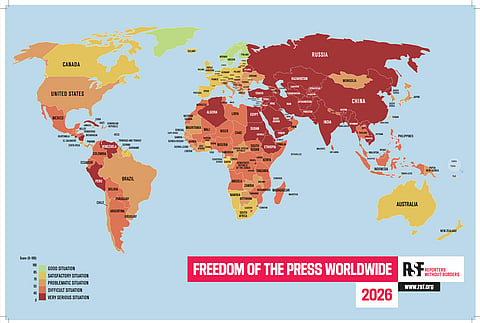


LONDON: The 2026 Reporters Without Borders World Press Freedom Index records the bleakest picture in 25 years. For the first time since the Index began in 2001, more than half of the world's 180 countries and territories (52.2%) now fall into the "difficult" or "very serious" categories.
In 2002, that proportion stood at just 13.7%. In the same period, the share of the global population living in a country rated "good" for press freedom has collapsed from 20% to less than 1%.
The decline is visible across all five indicators RSF tracks - economic, legal, security, political, and social environments for journalism. It is the legal indicator that has suffered the sharpest collapse this year, deteriorating in more than 60% of states - 110 out of 180 - between 2025 and 2026.
India is explicitly named among those where legal conditions for journalism have worsened most severely.
"In 2002, 20% of the world's population lived in a country where press freedom was rated 'good.' Twenty-five years later, less than 1% does."
Norway holds the top spot for the tenth consecutive year. Eritrea comes last for the third year running. The most dramatic improvement belongs to post-Assad Syria, which climbed 36 places following the fall of Bashar al-Assad's government in December 2025.
The steepest single-year fall belongs to Niger, dropping 37 places to 120th, reflecting the broader collapse across the Sahel.
Criminalisation Of Journalism
The Index's legal indicator has seen the most severe decline this year - worsening in over 60% of all assessed states. India is explicitly named alongside Egypt, Israel and Georgia as among the worst affected.
The criminalisation of journalism, rooted in the misuse of national security laws, defamation statutes, and emergency legislation, is proving to be a global phenomenon cutting across both authoritarian and democratic governments.
Twenty-five years after the September 11 attacks, expanding national security frameworks has become a primary tool for restricting press freedom worldwide.
Russia holds 48 journalists behind bars as of April 2026. In the Philippines, journalist Frenchie Mae Cumpio has been held six years on fabricated terrorism charges. In Hong Kong, publisher Jimmy Lai was recently sentenced to 20 years in prison, the heaviest sentence ever imposed on a journalist in the territory.
South Asia Concentrated Near the Bottom of the Global Table
In the Asia-Pacific region, 21 of 32 assessed countries and territories fall into the "difficult" or "very serious" categories, making it one of the most repressive regions in the world for press freedom. The situation continues to deteriorate, driven primarily by legal attacks on the press: abusive charges, draconian laws, and the spread of censorship models pioneered by China now reaching far beyond its borders.
No country in Asia-Pacific features in the top 20 of the Index. New Zealand at 22nd is the region's strongest performer, despite slipping six places. Taiwan (28th), Timor-Leste (30th) and Australia (33rd) face real challenges but offer broadly protective environments. They stand as exceptions in a region where press freedom is being steadily eroded.
India has fallen to 157th place globally - a "very serious" classification. RSF's 2026 Index specifically names India among the countries where the legal indicator has deteriorated most sharply this year. The report describes intensifying judicial harassment of independent media, driven by the growing deployment of defamation statutes and national security laws directly against journalists.
The pattern is consistent with findings documented in the IFJ's concurrent 2026 surveillance report, which identified India as one of the most heavily targeted countries for digital spyware operations, with forensic evidence of Pegasus infections confirmed as recently as late 2023, and noted that India's government has neither confirmed nor denied procuring the tool.
"In India, judicial harassment of independent media is intensifying, driven by the growing use of criminal statutes — defamation and national security laws among them — directly targeting journalists. — RSF 2026 Index, Asia-Pacific Analysis"
Pakistan ranks 153rd, also in the "very serious" category. RSF's Asia-Pacific analysis describes the press in Pakistan as facing "relentless waves of restrictions" in a fraught political climate, with authorities seeking to control and in some cases suppress the dissemination of journalistic content altogether.
Pakistan's powerful security establishment has long been associated with surveillance of journalists; reporters in the country routinely operate under the assumption that their calls and messages are being monitored.
Bangladesh sits at 152nd, one place above Pakistan, placing it in consecutive positions with its neighbours near the bottom of the global ranking.
The concentration of Bangladesh, Pakistan and India in this narrow band of the index reflects the scale of the press freedom crisis across the subcontinent. The country's media environment has deteriorated significantly in recent years, with political pressure on independent outlets intensifying.
Sri Lanka ranks 134th globally, classified in the "difficult" category. While it sits above Bangladesh, Pakistan and India in the regional ranking, Sri Lanka's media environment faces sustained legal and political pressures that prevent it from offering genuine protection to independent journalism.
Journalists covering sensitive political and economic topics, particularly in the aftermath of the 2022 economic crisis and subsequent political upheaval, have faced harassment, legal action, and intimidation.
Sri Lanka's classification as "difficult" reflects a media landscape where the formal architecture of press freedom is undermined in practice by the willingness of authorities to use legal instruments against reporters. Its position in the index is a reminder that even countries ranked above South Asia's worst performers are far from offering a safe environment for the press.
Nepal, at 87th, is the only South Asian country classified as "problematic" rather than "difficult" or "very serious", making it the region's strongest performer by a significant margin. Its ranking reflects a media environment that, while imperfect and facing real pressures, offers comparatively greater protections for independent journalism than its neighbours.
Nepal serves as a regional outlier rather than a model, given the scale of deterioration around it.
Afghanistan sits at 175th place globally. Since the Taliban returned to power in August 2021, the regime has implemented a wide array of laws designed to control the country's image, suppress any scrutiny of its rule, and impose its own propaganda as the dominant narrative. Independent journalism in Afghanistan is effectively prohibited in practice, regardless of constitutional provisions. Female journalists face specific and severe additional restrictions.
Bhutan ranks 150th in the "very serious" category and the highest-placed South Asian country in this bracket. The country's media landscape is characterised by the dominance of state-controlled outlets and limited space for independent journalism.
While Bhutan does not feature the same scale of documented political persecution seen in its neighbours, the structural absence of press freedom infrastructure places it firmly in the most concerning category.
The United States has fallen to 64th place - a fall of seven positions - as President Donald Trump's systematic attacks on the press become entrenched policy. Drastic cuts to the US Agency for Global Media led to the closure of international broadcasters, including Voice of America and Radio Free Europe.
In Latin America, Ecuador fell 31 places following journalist murders in 2025, Peru fell 14 places after four reporters were killed, and Nicaragua's media landscape lies in ruins.
Eastern Europe and the Middle East have remained the two most dangerous regions for journalists throughout the entire 25-year history of the RSF Index. Russia holds 48 journalists behind bars as of April 2026.
Saudi Arabia fell 14 places following the execution of journalist Turki al-Jasser. The lone significant positive: Syria climbed 36 places following the fall of Assad's government, the single largest improvement in the 2026 Index.
In more than 80% of all countries analysed globally, protection mechanisms for journalists are assessed as non-existent or ineffective.
Full Rankings Table
The table below covers selected countries across all categories. South Asian nations are highlighted in red. Norway holds first place for the tenth consecutive year; Eritrea comes last for the third year in a row.
Have you liked the news article?
Support us now:
https://www.gofundme.com/manage/jammu-kashmirs-sole-independent-voice-under-threat