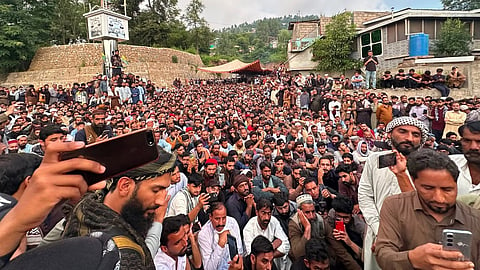


For one hundred days, Rawalakot has lived under an iron siege. And that’s not a metaphor, but literal encirclement by one of the world’s most militarised states. A town of teachers, farmers, students, shopkeepers has been cut off from food, medicine, communication, life’s basic rhythms. Yet through bullets, starvation, and terror, Rawalakot stands. The Kashmiri spirit refuses to kneel.
These hundred days are no mere chronicle of brutality. They are a testament to a people insisting on dignity while every instrument of the Pakistani state is deployed to crush them. It is also a story Pakistan tried to bury under blackout, fear, and blood.
The uprising began on 7 June 2026, when the Joint Awami Action Committee (JAAC) protested the reservation of twelve refugee seats in Pakistan-administered Jammu and Kashmir (PaJK) Legislative Assembly and an economic collapse that made flour, electricity, and survival unaffordable. The demands were modest: representation for local residents, affordable food, an end to the exploitation of a territory that produces cheap hydropower while its people freeze in the dark. Not separatist, not revolutionary—bread, electricity, the right to be counted.
Pakistan answered not with dialogue but with a pre-planned crackdown revealing its fear of the mildest Kashmiri assertion. Two days before the protests, JAAC was banned under anti-terrorism laws. When people still took to the streets, the Rangers and Frontier Constabulary, both under the army’s de facto control, were unleashed with orders amounting to a licence to kill. A confidential order later accessed by journalists showed thousands of armed personnel deployed to PaJK ahead of the protests, half instructed to carry arms and ammunition. It was marked “Most Immediate” and “Secret” - a bureaucratic whisper of the violence to come.
Those who were Killed
By late July, 90 civilians had been confirmed dead. Numbers stagger, but they rarely capture the horror of individual lives extinguished. In one 48-hour period, at least twenty-four unarmed protesters were shot dead in Mirpur and Rawalakot.
Rangers opened fire at point-blank range near Chinar Chowk, killing three in cold blood. A procession of hundreds of thousands marching toward Muzaffarabad was met first with tear gas, then live fire. Teenagers as young as fifteen were killed. A seventeen-year-old died shielding his sister. A shopkeeper was shot while handing out water. A paramedic was executed while evacuating the wounded. These are not casualties of crowd control. They are victims of state-sponsored murder.
Among the dead was Osama Jameel, a PhD student who sang Sarfaroshi Ki Tamanna at the Rawalakot bus stand every day until a Rangers’ bullet ended his life. His voice, once a symbol of youthful idealism, now echoes as a reminder of how far the Pakistani state will go to silence symbolic defiance. Another victim, Usman Nazir, was hunted down and killed in what activists call pure vengeance — punishment for being the brother of a key protest organiser. The message was unmistakable: dissent will be met not with argument but annihilation.
Strangulating the Rest
Yet the killing is only half the story. The other half is deliberate strangulation. Since the unrest began, authorities have imposed a complete internet blackout across PaJK, partially restored only days ago. Roads are blocked. Movement is restricted. Food and medicine have been deliberately prevented from entering Rawalakot. JAAC described the blockade as collective punishment, which it clearly is. But Pakistani generals fear no one while they remain darlings of the Western project that seeks to dismantle true people’s representation in Muslim countries for whatever fear, usually irrational.
The Pakistan state is laying siege with a deliberate attempt to starve and terrorise a population into submission. This regime has killed nearly hundred civilians, injured hundreds more, and imposed a blockade denying food and medicine to hundreds of thousands. Yet the protests continue. Sit-ins at Rawalakot’s main entry points remain. Long marches keep forming. The people have not broken.
Defence Minister Khawaja Asif, with delusional bombast, declared protesters “enemies like India,” collapsing the distinction between foreign adversaries and citizens demanding affordable flour. In the Pakistani state’s eyes, a Kashmiri asking for representation is now equivalent to a national security threat. This rhetorical sleight of hand has enabled the Pakistani state to justify heinous crimes that would otherwise be indefensible. It has also exposed the fragility of a state that claims to be the guardian of the nation but cannot tolerate peaceful dissent.
What makes this horror more obscene is the complicity of Pakistan’s mainstream media. For weeks, as Rangers gunned down unarmed protesters, as bodies lay on the roads, as ambulances ferried the wounded to overcrowded clinics, television channels and newspapers looked away. The blackout extended beyond the internet — to the national conscience. Pakistani media parroted the military’s narrative that protesters are “foreign-funded terrorists,” even as videos show security forces firing on civilians at point-blank range.
Defiance and Diaspora Campaigns
The killing of British nationals has jolted the diaspora in Europe, especially in the UK, where the largest Kashmiri community outside South Asia resides. Mohammad Akhtar, a 50-year-old British national from Peterborough, was shot dead on 9 June when Pakistani forces opened fire on protesters demanding economic and electoral reforms. He was not a terrorist. He was not an enemy of Pakistan. He was a British citizen killed by a state that receives hundreds of millions in British aid cyclically and enjoys Commonwealth partnership. Sheffield Central MP Abtisam Mohamed has raised the killing with Foreign Minister Stephen Doughty, calling videos of live fire “completely unacceptable.” She has signed a joint parliamentary letter and promised to press further.
But parliamentary letters do not bring the dead back. They certainly do not stop the deaths of unarmed civilians. Britain must work directly with Kashmiri diaspora groups. It must demand accountability for the killing of its citizens and press for an independent investigation into the massacres. It must consider targeted sanctions against Pakistani military officials responsible for this campaign of terror—and extend them to their family members.
One hundred days. One hundred days of defiance in the face of live fire. One hundred days of sit-ins, marches, strikes. One hundred days of a people saying, with one voice, that they will not be broken. Pakistan’s military can kill. It can besiege. It can starve. It can terrorise. But it cannot extinguish the Kashmiri spirit. That spirit lives in the teenager who faced a Ranger’s rifle and did not run. It lives in the mother who lost her only son and still demands justice. It lives in the PhD student who sang of sacrifice until his last breath. It lives in the people of Rawalakot, who have shown the world what courage looks like when everything else has been taken from them.
The Pakistan regime has failed. It has failed to force surrender. It has failed to silence voices. It has failed to erase the demand for dignity. And it will continue to fail as long as the Kashmiri spirit burns in the hearts of those who refuse to kneel.
Have you liked the news article?
Support us now:
https://www.gofundme.com/manage/jammu-kashmirs-sole-independent-voice-under-threat
