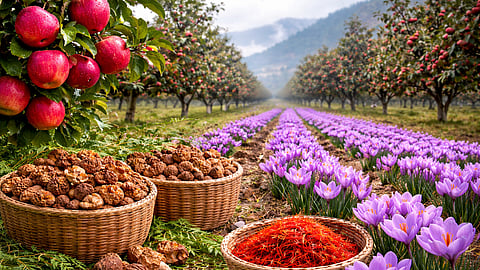


Kashmir’s economic story has long been defined not by the absence of quality, but by the absence of systems.
This was evident as far back as the early 1990s, when attempts to introduce Kashmiri products to global markets revealed a harsh truth: the region possessed exceptional goods, but lacked the infrastructure, consistency, and strategic vision needed to compete internationally.
Apples could not meet export standards because grading, waxing, and packaging were inadequate. Saffron, though among the finest in the world, suffered from fluctuating yields and weak supply chains.
Gucchi—the prized Kashmiri mushroom known in English as the morel mushroom and scientifically as Morchella esculenta—remained dependent on unpredictable forest collection, without any organized cultivation or aggregation system. The problem was never what Kashmir produced. It was how it was produced, processed, and presented.
More than three decades later, much of that structural gap persists. Yet, there are signs that the region may finally be approaching an inflection point. Scientific advances, particularly in the cultivation of Gucchi, suggest that Kashmir could move from dependence on wild harvesting to a more stable and scalable production model.
This is not a small shift. It has the potential to bring one of the world’s most sought-after gourmet products into a structured economic framework.
Globally, the morel mushroom market is already worth billions of dollars, driven by demand from high-end culinary sectors. What defines this market is not volume, but scarcity, provenance, and narrative. Kashmir, by virtue of its ecology and heritage, already possesses these attributes. What it has lacked is the ability to convert them into economic advantage.
But gucchi is only one piece of a much larger puzzle. If Kashmir is to rethink its economic trajectory, it must do so by looking at its entire portfolio of high-value products.
Trout is a case in point. Unlike gucchi, it already benefits from institutional support and a functioning production base.
The global trout industry is expanding rapidly, embedded within a much larger aquaculture economy that continues to grow as demand for high-quality protein rises.
Kashmir’s cold-water streams offer a natural advantage that few regions can replicate. Yet, despite this, there is no globally recognized “Kashmir Trout” brand. Countries like Norway and Scotland have built powerful identities around their seafood, linking production with branding, quality control, and export systems. Kashmir has not. The gap, once again, lies in the absence of a coherent value chain—from farm to processing to international markets.
Aromatic Rice
A similar story can be told about Mushk Budji, Kashmir’s indigenous aromatic rice. In a global market where premium rice varieties command significant value, heritage crops like Mushk Budji should occupy a distinct niche. Instead, they remain largely invisible. This is not due to a lack of quality or uniqueness, but due to weak positioning and limited market access.
Taken together, these sectors—gucchi, trout, saffron, and Mushk Budhi—point toward a fundamentally different economic model for Kashmir. This is not a model based on competing with large agricultural economies on volume. It is one based on competing on value, exclusivity, and identity.
The world offers multiple examples of how such a model can succeed. France has built entire industries around truffles and wine. Japan has elevated specialty rice and mushrooms into premium global products. Italy has protected and marketed its regional produce with precision and discipline. In each case, the strategy has been clear: focus on what is unique, protect it, brand it, and control its journey to the consumer.
Kashmir has the raw ingredients to follow a similar path. What it lacks is coordination.
The first imperative is control over the value chain. Without this, even high-value sectors risk becoming sites of extraction, where local producers receive minimal returns while external actors capture most of the value. This has been a recurring pattern in Kashmir’s economy, and it must be addressed if any meaningful transformation is to occur.
The second imperative is branding and geographical identity. Products like gucchi, trout, and Mushk Budhi must not be absorbed into generic national categories. They must be positioned distinctly, with their origin clearly tied to Kashmir. In a global market increasingly driven by authenticity and traceability, this is not just desirable—it is essential.
Market Access
The third imperative is market access. This is where the Kashmiri diaspora can play a decisive role. Those who have operated in international markets understand regulatory requirements, consumer preferences, and distribution networks. Their involvement can help bypass intermediaries and establish direct export channels, ensuring that value flows back to the region.
What makes this moment different from the past is the convergence of factors. Scientific advances are opening new possibilities in production. Global demand for premium, natural, and origin-specific products is rising. There is greater awareness, both within and outside Kashmir, of the need to rethink economic strategies.
Yet, opportunity alone is not enough. Without systems, it will remain unrealized, just as it did in the 1990s.
The challenge before Kashmir is not simply to produce better goods. It is to build an ecosystem that connects production with processing, branding, and markets. It is to move from a fragmented approach to a coordinated strategy. And above all, it is to ensure that the economic narrative of the region is shaped by its own people.
Gucchi, trout, and Mushk Budhi are not just commodities. They are symbols of what Kashmir can become if it chooses to leverage its strengths intelligently. They represent a shift from dependency to self-definition, from exporting raw value to exporting identity.
The question is no longer whether Kashmir has the potential. That has never been in doubt. The question is whether it can finally build the structures needed to realize it.
The answer will determine not just the future of its economy, but how it is seen in the world.
Have you liked the news article?
Support us now:
https://www.gofundme.com/manage/jammu-kashmirs-sole-independent-voice-under-threat