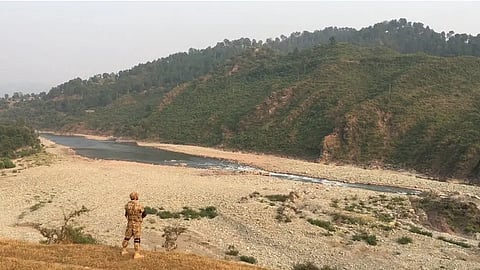


A recent report in DAWN by its Muzaffarabad correspondent, Tariq Naqash, brought into sharp focus a tragedy that few borders in the world can replicate.
Along this heavily militarised border, perceived to be temporary, people can see their loved ones, but cannot reach them. The grief and happy moments travel, but bodies cannot.
Raja Liaquat Khan, a 50-year-old from Keran in Kupwara, died after a heart attack. His funeral became a moment of collective mourning split by geography. His siblings and relatives, settled for decades in Pakistan-administered Jammu and Kashmir, gathered across the Neelum River, which marks the Line of Control, to witness his last rites.
They stood just a few hundred yards away.
Close enough to see his face when mourners uncovered it for a final glimpse. Too far to carry his coffin, to offer a shoulder, to perform the most basic act of farewell.
“Is there any greater agony than this that we could see our brother lying in a coffin just a few hundred yards away yet were deprived of giving him a shoulder?” a grieving brother said.
The images travelled quickly across social media, drawing anguish and reflection. But for those who have lived along the Line of Control, this was not an extraordinary moment. It was painfully ordinary.
I have seen this reality unfold in different forms along the LoC.
I once visited the same village where Raja Liaquat Khan passed away on the Indian side during quieter times. On the Pakistani-controlled side, a wedding was underway. The groom had been made to sit on a stone, waiting. On this side, under the watchful eyes of soldiers, relatives gathered and began throwing envelopes of cash tied to small stones across the divide.
It was an act both absurd and deeply human, a fragile bridge across a line that insists on separation.
I have travelled this line from Akhnoor to Poonch, Rajouri, Uri, Tootmar Gali, Chowkibal, Karnah, Keran, and up to Kargil at different times. Everywhere, the same story repeats itself, changing shape but never essence.
For most of the subcontinent, Partition eventually became a settled fact, however, painful its memory.
But in Kashmir, there has always been a lingering sense that this line was never meant to be permanent.
Human Wound
The Line of Control is not just a military boundary. It is an unhealed human wound.
Families have lived for decades divided by it, cut off from loved ones, shared memories, and even the right to grieve together. What happened in Keran is only one visible moment in a much larger, quieter tragedy that unfolds every day without headlines.
In 2005, as part of a group of Kashmiri journalists under the leadership of the late Shujat Bukhari, who traveled to Muzaffarabad for the first time, we could see and feel the layered pain with remarkable intimacy. A generation born after 1947, both sides have grown up with dreams of the “other side,” shaped by stories told by elders — stories so vivid that they created a romantic world in the imagination.
When one finally arrives in Muzaffarabad, the experience is both joyous and unsettling. It feels like home, yet it is not accessible without crossing continents. Baramulla lies barely 50 kilometres away, yet reaching it demands a journey of thousands of miles.
Moments like sharing noon chai and baqerkhani at the residence of a political leader in Muzaffarabad evoked memories of Sopore and Baramulla places just 50 kilometres away yet separated by an unyielding political divide.
Geographically close, politically distant. That contradiction defines Kashmir.
In Muzaffarabad, an elderly man once pointed towards the mountains and said: Beyond that lies Kupwara; beyond another ridge, Uri and Baramulla. When told that we were from those very places, his eyes lit up. He had once lived in Baramulla, running a shop with his father, before 1947 changed everything. Since then, he has spent a lifetime looking at those mountains, trying to recall the lanes of his childhood, the names of his friends.
The region that connected worlds has, in many ways, become a vast enclosure — where movement is restricted, and the sound of military boots has replaced the flow of caravans.
Even history bears witness to this rupture. Barely 50 kilometres from Muzaffarabad lie the ruins of the ancient Sharada temple — once a great centre of learning and scholarship. Today, local villagers continue to care for it, preserving a shared heritage that politics has failed to erase.
And yet, even scholars studying this shared past face barriers. Archaeologist Dr Rukhsana Khan, who has worked extensively on the Sharda civilisation, once had to deliver a lecture to Kashmir University via digital means after being denied a visa, a small but telling example of how even knowledge is constrained by borders.
Against this backdrop, the initiatives of the early 2000s appear even more significant.
Emotional Lifeline
The 2003 ceasefire allowed divided families to reconnect informally. Then, in 2005, the cross-LoC bus service and trade routes, initiated through political engagement between India and Pakistan, transformed that fragile contact into structured interaction. Families met after decades. Trade, though limited, carried memory, trust, and hope.
These initiatives became an emotional lifeline for Kashmiris on both sides.
But that lifeline weakened after 2019.
Restrictions tightened. Informal interactions disappeared. Fear replaced familiarity. In places like Keran, even waving across the river is now avoided, lest it invites scrutiny.
The silence that has replaced earlier exchanges is as telling as the cries heard during Liaquat Khan’s funeral.
In any other part of the world, such stories would have been archived and produced into acclaimed artworks.
There is a story of Justice (retd) Manzoor Gillani, who rose to become Chief Justice of the Supreme Court in Muzaffarabad, a full Bollywood masala that underlines the depth of this human tragedy. Just six months old when his parents travelled from Karnah to Muzaffarabad for a wedding in October 1947, he was left behind with his grandparents when conflict froze movement. He grew up without his parents, studied in Aligarh, and only in 1975, at the age of 28, could he finally reunite with them.
There are countless such lives. Most pass without notice.
There are no headlines when a mother cannot see her son across the mountains, or when siblings grow old as strangers. And yet, these are the stories that define Kashmir far more than the language of diplomacy.
In an age that celebrates connectivity and globalisation, Kashmir remains a painful contradiction. The DAWN report is not just about a funeral. It is about a condition that has endured for nearly eight decades.
Reviving cross-LoC bus services and trade is not merely a political choice. It is a humanitarian necessity. These links once allowed families to meet, to share grief and joy, to reclaim fragments of their broken lives.
Whose Citizens
For the sake of argument, at a time when the government in New Delhi repeatedly asserts its claim over the territory across the Line of Control, the contradictions in policy become difficult to ignore.
The Jammu and Kashmir Legislative Assembly continues to reserve 24 seats for areas under Pakistan-administered Kashmir, and there have even been recent attempts to extend this logic to parliamentary representation by proposing a Lok Sabha seat.
Yet, if those living across are officially regarded as citizens, then keeping the Line of Control effectively sealed for the movement of people and goods raises a fundamental question. How can a state claim political representation over a population while denying them the basic right to connect, communicate, and engage with the rest of the polity?
The continued closure of these routes is not just a strategic choice; it appears increasingly at odds with the very constitutional and political claims being made.
Because what unfolded in Keran is not an exception. It is the reality of a land where geography has been turned into destiny, and where a river can separate a family more completely than oceans. A coffin lay on one side. A family stood on the other. And between them, a line that still refuses to heal.
Have you liked the news article?
Support us now:
https://www.gofundme.com/manage/jammu-kashmirs-sole-independent-voice-under-threat