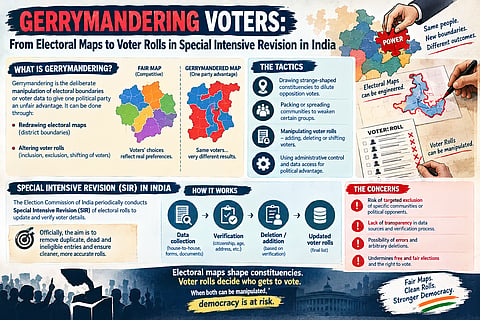


Gerrymandering is usually associated with the manipulation of electoral boundaries to secure a political advantage. In Jammu and Kashmir, this became a contentious issue when the delimitation exercise of 2022 redrew Assembly and parliamentary constituencies, aimed at diluting the political weight of the Muslim-majority Kashmir Valley.
Now, a different and potentially more far-reaching form of electoral engineering is in progress across India. This time, the controversy is not about redrawing constituency boundaries. It is about redrawing the electorate itself.
In Kashmir, experts accused the authorities of changing the political arithmetic by rearranging where voters belonged. Under the Special Intensive Revision (SIR) of electoral rolls, the concern is that the same political arithmetic could be altered by determining which voters remain on the rolls at all.
One changes the boundaries around voters. The other changes the voters within those boundaries.
The distinction is important, but so is the underlying question: Can an election be influenced before a single ballot is cast?
The 2022 delimitation exercise in Jammu and Kashmir offers a useful historical parallel.
Following the abrogation of Article 370 and the reorganisation of the former state in August 2019, a Delimitation Commission was constituted to redraw its electoral constituencies.
The exercise increased the number of elected Assembly seats from 83 to 90, excluding the seats reserved for areas under Pakistan's administration. Jammu's representation rose from 37 to 43 seats, while the Kashmir Valley gained just one additional seat, moving from 46 to 47.
The Commission defended its recommendations on geographical, administrative and representational grounds. But political parties in Kashmir questioned why Jammu received six additional seats while the more populous Valley received only one.
The controversy extended to the redrawing of parliamentary constituencies. The Anantnag constituency in south Kashmir was joined with Rajouri and Poonch districts across the Pir Panjal mountains, fundamentally altering its geographical and electoral composition.
Former Chief Ministers Farooq Abdullah and Mehbooba Mufti, among others, criticised the exercise, alleging that it would weaken the political influence of Kashmir's Muslim-majority population.
The BJP rejected these accusations and defended the new boundaries as more representative.
Nevertheless, the controversy established a troubling question about electoral fairness: Could the composition of representative institutions be altered through changes in the rules governing representation, even without changing individual votes?
That question has now acquired national relevance through the SIR controversy.
For generations of Indians who grew up watching Prannoy Roy explain election results on television, his voice has been synonymous with electoral analysis.
Beginning in the early 1980s, Roy transformed election coverage from a mechanical exercise in counting votes into an exploration of India's political and social landscape. He taught viewers to look beyond the numbers and understand not merely who won an election, but why they won, and which sections of society shaped the outcome.
It is against this background that his examination of the Special Intensive Revision of electoral rolls deserves serious attention.
If the findings presented by Roy and other independent researchers withstand scrutiny, India may be confronting something far more disturbing than administrative negligence or clerical errors.
The evidence raises the possibility of systematic voter exclusion, a form of electoral manipulation that takes place not inside polling booths but in electoral databases, long before citizens arrive to cast their ballots.
Traditional gerrymandering manipulates the geographical distribution of voters. What is now being alleged is something different: the manipulation of electoral participation through the removal of voters from official lists.
ECI defending SIR
The Election Commission of India (ECI) has defended the SIR as a necessary exercise to remove ineligible entries and ensure the accuracy of electoral rolls. Such revisions are legitimate and necessary in any functioning democracy.
But the legitimacy of an exercise cannot rest solely on its stated purpose. Its timing, methods, transparency and consequences are equally important.
Roy has questioned the extraordinary haste with which the revision was undertaken ahead of crucial state elections. A process involving verification of electoral eligibility requires careful preparation, adequate safeguards and sufficient opportunities for affected citizens to challenge their exclusion.
When such an exercise is compressed into a few months, errors become more likely. When those errors appear to disadvantage particular communities or political constituencies, the demand for an independent investigation becomes unavoidable.
The findings cited from West Bengal's 2026 Assembly elections raise particularly serious questions.
According to the analysis discussed by Roy, constituencies recording higher rates of voter deletion also experienced larger electoral swings in favour of the Bharatiya Janata Party (BJP).
In the 25 constituencies with the highest deletion rates, the swing against the Trinamool Congress (TMC) was reportedly almost twice that recorded in constituencies with the lowest deletion rates.
West Bengal's Chief Electoral Officer has disputed the suggested connection between SIR deletions and election results, describing the claims as misleading and speculative.
A statistical correlation does not, by itself, establish that deletions caused a particular electoral outcome. But the reported pattern warrants independent examination rather than political dismissal.
The more disturbing question concerns the identity of those removed from the rolls.
Research by the Sabar Institute and BehanBox found that women accounted for approximately 62 percent of voters deleted or placed under adjudication during the revision process.
In West Bengal, women constitute an important political constituency. Chief Minister Mamata Banerjee's welfare programmes have helped the TMC cultivate considerable support among female voters.
The disproportionate exclusion of women therefore carries potentially significant political consequences, whether intended or otherwise.
An even more serious concern involves Muslim voters.
The analysis cited by Roy suggests that Muslims faced a deletion rate approximately 52 percent higher than non-Muslims. This is a research estimate based on inferred religious identities, not an official religion-wise classification of electoral records.
In a state where Muslims constitute a substantial section of the electorate, such a disparity requires a convincing explanation.
The issue is not whether every deleted Muslim voter would have supported the TMC. Nor can unequal deletion rates alone establish deliberate religious discrimination.
The question is why an ostensibly neutral administrative exercise appears to have affected particular demographic groups so disproportionately.
In Jammu and Kashmir, the controversy concerned the alleged dilution of political representation through constituency boundaries. In Bengal, the concern is about the possible dilution of electoral representation through the composition of voter lists.
The methods differ. But both controversies raise questions about how electoral rules and administrative decisions can influence political representation.
Election Commission's Responsibility
The controversy places the Election Commission and the Chief Election Commissioner under intense scrutiny.
India's constitutional framework entrusts the Commission with conducting free and fair elections. Its credibility rests not merely on the efficient organisation of polling but on public confidence that every eligible citizen has an equal opportunity to participate.
The Commission must therefore provide comprehensive constituency-wise information on deletions, the reasons for removal, demographic patterns, objections received, appeals decided and names subsequently restored.
It must explain the disproportionate impact on women and address independent research suggesting higher deletion rates among Muslims.
Concerns expressed by former Chief Election Commissioner S.Y. Quraishi and former Supreme Court judge Rohinton Nariman underline the importance of electoral safeguards and institutional independence.
With major electoral contests approaching in Uttar Pradesh and Punjab, concerns about similar revision exercises deserve serious attention.
The danger is that large numbers of eligible citizens may find their names missing from electoral rolls despite having voted in previous elections.
For ordinary citizens, particularly the poor, elderly, migrant workers and those lacking extensive documentation, restoring a deleted name can become an exhausting bureaucratic struggle.
The consequences are especially severe when revisions take place shortly before elections, leaving insufficient time for appeals and corrections.
A citizen who discovers an erroneous deletion after the relevant deadline has effectively lost the opportunity to participate in that election.
No administrative explanation can compensate for that democratic injury.
There is also a deeper constitutional concern. India's electoral system rests on universal adult franchise. The right to vote, though regulated by law, is central to democratic citizenship.
It cannot become a privilege dependent on an individual's ability to navigate complicated documentation requirements or overcome administrative obstacles within an unreasonable timeframe.
The significance of Prannoy Roy's intervention lies in his reliance on electoral data rather than political slogans.
His analysis raises questions that require access to underlying records, independent verification, and transparent examination of the relationship between voter deletions and electoral outcomes.
The demand for an independent audit of the SIR process is therefore reasonable and necessary.
Such an audit should establish whether eligible voters were disproportionately removed, whether exclusions followed identifiable demographic or geographical patterns, and whether the procedures for challenging deletions were genuinely accessible.
Where wrongful exclusions are established, corrective measures must follow. Where deliberate manipulation is proved, those responsible must face accountability, regardless of their institutional position.
Calls for the Chief Election Commissioner's resignation reflect the depth of concern among critics. But the larger objective must be to restore confidence in the institution itself.
For Kashmiris, the present controversy carries a particular resonance.
The delimitation exercise of 2022 demonstrated how changes to electoral boundaries could affect political representation. The SIR controversy raises a question: whether electoral rolls themselves can become instruments through which representation is altered.
In conventional gerrymandering, politicians are accused of choosing their voters by drawing favourable boundaries. In the emerging controversy, the allegation is that electoral authorities may be determining which voters remain eligible to participate.
If substantiated, such manipulation would represent an even more direct threat to the principle of universal adult franchise.
The integrity of an election cannot be measured solely by the peaceful conduct of polling or the speed with which results are declared. It begins with the preparation of electoral rolls and the assurance that no eligible citizen is arbitrarily excluded.
Democracy does not begin when the first vote is cast. It begins when every eligible citizen is assured a place on the electoral roll.
Kashmir's delimitation controversy was about who would represent the voters. The SIR controversy raises an even more fundamental question: Who gets to be a voter in the first place?
That question must be answered before the credibility of future elections is placed in further doubt.
Have you liked the news article?
Support us now:
https://www.gofundme.com/manage/jammu-kashmirs-sole-independent-voice-under-threat