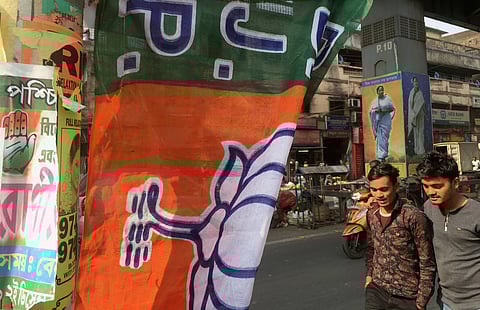


KOLKATA: Shamsul Haq earns fifteen thousand rupees a month as a daily wage worker somewhere in north India. He's been home in Dinajpur, a district bordering Bangladesh, for six months now. His father's name is on the voter list. His brother's too. His mother's name was deleted.
He is uneducated. But sit with him for ten minutes and he'll explain, with clarity, how the Special Incentive Revision (SIR) of electoral rolls is the backdoor NRC that Modi couldn't push through in 2019 when the streets erupted. He sees the thread: SIR to NRC to the Citizens Amendment Bill. It’s a conspiracy in the garb of administrative sanitisation.
Haq is jobless and now that is not his only worry. “I can get a job only as long as I have land,” he says, adding that he'll fight, even if it means eating less, sleeping less.
His mother's deletion is not an anomaly. It is a pattern.
The Form With a Blank Back
When SIR was conducted in Uttar Pradesh, forms were distributed with both sides printed. The front asked for details. The back listed the rules - that a valid passport, driving licence, or Class 10 certificate was sufficient proof of citizenship for voter enrolment.
In West Bengal, the back side was blank.
BLOs and enumerators were left to navigate confusion without guidance. People produced passports. Names were still deleted. The rules existed, they simply weren't printed. Whether by design or negligence, the effect was chaos, and deletions with little time to be challenged.
Surname spellings tripped the system. Bose didn't match Basu. Dutta didn't match Datta. A father with Thakur at the end of his name had children without it. Middle names shifted across documents. All these were deleted. The Electoral Commission cited "discrepancies." Families called it something else.
Matuas and Broken Promises
In North 24 Parganas, close to the Bangladesh border, lives the Matua community - Hindus who came from Bangladesh after 1971. They were once courted by the BJP with promises of citizenship under the CAA.
Santanu Thakur, their own union minister, who, remarkably, was not an Indian citizen himself when elected in 2024 and was later regularised could do little for them. Around 1.25 lakh Matua voters were struck off the rolls during SIR.
Roughly 30 percent of those still eligible in the area have moved toward TMC.
Sentiment and the Snide Remark
On the day BJP released its Bengal manifesto in Kolkata, Home Minister Amit Shah said it would be better if West Bengal were run from Delhi than from Bangladesh. The line drew applause in some rooms. In most Bengali homes, such snide remarks offend their sentiments.
Ajoy, a voter, doesn't mince words. He sees the Election Commission not as a neutral body but as a political instrument involving a vindictive drive to punish Bengalis for repeatedly voting TMC.
He acknowledges that bogus voters exist and have existed, and that every party in power has exploited that. But the scale and selectiveness of these deletions feel less like reform and more like retribution.
Baam to Ram, and Back Again
Babul Das was once a CPIM cadre. Now he's in the BJP. The Bengali shorthand for this shift is: "Baam to Ram" (Baam means the Left in Bengali). He's candid about why. It's revenge politics. CPIM and its allies, weakened beyond recognition since Mamata broke their decades-long fortress in 2011, are using the BJP as a vehicle to defeat TMC.
Once TMC falls, Das says, they'll pivot again, back toward the left. I told him BJP doesn't work like that. It stays. It's a juggernaut.
He laughed. Bengal, he said, thinks and works differently from the Hindi belt.
He may not be wrong. Walk through any town and you'll find left-leaning households that are now "Gita Bhawans." Lifelong atheists, beef-eaters, dialectical materialists are wearing saffron. The transformation is real. Whether it's permanent is another question.
Why TMC Holds the Village
Barring Darjeeling-Gorkhaland, TMC's grip on rural Bengal is structural. The party has built itself into the mohalla. It is present at funerals, at emergencies, in the everyday drill of life. It functions less like a political party and more like the neighbourhood itself.
BJP, by contrast, is seen as weaponising religion and gender. Mamata's welfare schemes like Lakshmir Bhandar and Swasthya Saathi reached poor women directly and without discrimination. She didn't sort beneficiaries by faith. BJP's dominant narrative of ‘Muslims as infiltrators’, ‘Bengal as ungovernable without Delhi’ doesn't hold the same weight as a gas cylinder subsidy or a health card.
Murshidabad and the Weight of History
On the eve of August 14, 1947, Murshidabad hoisted the Pakistani flag. It was the Shia population who chose to stay, opting for a Hindu-majority India over a Sunni-majority Pakistan. Since then, their allegiance to the Indian state has been unbroken. They've participated in every election, every civic process.
Amit Shah calls them ghus-paithia (infiltrators) or family of Mir Jafar.
Law-abiding Muslims in Murshidabad, whose grandparents made a deliberate choice for India, now quietly call that choice their "historical mistake." That is the wound BJP is reopening, and it will not close easily.
The Numbers, and What Comes After
Voter turnout crossed 89.93 percent by 5pm in the first phase of elections in West Bengal, held in 152 of 294 assembly constituencies with over 3.22 crore voters. The machinery moved.
In 2021, BJP won 77 seats. TMC says they'll fall to 50 this time. But the strike rate may hold, meaning the vote share gap could narrow even if seats don't. It may be a tight, contested result. Perhaps, followed by likely violence, the invocation of Article 356, even fresh elections.
And somewhere in the background is the delimitation controversy. West Bengal currently sends 42 MPs to Parliament, calculated on the 1971 census. The projected redraw would drop that to 38. UP goes from 80 to 92. For Bengali urbanites already sensitive to what they call Delhi's dadagiri, this is not just arithmetic. It's a statement about whose India this is.
Lessons from History
Curzon tried to break Bengal in 1905. The plan was eventually withdrawn but the job was done by the Partition more permanently in 1947, delivering East Pakistan, and then Bangladesh in 1971. The cultural thread between West Bengal and Bangladesh is real, deep, acknowledged on both sides.
But when BJP hyphenates Bengalis of West Bengal with Bangladesh as a threat, as an insult, as a political shorthand, it irritates people on both sides of that border. Bengal has resisted this kind of Iron grip before, from the British, from Congress, from CPIM's long dominance. It may resist again.
But not forever. The juggernaut moves slowly, and maybe BJP’s fortunes change. Additionally, Bangladesh, like Pakistan on the western frontier, will remain a ready flashpoint as the fuel for whoever needs a fire next.
Meanwhile, Shamsul Haq's mother, like many other millions, still doesn't have her name on the list.
Have you liked the news article?
Support us now:
https://www.gofundme.com/manage/jammu-kashmirs-sole-independent-voice-under-threat