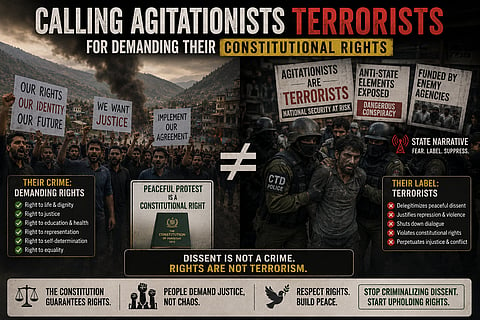


There is a peculiar genius to Pakistan’s ruling order: it can take a people asking for flour, electricity, dignity, representation, and constitutional accountability, and, with the dead-eyed solemnity of a clerk stamping a death warrant, declare the whole thing terrorism.
This is the miracle of the Pakistani security state. It manufactures poverty, strangles politics, humiliates citizens, imprisons the popular, bombs the peripheral, disappears the inconvenient, and then clutches its medals in theatrical astonishment when the governed begin to object.
The objection, naturally, is never allowed to be framed as politics. It must be sedition, conspiracy, foreign manipulation, terrorism, “instigation,” “mob rule” - anything except the plainest fact in the republic: a people refusing to be herded like livestock by men who have mistaken fear for legitimacy.
Grievances of the ‘Azad’ People
Pakistan-administered Jammu and Kashmir (PaJK), also locally called ‘Azad Jammu and Kashmir’, has now been dragged onto this national stage of accusation. The word “Azad” has always carried a faintly comic burden, but history has darkened the joke. Kashmiris under Pakistani administration are told they are free, provided they do not ask who governs them, who controls their resources, who fixes their prices, who rigs their representation, who polices their anger, or why Islamabad thunders about Kashmiri self-determination abroad while treating Kashmiri self-assertion at home as a security emergency.
The protests in PaJK did not descend from abstraction. They were not born in some laboratory of treason. They came from electricity bills, wheat prices, unemployment, inflation, constitutional manipulation, and the grinding daily insult of being ruled through structures designed to keep local agency decorative, not decisive.
At the center of this anger are the refugee seats: a political mechanism advertised as a sacred concern for displaced Kashmiris but functioning, in practice, as a lever through which Islamabad makes and unmakes governments in Muzaffarabad.
The refugees themselves are not the enemy. That is the poison Islamabad needs injected into the public bloodstream. The Joint Awami Action Committee (JAAC) has not demanded that displaced Kashmiris be humiliated, erased, or abandoned. It has demanded that their suffering not be converted into electoral machinery by a state that remembers their wounds only when it needs their seats. The refugee is not being protected; he is being weaponised. The resident Kashmiri is not being represented; he is being managed. And between the two, the security state performs its oldest and filthiest trick: divide the wounded, then arrest the ones who refuse to bleed politely.
Anatomy of Fear Behind Divide & Rule
This is an old imperial craft. Divide the governed. Patronise one section. Demonise the other. Then announce that your own boot is the only thing preventing chaos. The British did not perfect this method because they were uniquely clever; they perfected it because ruling elites everywhere find it irresistible.
Pakistan’s security establishment has merely given it a local accent, a few constitutional footnotes, a press conference vocabulary, and the sacred stamp of counter-terrorism.
What makes the current moment so combustible is not only repression in Kashmir. It is that Kashmir has become one chamber in a larger national anatomy of fear. Pashtuns displaced by wars they did not choose are treated as suspects in their own homeland. Baloch families, demanding the return of the disappeared, are lectured about national security by the very institutions that made disappearance a language of governance. Supporters of Imran Khan are not engaged as citizens with political preferences but diagnosed as a contagion to be quarantined.
Tens of thousands of Pakistanis have learned that speech is safe only when it praises power, mourns selectively, or condemns the correct tyrant across the border.
The state’s moral universe is now magnificently simple. A Kashmiri resisting India is heroic. A Kashmiri resisting Islamabad is manipulated. A Pashtun mourning a drone strike is suspect. A Baloch mother holding a photograph is a threat. A voter supporting the wrong party is diseased. A student asking why generals own the future is an agent. By this logic, Pakistan is not a country. It is a courtroom. The accused are always ordinary citizens. The judge always arrives in uniform.
Pakistan’s intelligentsia, meanwhile, performs its usual ballet of selective bravery. It can denounce Indian repression in Kashmir with polished outrage, trembling adjectives, and symposium-ready sorrow, then suddenly forget the alphabet when Kashmiris on Pakistan’s side are beaten, banned, or branded. Its language of freedom becomes strangely conditional: eloquent when the oppressor sits in Delhi, evasive when the trail leads to Rawalpindi. This is not nuance. It is cowardice dressed up as sophistication.
The regime’s defenders insist that order must be maintained. Order is the favourite word of people who have already stolen justice. There is always order in a prison, always discipline in a graveyard, always stability in a room where everyone is too terrified to breathe loudly. But societies are not stabilised by silencing pain. They are stabilised by answering it. When peaceful movements are banned, when protesters are branded terrorists, when the language of rights is treated as insurgency, the state does not defeat extremism. It teaches citizens that moderation is a trap.
This is the danger in PaJK. Not that Kashmiris are suddenly becoming anti-Pakistan, as the propagandists will lazily claim, but that Pakistan’s rulers are teaching them the difference between a people and a state. These protesters are not rejecting Pakistanis. They are rejecting a system that speaks in their name while denying them political adulthood. They are saying, with admirable clarity, that solidarity cannot mean obedience, unity cannot mean subordination, and freedom cannot be administered from Islamabad like a ration card.
Good Kashmiri, Bad Kashmiri
The tragedy is that Pakistan’s Kashmir narrative abroad depends on precisely the principles it tramples at home. Self-determination cannot be exported while being rationed domestically. Dignity cannot be invoked at the United Nations and suspended in Rawalakot. Justice cannot be demanded for Kashmiris under Indian rule while Kashmiris under Pakistani rule are criminalised for demanding it themselves.
The people of PaJK have exposed the central fraud of the system: it does not fear terrorism. It fears politics. It fears citizens who organize without permission, speak without handlers, and refuse the orphanage model of citizenship in which rulers provide slogans in exchange for silence.
So the protesters will be called terrorists. Naturally. In Pakistan today, “terrorist” increasingly means a citizen who has run out of fear before the state has run out of lies.
Have you liked the news article?
Support us now:
https://www.gofundme.com/manage/jammu-kashmirs-sole-independent-voice-under-threat