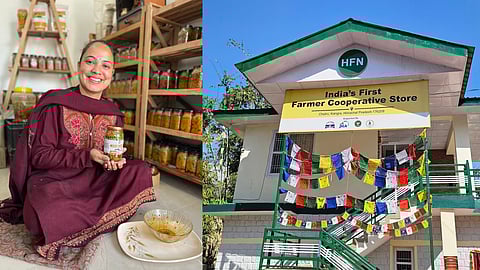


Kavita is a member of a self-help group of eight women in a village in Palampur district of Himachal Pradesh. The pahadi (hill) women prepare chutneys and pickles. But while Kavita and her co-workers know the secret to a tasty pickle, they are not trained in the nitty-gritty of marketing and packaging. Selling their products from their home in the hills is a huge challenge.
But recently, a first-of-its-kind co-operative store of Farmer Produce Organisations (FPOs) has been set up in Dharamshala that is just 40 kilometres from their village. Pickles made by Kavita’s group have made their way to this store set up by HFN Agritech Pvt. Ltd. Apart from the pickles, various products of 20 FPOs in the state have been stocked up. An FPO is a group of farmers who aggregate their resources to access better technology, financing, and markets for collective business.
“We make pickles without adding any sirka (vinegar) or palm oil. People visiting Palampur enjoy our products, but we have struggled to package and sell them,” said Kavita. “We have now tied up with HFN, which is helping us with the branding and packaging, and also selling our products at its store in Dharamshala. Our pickles and chutneys are also available for sale on HFN's website,” said Kavita, who hopes this will help their business grow.
This is just the beginning, promises Ruchit G Garg, Founder and CEO of Harvesting Farmer Network (HFN). A tech person, Garg is on a mission to connect smallholders' farmers under a single umbrella and help their business develop. His company, HFN was launched on 12 April 2020, and is an e-commerce platform that connects consumers directly with such farmers, who offer them a wide range of fresh and high-quality agricultural products.
It is an important initiative because 89.4 per cent of agricultural households in India are categorised as small and marginal farmers, as per the Ministry of Agriculture & Farmers Welfare. These farmers own less than two hectares of land and often get left out of various schemes.
“Branding, labelling, pricing and selling the produce is just one part of HFN’s work. We provide end-to-end solutions to smallholders farmers and FPOs by building operating systems for them, linking them with online portals to buy quality seeds and fertilisers, handling marketing for FPOs, and helping them with various legal compliances,” Garg told Kashmir Times.
FPOs Under A Single Roof
The Dharamshala store is the first physical store of HFN where products of various FPOs and smallholder farmers are sold. This initiative has been set up in collaboration with the Himachal Pradesh government, which has offered space (a property of the state agriculture department) to HFN for a modest rent. The store is located on Dharamshala-Mcleodganj road. Products of various FPOs from the state are available here under a single roof.
HFN sells more than 300 types of products including grocery items, health and wellness products, dry fruits and seeds, pickles and chutneys, apparel and clothing through its website. Saffron, provided by farmer collectives in Kashmir, is also available. There is no listing fee or entry fee for FPOs; the only condition is the product has to be of good quality and directly sourced from the smallholder farmers.
“Local farmers and women self-help groups in our country make so many products. But, if there is no quality control, and packaging is not up to the mark, then sales become difficult. We are helping such farmers and groups standardise their products and follow FSSAI guidelines to ensure they meet quality standards and win the trust of consumers. We are also regularly training FPOs on these aspects,” said Garg.
According to him, HFN is working with about 200-300 FPOs across the country. In Himachal, the company has a partnership with 20 FPOs. In Uttar Pradesh, HFN has helped set up 19 FPOs and all are profitable, Garg said.
The Indian government is promoting FPOs through its central scheme of ‘Formation and Promotion of 10,000 Farmer Producer Organizations (FPOs)’. Launched by Prime Minister Narendra Modi on 29 February 2020, the scheme aims to establish and promote 10,000 new FPOs across the country by 2027-28.
Under this scheme, each FPO can receive financial support of up to Rs 18 lakh for a period of three years. Additionally, there is a provision for a matching equity grant of up to Rs 2,000 per farmer member (capped at Rs 15 lakh per FPO) and a credit guarantee facility of up to Rs 2 crore to ensure better access to institutional credit. To ensure sustainability, the government engages Cluster Based Business Organisations (CBBOs) to provide professional handholding and registration support to each FPO for five years.
“We work with over 40 lakh farmers in 13,000 villages of the country through 9,000 formal clusters,” said Garg, whose company has also launched a decentralised biogas unit, HFN BioGas Cube, to address energy crisis in rural India.
Modular Biogas Plant
India imports 60 per cent of its LPG (liquefied petroleum gas), with nearly 90 per cent of those shipments navigating the Strait of Hormuz where maritime trade is disrupted due to the Israel-Iran conflict. This has deepened energy and public health crises as rural households and migrant workers in cities are facing a shortage of LPG and increasingly turning to solid biomass fuels (wood, cow dung cakes, crop residues) for cooking.
According to Garg, India likely has equal or higher untapped biogas potential than China, and it can potentially replace more than 80 per cent dependence on LPG. Biogas is a renewable source of energy and is a mixture of methane, carbon dioxide and small quantities of other gases produced by anaerobic digestion of organic matter in an oxygen-free environment.
Dung availability is big in India’s villages. Rural India has one of the world’s largest livestock populations—536.76 million, as per the 21st Livestock Census. This dung, food wastes, crop wastes, human wastes— can be used to generate decentralised biogas for cooking.
Garg’s company has developed HFN BioGas Cube, which is a ready-to-use, modular bio-gas unit that allows its user to produce cooking fuel (biogas) using a mixture of cow dung, kitchen waste, and water. It has been designed keeping in mind a small-scale farmer with 2-3 cattle. Apart from providing about three hours of free gas for cooking, the unit also gives free organic fertiliser for the farm.
The capacity of HFN BioGas Cube is 1,000 litres and it requires up to 4 square metres of space. It is made of strong HDPE-2 (high-density polyethylene) material and has a stainless steel cage for protection. The unit works by feeding the tank with cow dung and water in a 1:1 ratio. It requires a daily feed of 15 kilograms (kg) of cow dung and 15 kg of water to maintain the gas pressure. The full production of gas starts within 3-4 weeks of installation. HFN recommends adding 3 kg of kitchen waste daily to improve gas production efficiency.
The company has also designed a booster dose for the HFN BioGas Cube, which when put into the gas every 30 days, will speed up the gas chamber reactions and increase the gas production by another 15 per cent.
Biogas requires a slightly modified version of a traditional gas stove. Consumers can either get their existing stove modified or buy a biogas stove which starts from INR 600 onwards. Without the government subsidy, the cost of HFN BioGas Cube is INR 25,000 per unit.
The Indian government is also promoting biogas to meet energy demands of the country. The Ministry of New and Renewable Energy’s (MNRE) Biogas Programme supports the installation of small (1-25 cubic metre) and medium (25-2,500 cubic metre) biogas plants through Central Financial Assistance to provide clean cooking fuel, organic manure, and renewable energy. The National Bioenergy Programme (Phase-I) for FY 2021-22 to 2025-26, with a INR 100 crore outlay for biogas, provides subsidies of INR 9,800- INR 70,400 per plant, depending on capacity and beneficiary category.
Have you liked the news article?
Support us now:
https://www.gofundme.com/manage/jammu-kashmirs-sole-independent-voice-under-threat