

Mir Rahi*
Rising costs, shrinking landholdings, labour shortages, health risks, climate uncertainty and market competition are creating pressures that the traditional apple farming is struggling to navigate and combat in Kashmir.
For generations, apple orchards have shaped the economy, culture, and the social fabric of Kashmir, becoming its lifeline. Several villages are dependent on apples for income and survival. Lakhs of families are directly and indirectly engaged and dependent on apple farming and trade, involving a long chain of people involved in plantation, storage, packing, transportation, and finally trading.
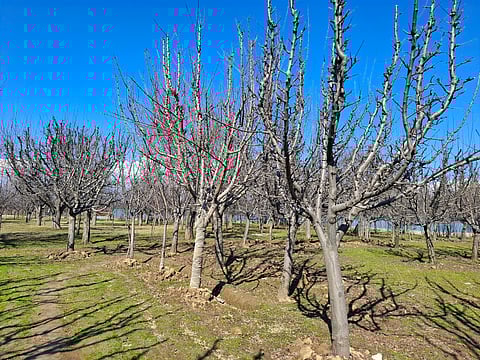
Traditional apple orchards with tall trees, wide spacing, and large canopies served this economy substantially well for centuries. However, the conditions under which these orchards once thrived are changing rather quickly now.
Unsustainable Traditional Orchards
One of the most pressing challenges facing Kashmiri farmers today is the shrinking of landholdings. With population growth and division of land among heirs, orchard sizes have steadily decreased. What was once a viable orchard has often been split into two or three smaller units, making traditional farming less profitable or even unviable at times.
Traditional apple orchards require large space and a long waiting period before returns begin. In contrast, high-density orchards allow farmers to produce more apples from the same land. This is especially important in Kashmir, where expanding agricultural land is neither possible nor desirable in most cases.
Another Kashmir-specific issue is the aging of apple orchards. A large number of orchards in the Valley are 40 to 60 years old. Over time, these orchards show declining productivity, increased disease pressure, poor fruit quality, and rising management costs.
Replantation is becoming unavoidable. In many cases, farmers are already cutting down old orchards due to low returns.
Traditional apple trees often take 10 to 15 years to reach full production. For many families, this means years of investment without a stable income.
The drought conditions during summers and heavy rains in spring and early autumn for last several years has been destroying traditional apple orchards for the past several years.
These orchards don't even cover up the cost of nutritional management, pesticide spray and labour, forcing orchard owners to either convert their orchards or look for other alternatives. One of these is switching to high density apple farming which has proved to be highly profitable so far.
Replantation with High Density Apples.
In many cases, farmers are already cutting down old orchards due to low returns. High-density systems give an opportunity to replant in a more productive, efficient and future-ready manner, rather than repeating mistakes of the past.
It is in this context that high-density apple orchards emerged as one of the most significant changes in Kashmir's horticulture sector in the last decade. Introduced nearly ten years ago, the system promises higher productivity, early income, better fruit quality, improved safety and future-readiness.
Traditional apple orchards require large space and a long waiting period before returns begin. In contrast, high-density orchards allow farmers to produce more apples from the same land. This is especially important in Kashmir, where expanding agricultural land is neither possible nor desirable in most cases.
Given the Valley's favourable climate, fertile soils, and sufficient chilling hours, high-density apple farming fits naturally into Kashmir's own conditions. It is not an imported idea forced on the region but a system that responds directly to local realities.
At the same time, it demands careful planning, discipline, and responsible support, otherwise the results may not be as expected.
When high-density apple orchards were first introduced in Kashmir, the response was mixed. Many farmers were hesitant, due to both the economic risks and emotions involved. These trees had been planted by parents or grandparents, often forming the very foundation of a family's livelihood.
There were also fears about the high initial investment, unfamiliar planting material, new training systems, and dependence on imported rootstocks. For many small and marginal farmers, these risks seemed quite daunting in the beginning.
Over time, however, experience began to replace doubt. Farmers who adopted the system early, reported higher yields, better fruit quality, and faster returns. Confidence slowly grew. Today, high-density apple orchards are no longer seen as an experiment. They are increasingly viewed as a necessary transition for the future of apple farming in Kashmir.
(*Mir Rahi is a freelance journalist from Kashmir)
Have you liked the news article?
Support us now:
https://www.gofundme.com/manage/jammu-kashmirs-sole-independent-voice-under-threat