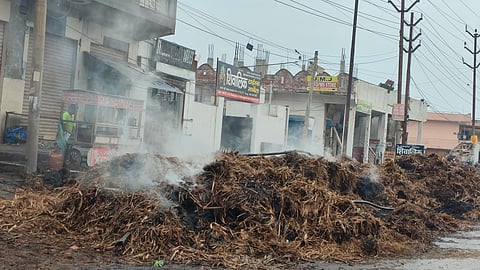


(A ground report from Loni (Ghaziabad), Uttar Pradesh.)
Nisar Ahmad’s eyes are fixed on the sewing machine in front of him as he deftly guides the cloth under the needle. The 33-year-old works at a garment factory where he puts in 12 hours a day. “I have been working here for the past 15 years. But, I wonder how much longer I can continue doing this, as my lungs and overall health are slowly giving way,” said Ahmad.
The garment factory where he works is located at the outskirts of Delhi in a small city Loni, which has recently been declared the most polluted city in the world.
According to the 2025 World Air Quality Report by the Swiss company IQAir, which has analysed data from over 9,400 cities across 143 countries, Loni’s annual average PM2.5 concentration last year was 112.5 micrograms per cubic metre (µg/m³). This is the highest in the world and 22 times the World Health Organization’s safe limit.
Located in Ghaziabad district of Uttar Pradesh, Loni is one of India's largest industrial hubs, with over 1,000 units manufacturing garments, leather, yarn, automobile parts, plastics, packaging, electronics components, e-waste, furniture, ice cream, biscuits, and rice mill machine parts. The heavy flow of diesel trucks using Loni as a transit corridor between Delhi and western Uttar Pradesh adds to the air pollution load.
Ahmad’s factory is located in Loni’s Tronica City, which is a planned industrial area of eight sectors, But, it is surrounded by hundreds of unauthorised units that belch out smoke and toxic pollutants. While he is aware of the high pollution around him, Ahmad says he doesn’t have much of a choice.
“I get paid on a per piece basis and earn Rs 15,000 a month, which barely keeps me afloat. Five family members, including my mother and wife, depend on me,” Ahmad told On Air. “Pollution causes illness, and doctor’s fees consume a significant portion of my income. I don't have access to any social security or health insurance,” he complained.
It was in the late 1990s when driven by court orders many polluting industries were relocated from Delhi to peripheral areas, including Loni, in a bid to clean the national capital’s air. But, Delhi continues to be the fourth most polluted city in IQAir’s latest global ranking. Loni, on the other hand, has jumped to number one position.
Loni’s Municipal Council Executive Officer KK Mishra, however, dismissed the IQAir report. “We don't know which agency prepared this report or what its parameters [of measuring the pollution] were. We don't have any such report. Twelve departments, including the municipal corporation, public works department, police, industry, and transport, work on air pollution, and strict enforcement is ensured,” Mishra told On Air.
Notwithstanding this, it is no secret that illegal industrial activities abound in Loni. Various reports point out how e-waste from Delhi and other neighbouring areas comes to Loni and is burned in the dead of the night to retrieve metals and other elements. Even plastic waste and mixed garbage is regularly burnt, complain local residents.
Vikram Mavi runs a gymnasium in the Tila village area of Loni. He pointed towards a huge pile of discarded mobile phone covers and screen guards. “Waste contractors set fire to this garbage at night. The burning rubber, plastic, and other waste fill the sky with smoke. If the pile is not burnt, it starts to rot and stink in the summer heat, making life difficult for those who live here,” the 44-year-old told On Air.
Naresh Chand, a tea-seller in Krishna Vihar in Loni, said he worked in a leather factory.“I quit because I kept falling ill. But, I am still exposed to pollution,” he said. “Though the government has banned dirty fuel like coal, it continues to be used surreptitiously to fire furnaces and in local dhabas for cooking. Coal is back in extensive use because of the fuel crisis due to the ongoing war in the Gulf.”
To ensure uninterrupted electricity supply, many industrial units in Loni use generator sets and these diesel-run gensets also contribute to the pollution.
Industrialist Anil Gupta has a transformer parts manufacturing company in Ghaziabad which employs 300 workers. He knows Loni like the back of his hand. He alleged that factories neither install effluent treatment plants nor dispose of solid waste properly, and brazenly flout environmental laws.
“Barring rare exceptions, pollution of water bodies and burning garbage in the open is common practice in Loni. The air pollution is unbearable and is slowly killing the local people. But owners don’t care as they don’t live in polluted Loni,” said Gupta.
On Air also met a manager of a factory in Loni’s Tronica City that employs 400 workers. He admitted that workers face high pollution both inside the industrial units and outside, as the air is thick with pollutants. He pointed towards a huge flyover that is under-construction through Loni city.
“This flyover is part of the Delhi-Saharanpur Highway. But no one knows when its construction will be completed. No anti-pollution regulations are being followed. Dust pollution is high. Day in and day out people inhale toxic air. It is no surprise if the workers fall ill,” he said on condition of anonymity.
Loni’s Municipal Council Executive Officer Mishra also said he had no clear idea when the flyover would be completed. “I think the agency that was constructing it has got blacklisted and it's just standing there unfinished,” he said.
The factory manager, who requested anonymity, also complained that government social security schemes for workers mostly remain only on paper. “Employee State Insurance [ESI] covers all workers earning less than Rs 21,000 per month in the state, but not everyone benefits from it. Companies often hire workers on daily wages through contractors, circumventing regulations,” he said.
Mumtaz Naushad Saifi, a councillor of ward 49 in Loni said that the workers were being exploited and labour rights not enforced properly. “We want to clean up Loni and get rid of this number one tag that has been given to us because of high air pollution,” she said.
On Air reached out to Uttar Pradesh Pollution Control Board (UPPCB), which has two real-time air quality monitoring systems in Loni. Unwilling to be named, an official of UPPCB said that many illegal industries operate in Loni.
“The matter was even taken to the High Court and a committee has been formed by the District Magistrate, which, in collaboration with the Municipal Corporation and the Police Department, conducts periodic drives to crack down on illegal industries. But corruption is so rampant that not much is being done,” he said.
Industrial sector experts stress on the need for systemic reforms—strengthening state pollution control boards, upgrading industrial infrastructure, and ensuring continuous, transparent monitoring of emissions in clustered industrial zones like Loni.
“Addressing pollution in places like Loni requires strengthening state pollution control boards with more humanpower and better laboratories, improving industrial infrastructure, and enforcing continuous monitoring. Transparent, public reporting is key to driving accountability and real change. Unless we do that, we will see more industrial towns like Loni around us,” said Nivit Kumar Yadav, Programme Director, Sustainable Industrialisation and Renewable Energy Unit, Centre for Science and Environment, New Delhi.
(This story was first published in ON AIR, India's only bilingual webzine on air quality, published by Chintan Environmental Research and Advocacy Group. Read the original story here.)
Have you liked the news article?
Support us now:
https://www.gofundme.com/manage/jammu-kashmirs-sole-independent-voice-under-threat