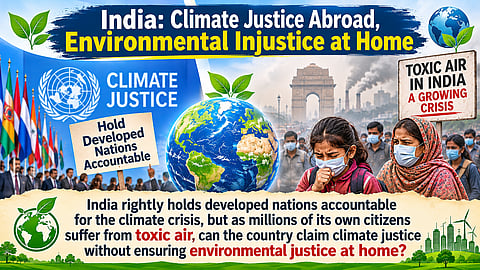


As world leaders gathered at the COP31 climate summit in Antalya, Turkiye, to discuss the future of the planet, India once again raised its familiar and legitimate demand for climate justice.
Developed nations, it argued, must acknowledge their historical responsibility for global warming and provide financial and technological support to developing countries. There is considerable merit in this position. But listening to the discussions at the summit, I found myself confronting another question: While India demands climate justice from the rest of the world, how seriously is it pursuing environmental justice for its own citizens?
The question became particularly troubling when I thought about the toxic air that millions of Indians breathe every day, the enormous public health burden it imposes and the political indifference that often surrounds the issue. Can a country convincingly demand accountability from wealthy nations for the environmental damage they have caused while failing to demonstrate comparable urgency in protecting its own people from pollution?
On November 11, the Anadolu Hall inside COP31's Blue Zone was filled with delegates attending the Antalya Leaders' Summit. United Nations Secretary-General António Guterres opened his address with a reminder that the first responsibility in confronting the climate crisis was to tell the truth. He warned that global emissions had reached record levels in 2025, temperatures continued to rise and the climate crisis was advancing faster than international efforts to contain it.
Turkish President Recep Tayyip Erdoğan emphasised the historical responsibility of developed countries, arguing that nations which had consumed a disproportionate share of the world's carbon budget must shoulder a greater responsibility for reducing emissions and financing climate action. He also drew attention to the environmental destruction caused by wars, describing Israel's actions in Gaza as both genocide and environmental devastation.
Brazilian President Luiz Inácio Lula da Silva warned that wars and trade disputes were diverting international attention from the survival of future generations. Other leaders spoke about clean energy, climate finance and the growing vulnerability of communities exposed to environmental disasters.
These speeches reflected an important reality: climate change is not merely an environmental problem but also a question of economic inequality, political responsibility and justice. Yet the same understanding of justice must apply within national boundaries, not only between countries.
Legitimate Demand, Domestic Contradiction
India has long argued that developed nations became prosperous through decades of industrialisation powered by fossil fuels, leaving developing countries to bear consequences for which they were not primarily responsible. It is a powerful argument, grounded in the unequal history of global emissions and the continuing disparities in financial and technological resources.
At COP31, Narendra Bhushan, Secretary in India's Ministry of Environment, reiterated the importance of climate justice, historical responsibility and financial support for developing countries in his opening statement.
India is justified in making these demands. Its development needs are enormous, and it cannot be expected to bear the same historical responsibility as countries that industrialised much earlier. The principle that those who contributed most to the climate crisis should shoulder a greater burden remains central to any equitable international response.
But this principle raises an uncomfortable question when applied to India's domestic circumstances. If wealthy countries must be held accountable for the environmental consequences of their development, should India's own political leadership not also be accountable for the pollution generated by its energy policies, industrial expansion, transport systems and urban development?
The two responsibilities are not contradictory. India can demand climate finance internationally while accepting responsibility for protecting public health domestically. Indeed, doing both would make its position on climate justice more credible.
What is difficult to reconcile is the prominence given to environmental justice in international diplomacy and the comparatively limited political urgency surrounding the right to breathe clean air at home.
The scale of India's air pollution crisis should make it impossible for any government to treat the issue as secondary.
At a COP31 ministerial roundtable on health, World Health Organization Director-General Tedros Adhanom Ghebreyesus drew attention to the devastating consequences of polluted air, noting that air pollution causes approximately seven million deaths worldwide every year.
According to the State of Global Air 2025 report, air pollution contributed to nearly two million deaths in India in 2023, representing roughly a quarter of the global toll. This means that a country accounting for a much smaller share of the world's population bears an extraordinarily high proportion of pollution-related deaths.
Behind these figures are families who lose their breadwinners, children whose health is compromised before they reach adulthood, and elderly people whose existing illnesses are aggravated by polluted air. There are also enormous economic consequences, including medical expenses, lost working days and declining productivity.
Yet clean air rarely commands the sustained political attention that such a crisis deserves.
It was striking that India's opening statement at COP31, while emphasising climate justice and international financial obligations, made no explicit reference to the country's air pollution emergency or its public health consequences.
Of course, climate change and air pollution are not identical issues, and international climate negotiations operate within a framework distinct from domestic air quality management. The absence of a particular subject from one diplomatic statement cannot be taken as evidence that the government has no policies to address it.
Nevertheless, the omission raises a broader question about priorities. When India presents its vision of climate justice to the international community, should the protection of its own citizens from environmental harm not form an equally important part of that vision?
After all, what is climate justice worth if the people in whose name it is demanded cannot enjoy something as fundamental as clean air?
Troubling Contradictions
The contradiction becomes more troubling when one examines how environmental concerns are discussed within India. Instead of being treated primarily as matters of science, public health and governance, they are frequently drawn into political and religious controversies.
Consider the controversy surrounding actress Dia Mirza, a Goodwill Ambassador for the United Nations Environment Programme, who appeared in an advertisement encouraging people to avoid bursting firecrackers during Diwali and remain mindful of environmental consequences.
Following criticism, the Brihanmumbai Municipal Corporation removed the advertisement from its social media accounts. According to media reports, similar appeals featuring actress Madhuri Dixit, actress Nishigandha Wad and cricketer Ajinkya Rahane remained available.
The episode raises a question that extends well beyond the advertisement itself. Should an appeal to protect public health be evaluated on its scientific merit, or should its acceptance depend on the political and ideological identity attributed to the person making it?
Religious festivals are an important part of India's cultural life, and the freedom to celebrate them deserves respect. But that freedom need not be placed in opposition to the responsibility to protect the health of fellow citizens. A government committed to both religious freedom and public welfare should be capable of finding a reasonable balance.
Unfortunately, environmental concerns are sometimes portrayed as attacks on religious traditions, making meaningful public discussion more difficult.
Remarks attributed to Uttar Pradesh Chief Minister Yogi Adityanath illustrate this tendency. Defending Diwali celebrations involving fireworks, he questioned concerns about the temporary increase in pollution and suggested that it would eventually disappear.
Such arguments overlook the fact that even short periods of severe pollution can have serious health consequences, particularly for children, elderly people and those suffering from respiratory or cardiovascular diseases.
More importantly, political leaders have a responsibility to explain public health risks rather than dismiss them through cultural or political arguments.
The issue is not whether people should celebrate Diwali or any other festival. It is whether the state is prepared to place scientific evidence and public health considerations at the centre of its decisions, even when doing so is politically inconvenient.
Beyond Firecrackers
It would, however, be a serious mistake to reduce India's air pollution crisis to the debate over Diwali fireworks. Such a narrow approach can itself become a distraction from the structural causes of pollution and the responsibility of governments to address them.
India's dependence on coal, emissions from industries and power plants, inadequate regulation, vehicular pollution, construction dust, agricultural residue burning and poorly planned urban expansion all contribute to deteriorating air quality.
These are not problems that can be solved through appeals to individual responsibility alone. They require sustained policy interventions, public investment, effective regulation and the political willingness to confront powerful economic interests.
When a government promotes industrial expansion without adequate pollution safeguards, allows environmental regulations to be weakly enforced or fails to develop affordable and efficient public transport, the resulting environmental costs are eventually transferred to ordinary citizens.
This is precisely where the language of climate justice becomes relevant within India.
If developed countries are expected to acknowledge the environmental costs of their industrialisation, India's policymakers must also recognise the consequences of the development model they pursue at home.
The question is not whether India should develop. It must. The question is whether development should be pursued in ways that impose avoidable health and environmental costs on millions of people who have little influence over those decisions.
One of the most important dimensions of environmental justice is the unequal distribution of environmental harm. Pollution may spread across an entire city, but the ability to escape its consequences is determined to a considerable extent by income, occupation and living conditions.
Those with sufficient resources can purchase air purifiers, live in better-protected homes, use private transport or work indoors. Such measures cannot eliminate exposure, but they can provide a degree of protection.
For construction workers, street vendors, rickshaw pullers, delivery workers and daily-wage labourers, these options are largely unavailable. Their livelihoods depend on spending long hours outdoors, often in the most polluted parts of cities. Children growing up in poorer neighbourhoods face similar disadvantages, with limited access to protective measures and healthcare.
The consequences are deeply unequal. People who may have contributed relatively little to industrial emissions or excessive consumption often bear some of the heaviest costs.
This is not simply an environmental problem. It is a question of social and economic justice.
India frequently argues at international forums that developing countries should not be forced to bear a disproportionate share of the costs created by wealthy nations. The same principle should apply to vulnerable communities within India.
Why should a construction worker, whose labour helps build the country's infrastructure, have to sacrifice his health because pollution regulations are inadequately enforced? Why should children from low-income families face greater environmental risks simply because their parents cannot afford cleaner surroundings?
If climate justice means protecting those who are most vulnerable and least responsible for environmental damage, it must begin by addressing these inequalities at home.
Development Path
India's political discourse frequently celebrates economic growth, expanding highways, modern airports, industrial corridors and ambitious infrastructure projects as evidence of national progress. These achievements have their importance, particularly in a country where millions still require better economic opportunities and public services.
But development cannot be judged by physical infrastructure and economic output alone.
A city with wider roads, taller buildings and expanding industries cannot be considered fully developed if its residents are routinely exposed to dangerous levels of pollution. Nor can economic growth be regarded as an unquestionable success when part of its cost is paid through deteriorating public health.
The true measure of development must include the quality of life it provides, the health of children, the safety of workers and the condition of the environment in which people live.
This also requires a change in political priorities. Clean air should not become a matter of public debate only during severe pollution episodes or when controversies arise around religious festivals. It should be a central concern of urban planning, industrial policy, healthcare, public expenditure and electoral accountability.
Young people and civil society groups have repeatedly raised their voices against pollution. Their demands deserve serious engagement, not merely administrative responses. Political parties, too, should be expected to explain what they intend to do about air quality and how they will measure progress.
Environmental justice cannot be achieved through international declarations alone. It requires institutions willing to enforce regulations, governments prepared to make difficult choices and a political culture that regards clean air as a public right rather than a private luxury.
Justice Must Begin at Home
There is no reason for India to abandon its demand for climate justice from developed nations. On the contrary, it should continue pressing for fair climate finance, technology transfer and recognition of historical responsibility. These remain essential to any meaningful international climate agreement.
But the credibility of that demand would be strengthened if India demonstrated an equally firm commitment to environmental justice within its own borders.
A country cannot control the historical emissions of industrialised nations, but it can make decisions about its own energy policies, pollution standards, industrial regulations, public transport and urban development. It can decide whether public health will be treated as an unavoidable cost of economic growth or as a fundamental measure of development.
It can also decide whether environmental concerns will be examined through scientific evidence and public interest, or allowed to become casualties of religious polarisation and political rivalry.
The larger lesson from COP31 is that climate justice cannot be confined to negotiations between rich and poor countries. It must also address the inequalities that exist within societies, where the benefits of development and the burdens of pollution are distributed very differently.
India's demand for global climate justice is legitimate. But justice loses much of its meaning when it is invoked internationally without receiving the same attention domestically.
As I listened to world leaders in Antalya discuss the responsibilities of wealthy nations and the rights of vulnerable communities, I kept returning to a simple thought: the principles India demands from the world must also guide the way it treats its own people.
India is right to ask developed nations to pay for the environmental damage they have caused. But it must also ask itself who is paying the price for pollution at home, and why that burden continues to fall so heavily on those least able to bear it.
Ultimately, the test of India's commitment to climate justice will not lie only in the strength of its speeches at international summits or the financial commitments it secures from wealthy nations. It will also lie in whether its children can grow up breathing healthier air, whether its workers can earn a livelihood without sacrificing their health, and whether environmental protection becomes a genuine priority of governance.
Before asking the world to deliver climate justice, India must demonstrate that justice begins at home.
Have you liked the news article?
Support us now:
https://www.gofundme.com/manage/jammu-kashmirs-sole-independent-voice-under-threat