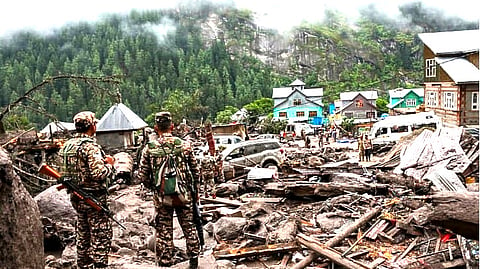


Jammu and Kashmir has been under near-continuous assault from the cloudbursts and flash floods in recent weeks. They are tearing through the hilly areas, causing landslides, Chenab has crossed the danger mark, highways have been disrupted; and at least 30 people are dead and properties partially or fully damaged.
None of this is unfamiliar. Almost the same sequence played out last year. What repeats each monsoon is not only the weather but the gap it exposes. The institutions closest to the ground and best placed to notice the first warning signals are also the ones that are least equipped, structurally, to report or act.
Jammu and Kashmir's Panchayats are, in institutional terms, newly built and were never designed with the environment in mind at all. The Jammu and Kashmir Panchayati Raj Act of 1989 kept local self-government largely nominal. The 73rd Constitutional Amendment, which gave Panchayati Raj Institutions constitutional status and real devolved powers across the rest of the country, now extended to Jammu and Kashmir has made little change.
The institutions are still finding their feet, working out basic questions of authority and capacity under conditions of bureaucratic caution and continuing security sensitivity even as climate disaster risks, as repeated incidents show, in this region are far more profound.
This important connection between a young institution, a fragile mountain landscape, and a warming climate has been largely absent from the growing literature on "ecological democracy." Scholars from Robyn Eckersley, who has argued for an eco-centric political theory, to John Dryzek, who has described a "democracy without boundaries" folding environmental stewardship into democratic participation.
Much of this literature has built this field around mature Western democracies or India's longer established Panchayati Raj states. Jammu and Kashmir, where local self-government is still new in any operational sense, has barely featured in it.
A Landscape on the Edge
Jammu and Kashmir is located in one of the world's most ecologically fragile zones. The Himalayas are geologically young and prone to landslides, flash floods and glacial retreat, changes that unfold at a scale too fine-grained for a distant bureaucracy to track, let alone answer in time.
Only communities living directly on that land tend to notice a drying spring, an eroding slope, or a shrinking pasture early enough to act.
Climate change is not an abstract concern. Shifting snowfall, erratic monsoons and glacial melt are already unsettling agriculture, water supply and livestock-based livelihoods. When ecological disruption turns immediately into food and water insecurity for rural households, environmental decision-making cannot be left to experts sitting elsewhere. It has to sit where the consequences land.
Panchayati Raj Institutions, however, were built for roads, sanitation and welfare delivery, not environmental stewardship. Without a deliberate ecological mandate, Panchayats carry no obligation to weigh ecological cost against short-term development gains, so unregulated construction, unsustainable tourism and resource overuse happen by default rather than informed local choice.
That default also wastes a resource centralised environmental policy routinely ignores - the generations-deep ecological knowledge rural and pastoral communities hold about forests, water systems and seasonal cycles is consulted symbolically, if at all.
The same gap shows up in tourism and resource extraction. State-level regulation, enforced from a distance, is usually too slow to stop damage as it happens. A Panchayat with genuine ecological authority could act as a faster, more accountable check but only if that authority is deliberately built into the institution rather than assumed to follow automatically from its existence. Because Jammu and Kashmir's Panchayats are still being built, this is an unusually open moment to do exactly that.
Ecological democracy, in this sense, means a decentralised, participatory system of governance in which citizens actively take part in conserving, managing and sustainably using natural resources, while pursuing environmental justice and intergenerational equity. It widens governance beyond political accountability and service delivery to include environmental accountability as well.
Evidence of Climate Change
Meteorological records show Jammu and Kashmir's annual temperatures rose by roughly 0.8°C between 1980 and 2016, with daytime highs in Kashmir and night-time lows in Jammu both rising steadily. Under a high-emissions scenario, researchers project average annual temperatures could rise a further 5.2°C in Kashmir, 4.8°C in Jammu and 6.5°C in Ladakh by the century's end, with glacier cover across the region shrinking by as much as 85 percent.
The glaciers are already showing it. The Kolahoi glacier, the largest in the Kashmir Himalayas and a key source for the Jhelum basin's Lidder and Sind rivers, has retreated by roughly 2.85 kilometres since 1857, with the pace accelerating sharply after 2000; it lost close to a quarter of its ice cover between 1962 and 2018 alone. Because meltwater from glaciers like this feeds irrigation, drinking water and hydropower downstream, that retreat becomes resource pressure for the very communties Panchayats exist to serve.
Rainfall patterns are shifting too. What once fell across two months in the Kashmir Valley is now compressed into spells as short as ten days, producing a punishing cycle of drought-like dry spells followed by the kind of intense, flood-inducing bursts now battering Poonch and Rajouri. Srinagar recorded its hottest July day in 25 years in 2024, alongside one of its warmest nights in over a century.
None of this is a future risk. It is a measured trend, which strengthens the case for ecological accountability into local government, while these institutions are still taking shape.
Jammu and Kashmir presents a particularly compelling case for ecological democracy because a significant proportion of its rural population maintains a close relationship with natural resources. Forests provide fuelwood, fodder, medicinal plants, and livelihood opportunities. Water bodies support agriculture, fisheries, and domestic needs. Pastures sustain livestock-based economies, while biodiversity contributes to ecological balance and tourism potential. Environmental degradation therefore has immediate consequences for the daily lives of rural households.
Two New Tools for New Institutions
Turning ecological democracy into practical governance calls for instruments designed for institutions this early in their development, not borrowed from systems that assume institutional capacity Jammu and Kashmir's Panchayats do not yet have.
The first is an Ecological Democracy Index, combining measures of environmental governance, natural resource management, waste and pollution control, climate resilience and community participation, to let the ecological performance of individual Panchayats be tracked and compared as their powers mature.
The second is the Ecological Gram Sabha - a forum dedicated to environmental issues like water conservation, forest protection, biodiversity, climate adaptation, waste management, and sustainable agriculture. This can sit alongside the general Gram Sabha rather than replacing it.
Introduced now, while Jammu and Kashmir's Panchayati Raj structure is still being defined, it would build ecological concerns into grassroots democracy from the outset, rather than retrofit them later.
A third, complementary instrument is a Mountain Development Stress Index. This would give Ecological Gram Sabhas and district planners a district-level reading of developmental vulnerability across climate stress, agriculture, livestock resilience, health access, education and economic diversification.
Composite vulnerability indices are not new to Himalayan research; similar tools already exist for farming communities in Himachal Pradesh and for villages in Kashmir's own Kupwara district. What would be new is building one consistently across all of Jammu and Kashmir's districts on common indicators, treating health and education access as core measures alongside climate and livelihood.
Women belong at the centre of this framework, not the margins. They are typically the ones who fetch water and fuelwood and manage household resources. Young people are equally central, well placed to lead biodiversity mapping, environmental monitoring and eco-tourism initiatives.
Tourism regulation is a related opportunity. Panchayats empowered to manage waste, regulate activity and protect sensitive sites could let communities benefit economically from tourism without absorbing all of its ecological cost.
Timing is Crucial
What makes ecological democracy worth proposing in Jammu and Kashmir is not the idea itself, which has a long history in Western green political theory. It is the timing. The region's Panchayati Raj Institutions are still newly operational; their powers still being negotiated. Embedding ecological participation, an Ecological Democracy Index and Ecological Gram Sabhas into that formative period, rather than into an already-mature system of local government, is the more pragmatic thing to do.
As rain keeps falling this week, rivers keep rising, and rescue teams keep searching hillsides in Poonch for the missing, that argument stops being academic. Jammu and Kashmir's local government is, in effect, still being poured. It will not get many more chances to build ecology into that foundation rather than bolt it on afterward.
Bibliography:
Jaswal, A. K., & Prakasa Rao, G. S. (2010). Recent trends in meteorological parameters over Jammu and Kashmir. Mausam, 61(3), 369–382.
Fatima, K., Jan, M., Ahmad, I., Farooq, M., & Muslim, M. (2025). Micro-level vulnerability assessment among agricultural communities of District Kupwara, Kashmir Himalaya. Scientific Reports, 15, 14950.
Mongabay India. (2024). Changing patterns in precipitation and temperature affect Kashmir's ecosystem. Mongabay India.
Pandey, R., & Jha, S. K. (2012). Climate vulnerability index — measure of climate change vulnerability to communities: a case of rural Lower Himalaya, India. Mitigation and Adaptation Strategies for Global Change, 17(5), 487–506.
Rana, R. S., Kalia, V., Singh, S., Randhawa, S. S., Chauhan, R., Katoch, A., Sandal, A., Thakur, R. K., & Upadhyay, S. K. (2021). Climate vulnerability assessment of farming systems in Himachal Pradesh, Indian Himalayas. Mountain Research and Development, 41(4).
Rashid, I., Majeed, U., Aneaus, S., & Pelto, M. (2020). Linking the recent glacier retreat and depleting streamflow patterns with land system changes in Kashmir Himalaya, India. Water, 12(4), 1168.
Rashid, I., Romshoo, S. A., & Abdullah, T. (2017). The recent deglaciation of Kolahoi valley in Kashmir Himalaya, India in response to the changing climate. Journal of Asian Earth Sciences, 138, 38–50.
Romshoo, S. A., Bashir, J., & Rashid, I. (2020). Twenty-first century-end climate scenario of Jammu and Kashmir Himalaya, India, using ensemble climate models. Climatic Change, 162, 1473–1491.
Zaz, S. N., Romshoo, S. A., Krishnamoorthy, R. T., & Viswanadhapalli, Y. (2019). Analyses of temperature and precipitation in the Indian Jammu and Kashmir region for the 1980–2016 period: implications for remote influence and extreme events. Atmospheric Chemistry and Physics, 19(1), 15–37.
Have you liked the news article?
Support us now:
https://www.gofundme.com/manage/jammu-kashmirs-sole-independent-voice-under-threat