

Kashmir is often described as the “Switzerland of the East.” But Switzerland did not become prosperous because of its mountains. It became prosperous because it built a rural economy based on value-added agriculture—cheese, chocolate, dairy, and processed foods.
If Kashmir is to claim that comparison, it must now confront a new economic reality: global competition is arriving at its doorstep.
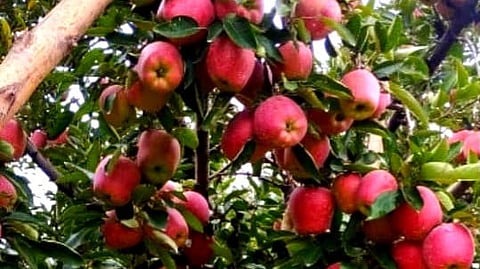
The emerging trade framework between India and the United States signals a gradual opening of agricultural markets, including apples. Officials say domestic farmers will be protected through quotas, minimum import prices, and reduced, but not eliminated, tariffs. Yet the direction of policy is unmistakable. The apple market is slowly opening to foreign competition.
Under the proposed arrangement, import duties on US apples could fall sharply from earlier levels, possibly to around 25 per cent or even lower in future rounds of negotiations. A minimum import price is expected, but the long-term trajectory is clear: Kashmir’s apple growers will increasingly face highly mechanised, subsidised, and globally efficient producers.
This is not merely a trade issue. It is an existential economic question for Kashmir’s rural society.
The apple industry produces roughly 21–28 lakh metric tonnes annually and supports about 3.5 million livelihoods. It contributes nearly 8 per cent to the region’s Gross State Domestic Product (GSDP). In employment terms, it is the single largest rural sector, generating about 400 man-days per hectare each year.
Yet beneath this scale lies a structural weakness. Nearly one-fifth of the crop is lost annually. About six lakh metric tonnes fall into the C-grade category—fruit unsuitable for the fresh market but ideal for processing into juice, concentrate, cider, or dried products. Kashmir’s processing capacity, however, is only about one lakh metric tonnes. The rest is wasted.
This is not just a technical inefficiency. It is an economic vulnerability.
In a protected domestic market, inefficiencies can survive. In a liberalised trade environment, they cannot. If imported apples begin to arrive at competitive prices, the local industry will face only two choices: compete on cost and quality, or collapse under price pressure.
There is no third option.
To understand the stakes, it is useful to look at the recent history of the apple trade between India and the United States. Until 2019, U.S. apples faced a duty of about 50 percent. In retaliation for American tariffs on Indian steel and aluminium, India imposed an additional 20 per cent duty on U.S. apples and walnuts, along with a fixed charge on almonds.
Dramatic Impact
The impact was dramatic. Imports of U.S. apples fell from about 1.27 lakh tonnes in 2018–19 to just over 4,000 tonnes in 2022–23. During this period, other countries—Turkiye, Italy, Chile, Iran, and New Zealand—captured market share. Total apple imports into India remained stable at around five lakh tonnes annually, but the source countries shifted.
In 2023, India removed the additional retaliatory duty on US apples. At the time, the government clarified that the core duty of 50 per cent remained in place, along with a minimum import price of ₹50 per kilogram to prevent market flooding.
Now, however, the new trade framework could alter that balance. If duties are reduced significantly, the United States could dominate India’s imported apple market, potentially push out other countries while also threatening domestic growers.
The structural disadvantage is stark. Indian orchards typically produce 7–8 tonnes per hectare, while producers in the United States, China, New Zealand, and Iran achieve yields of 40–70 tonnes per hectare. This gap is driven by better technology, mechanisation, logistics, and decades of investment.
In such a scenario, expecting Kashmir’s farmers to compete on raw apple prices alone is unrealistic.
Need for Value Addition
Kashmir cannot compete with the United States on scale, mechanisation, subsidies, or logistics. But it can compete on high-value products. A raw apple is a low-margin commodity. Apple concentrate, cider, dried fruit, and branded packaged products are not.
The same logic applies beyond apples. Kashmir produces strawberries, cherries, apricots, pears, plums, walnuts, almonds, and large quantities of milk. Many of these products are seasonal and perishable. They are often sold at distress prices because of a lack of storage, transport, and processing facilities.
Strawberries, for example, have expanded rapidly in some districts. Yet farmers frequently suffer price crashes because the fruit cannot be stored or shipped over long distances. With proper processing, the same fruit could become jam, syrup, confectionery inputs, or premium export goods.
This is precisely the path Switzerland took. It never tried to compete with the world on cheap milk or bulk agriculture. It competed on value. Its rural districts-built industries around cheese, butter, chocolate, and fruit preserves. Milk became chocolate. Fruit became jam. Nuts became confectionery. These products created global brands—and rural prosperity.
Kashmir has similar building blocks: high-quality milk, apple and strawberry belts, walnut and almond orchards, and a climate well-suited for dairy and confectionery. What it lacks is the processing infrastructure and policy vision to turn these advantages into economic strength.
A Kashmir brand of strawberry jams, cherry and apricot preserves, apple-nut energy bars, walnut chocolates, almond pralines, and premium dairy products could target tourism markets, the Middle East, Central Asia, and even Europe. These products have longer shelf lives, are easier to transport, and carry higher value per kilogram.
The most practical approach would be district-level processing clusters. Major fruit-producing districts—Shopian, Pulwama, Baramulla, Anantnag, Kulgam, Kupwara, and Budgam—should host integrated agro-processing parks. These would combine apple processing units, jam and preserve facilities, dairy plants, nut processing centres, confectionery units, cold storage, and logistics hubs.
Such clusters would reduce fruit wastage, stabilise farmer incomes, lower costs through scale, create rural employment, and build export-oriented industries. Most importantly, they would allow Kashmir’s farmers to compete in a globalised market.
At the same time, the question of protection cannot be ignored. The experience of the 2019–2023 retaliatory duties show how tariff policy can reshape trade flows. Without safeguards such as minimum import prices and calibrated duties, domestic farmers could face predatory pricing and market flooding.
Social Stability at Risk
The proposed duty reductions on apples come at a time when the United States continues to maintain significantly higher tariffs on certain Indian exports, including carpets. Such asymmetries raise legitimate concerns about reciprocity and fairness.
For Kashmir’s apple growers, the stakes are immediate and personal. An annual market of 30–35 lakh tonnes cannot be surrendered without consequences. The region’s orchards are not just an agricultural sector. They are the backbone of rural livelihoods and social stability.
For decades, Kashmir’s economy has depended on protected markets and raw produce. That era is ending. The orchards already produce the fruit. The villages already produce the milk. The hills already produce the nuts.
What is missing is the processing infrastructure—and the policy vision—to turn these resources into global brands.
Kashmir’s future will not be secured by harvests alone. It will be secured when apples become juice, strawberries become jam, milk becomes cheese, and walnuts become chocolate.
That is how Switzerland built its prosperity. In an era of global trade, that is how Kashmir must build its own.
Have you liked the news article?
Support us now:
https://www.gofundme.com/manage/jammu-kashmirs-sole-independent-voice-under-threat