

Recent statements from India that it intends to ensure that “not a single drop” of water reaches Pakistan have once again brought the Indus Waters Treaty (IWT) into the spotlight.
While many observers view such remarks through the familiar prism of India-Pakistan rivalry, they also expose a deeper and largely ignored reality: the people whose land gives birth to these rivers remain absent from every major discussion concerning their future.
A few years ago, following his removal from office, former Pakistan Prime Minister Imran Khan participated in an online discussion organised by Istanbul Sabahattin Zaim University. During the interaction, I asked him a question that many Kashmiris have often pondered: if he returned to power, what more could Pakistan do for Kashmir?
After reflecting for a moment, he replied that, except for war, he would go to any extent for Kashmir.
His answer was significant. It reflected not only his personal preference for avoiding military confrontation but also the broader approach successive Pakistani governments have adopted over the years.
Despite strong rhetoric, Pakistan has largely relied on diplomatic engagement, international forums, political advocacy, and legal arguments.
Several months later, during a meeting with him in Lahore in early 2023, I revisited that exchange. I reminded him of his earlier response and shared a concern that had been occupying my mind.
I asked if a time could come when water would create pressures that no Pakistani government could afford to ignore.
At the time, the observation may have sounded speculative. Today, it appears considerably less so.
The rivers governed by the Indus Waters Treaty are not merely waterways. They form the backbone of Pakistan’s agricultural economy and sustain millions of livelihoods. Any serious disruption in water flows would not be viewed simply as a technical disagreement between two states. It would be perceived as a challenge to food security, economic stability, and national resilience.
This is why recent rhetoric surrounding the treaty should concern the wider international community. Water disputes have historically proven more dangerous than many territorial disagreements because they directly affect the survival and well-being of entire populations.
Yet there is an aspect of this debate that remains almost absent.
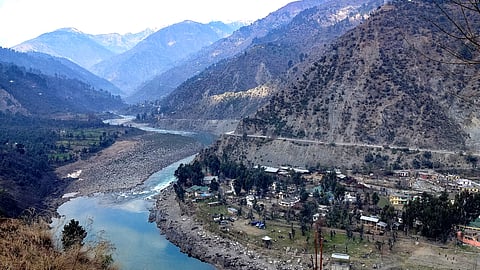
The waters at the centre of the dispute originate in Jammu and Kashmir.
Exclusion of Stakeholders
India asserts upstream rights and control. Pakistan asserts downstream entitlements and treaty protections. International discussions focus on legal obligations, arbitration mechanisms, hydrological data, and strategic calculations. Meanwhile, the people whose homeland nourishes these rivers are rarely treated as stakeholders.
This exclusion is not new. Since the signing of the Indus Waters Treaty in 1960, Kashmir has largely been viewed as territory through which rivers pass rather than as a people with legitimate interests in the management of those resources.
The consequences of that approach are becoming increasingly evident.
The future of the Indus basin is now being shaped by forces that policymakers in 1960 could scarcely have anticipated. Climate change is accelerating glacial melt across the Himalayas. Weather patterns are becoming more unpredictable. Water scarcity is emerging as one of the defining challenges of South Asia. Growing populations and expanding economies are putting increasing pressure on already stressed resources.
In such circumstances, continuing to discuss Kashmir’s rivers without involving Kashmiris is neither practical nor sustainable.
The present controversy should therefore serve as a wake-up call. It demonstrates that Kashmir is also an issue of environmental stewardship, resource management, economic development, and regional stability.
More importantly, it exposes a fundamental contradiction. Both India and Pakistan claim rights and interests in waters originating from Kashmir. Yet the people of Kashmir themselves remain largely excluded from decisions that directly affect their future.
This imbalance cannot continue indefinitely.
Any future framework governing the waters of the Indus basin, whether through treaty revision, arbitration proceedings, climate adaptation initiatives, or broader regional arrangements, must recognise Kashmiris as stakeholders in their own right.
Their participation cannot be reduced to symbolism or consultation after decisions have already been made. It must become an integral part of any credible and sustainable process.
The lesson from recent developments is clear. Water is rapidly becoming one of the most consequential aspects of issues affecting India and Pakistan.
The question facing policymakers is whether they will recognise this reality before tensions over water create new and potentially dangerous fault lines in the region.
For decades, the world has viewed Kashmir primarily through the lenses of territory, sovereignty, and security. The emerging debate over water reveals a deeper truth. The future of South Asia’s most vital rivers cannot be separated from the future of the people whose land sustains them.
The time has come to place Kashmiris where they belong: not on the margins of the discussion, but at its centre.
Have you liked the news article?
Support us now:
https://www.gofundme.com/manage/jammu-kashmirs-sole-independent-voice-under-threat