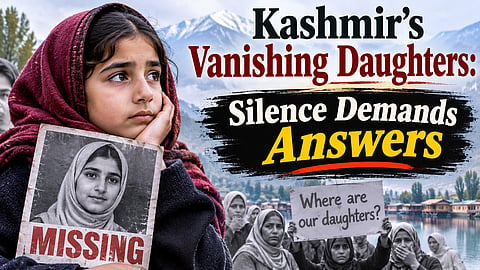


Every daughter is everyone's daughter. Every mother deserves the same love, dignity and protection that we wish for our own. These are values societies proudly proclaim, particularly when speaking about women's rights, equality and freedom from violence. Yet, when thousands of women and girls are reported missing in Kashmir, the voices that ordinarily champion women's dignity often fall silent.
The same people who celebrate women's empowerment and condemn violence elsewhere appear reluctant to confront the suffering of women in conflict-affected and occupied territories. What meaning do universal principles hold if compassion stops at political boundaries? Can women's rights truly be universal when concern depends on whose daughter has disappeared?
The word vanish may appear simple, but behind it lies a world of suffering. It carries the fear that keeps a mother awake through the night, the helplessness of a father searching from one police station to another, and the anguish of a family unable to accept an empty place at its table.
For families whose daughters have disappeared, uncertainty becomes a permanent companion. Every unexpected knock raises hope. Every passing day deepens anxiety. A mother continues to listen for familiar footsteps, while a father clings to the possibility that the next telephone call might finally bring news.
For thousands of families in Indian-administered Jammu and Kashmir, disappearance is not a passing tragedy. It is an unanswered question that enters their homes and refuses to leave.
As the world prepares to observe the International Day for the Elimination of Violence against Women on November 25, the plight of missing Kashmiri women and girls demands attention beyond ceremonial expressions of sympathy.
According to figures obtained through a Right to Information (RTI) application and reported by The Tribune, 16,397 women and girls were reported missing in Jammu and Kashmir between 2019 and 2026. Of these, 12,126 were traced, while 4,271 remained untraced.
More than one-fourth of the reported cases thus remained unresolved. These are not merely entries in official registers. Behind every number stands a human life, a family awaiting news and an uncertainty that no statistical explanation can diminish.
The figures concerning minor girls are particularly alarming.
Between 2019 and August 2026, as many as 1,804 minor girls were reported missing. Only 788 were traced, leaving 1,016 unaccounted for. Among adult women, 14,593 were reported missing between 2019 and June 2026, with 3,255 remaining untraced.
The year 2025 recorded the highest annual number of missing adult women, at 2,595, including 493 who remained untraced. During the same year, 289 minor girls were reported missing, with 166 cases unresolved.
The disturbing pattern continued into 2026. By August, another 286 minor girls had been reported missing, of whom 158 remained untraced.
These figures should trouble the conscience of every institution entrusted with protecting women and children. How many more families must endure years of uncertainty before the safety of women and girls becomes an urgent institutional priority?
Concern Beyond Disappearances
Human rights activists and observers have raised fears that conflict-related insecurity, poverty and limited economic opportunities may expose vulnerable women and girls to exploitation. There are concerns about women being lured to cities outside Kashmir through promises of employment, financial assistance and better living conditions, only to face possible trafficking, forced labour, coerced marriages or other forms of abuse.
Such allegations require careful, independent investigation. Missing-person figures alone cannot establish that trafficking or coercion occurred in any particular case. Nor should every disappearance automatically be attributed to criminal activity.
Nevertheless, the possibility of exploitation cannot be dismissed merely because the circumstances remain unclear. The authorities have a responsibility to investigate credible allegations, identify patterns of vulnerability and ensure that women and girls are protected from those who might exploit their circumstances.
The wider crime statistics add another troubling dimension.
According to National Crime Records Bureau figures cited in reporting on the issue, 1,202 cases involving kidnapping, abduction or inducement of women to compel marriage were registered in Jammu and Kashmir in 2024 under Section 87 of the Bharatiya Nyaya Sanhita.
These cases are distinct from the missing-person statistics and should not be conflated with them. Nevertheless, they raise serious questions about women's personal security, freedom of choice and access to effective legal protection.
Equally concerning is the lack of sufficiently detailed public information about unresolved disappearances. The absence of district-wise figures from the Home Department restricts public scrutiny of where women and girls are going missing, how investigations are progressing and whether particular areas require additional protective measures.
Families deserve more than assurances that investigations are underway. They have a right to know what steps have been taken, whether credible leads have been pursued and what institutional mechanisms exist to ensure that unresolved cases do not disappear into administrative files.
Transparency is not a concession to grieving families. It is an obligation of responsible governance.
The International Day for the Elimination of Violence against Women must not become another occasion for speeches, declarations and symbolic gestures. Its significance lies in compelling governments and societies to confront the realities that threaten women's lives, dignity and freedom.
That responsibility cannot end at the boundaries of politically convenient concern.
Women living in conflict-affected regions deserve the same attention, protection and access to justice as women elsewhere. Their suffering must neither be ignored because of geopolitical considerations nor reduced to an instrument of political argument.
International human rights organizations, women's rights bodies and relevant United Nations mechanisms should examine the unresolved cases, seek transparent information from the authorities and encourage credible investigations wherever circumstances warrant them.
The responsibility, however, rests first with the institutions charged with maintaining law and order and protecting citizens.
Every unresolved case must receive sustained investigative attention. Missing minor girls must be treated as an immediate protection priority. District-wise information should be made publicly available without compromising the privacy or safety of victims and their families.
Authorities should establish reliable mechanisms to keep families informed about investigative progress. Allegations of trafficking, coercion, forced marriage and exploitation must be examined independently, with those found responsible held accountable under the law.
Civil society organizations, women's groups, community leaders and educational institutions also have a role in raising awareness, supporting vulnerable families and ensuring that those seeking help can do so without fear or stigma.
Above all, the search for missing women and girls must remain an active institutional responsibility rather than a temporary response to public outrage.
Another Dimension
There is another dimension to this tragedy that statistics cannot capture: the emotional burden borne by families who have no answers.
For a mother, the absence of her daughter does not become easier with time. For a father, every unsuccessful search brings another confrontation with helplessness. For siblings, childhood memories become reminders of someone whose return remains uncertain.
Such families do not merely seek sympathy. They seek information, protection, accountability, and, above all, the possibility of reunion.
Every daughter deserves to return home safely. Every mother deserves to sleep without wondering where her child might be. Every family deserves the assurance that someone is searching, investigating, and refusing to give up.
If we truly believe that every daughter is everyone's daughter, the anguish of Kashmiri families cannot be met with indifference.
The missing daughters of Kashmir are not simply figures in official records or subjects for annual commemorations. They are individuals whose lives matter and whose families deserve answers.
Their absence poses a question to the conscience of society and the credibility of institutions entrusted with protecting women.
The vanishing daughters of Kashmir are not asking the world for sympathy alone. They are waiting for protection, answers, and justice.
Have you liked the news article?
Support us now:
https://www.gofundme.com/manage/jammu-kashmirs-sole-independent-voice-under-threat