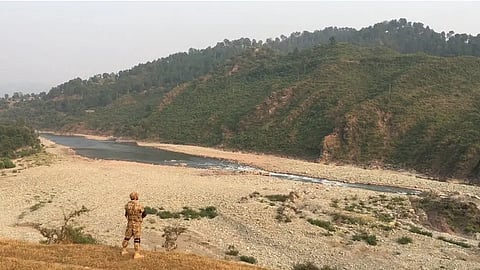


The Line of Control in Jammu and Kashmir is often discussed in military and diplomatic terms. Yet for the families living along it, the reality is deeply personal. It is not merely a boundary on a map. It is a barrier that has kept parents away from children, brothers away from sisters, and grandparents away from grandchildren for decades.
Few recent incidents illustrate this pain more vividly than the death of Raja Liaqat Khan from Keran in the Kupwara district of Indian-administered Kashmir. His siblings and relatives live across the Line of Control in Pakistan-administered Kashmir in Neelum Valley. Despite being only a few hundred yards away, they could not attend his funeral or stand beside him during his final rites.
Instead, family members gathered on opposite banks of the Neelum River. They watched from afar as the funeral prayers took place. Relatives briefly uncovered the deceased’s face from the coffin so his siblings across the river could have one final glimpse of their brother. It was a heartbreaking moment that quickly spread across social media because it captured the silent suffering of divided Kashmiri families.
One of Raja Liaqat Khan’s sisters said that if human-made borders cannot unite families in moments of happiness, they should at least allow them to come together in moments of grief. Her words reflected the emotions of countless families separated across the Line of Control for generations.
For nearly eight decades, many Kashmiri families have lived with this painful reality. In several areas, relatives can see one another across mountains and rivers but remain unable to meet. They live close enough to exchange greetings by shouting across valleys, yet remain cut off by restrictions and barriers.
The tragedy is not only physical separation. It is also an emotional separation. Families are denied the ordinary experiences that define human relationships. They cannot celebrate weddings together, comfort one another during illness, or mourn together after a death.
Over the years, this separation has shaped an entire generation. Children grow up listening to stories about relatives they have never met. They hear about family homes across the river but know them only through memories passed down by elders. They learn very early that distance in Kashmir is not measured in kilometres but in permissions and restrictions.
This separation also creates a deep psychological burden. Elderly parents spend years hoping they will one day reunite with their children and siblings before death overtakes them. Many pass away with that wish unfulfilled. Some families manage to speak occasionally through phone calls or video links, but technology can never replace physical presence. A screen cannot substitute a mother’s embrace or the comfort of sitting beside a grieving sibling.
Intense Pain
For women in divided families, the pain is often even more intense. Mothers are separated from married daughters. Sisters grow old without seeing their brothers. Children born on one side of the Line of Control often know their relatives on the other side only through faded photographs and family stories. Weddings, births, and funerals become reminders not of togetherness but of absence.
Even during festivals such as Eid, divided families often gather along the banks of the Neelum River to greet one another from afar. Some exchange sweets and dry fruits by tying them to ropes or wrapping them with stones and throwing them across the river in the hope that they will reach safely. These small acts reveal how strongly families continue to hold on to one another despite decades of separation.
In earlier years, cross-Line of Control bus services and limited travel arrangements offered some hope to separated families. Though difficult and heavily regulated, these initiatives allowed some relatives to reunite after decades. Elderly parents met children they had not seen since their youth. Brothers embraced after half a century apart. These meetings demonstrated that humanitarian measures can reduce suffering even when larger political questions remain unresolved.
Unfortunately, many of these channels have either weakened or stopped altogether. The result has been renewed isolation for families already exhausted by years of waiting. The younger generation now fears that even the limited possibilities for reunion may disappear entirely.
The suffering of divided families rarely receives the attention it deserves. Public discussions about Kashmir are usually dominated by strategic and political narratives, while the emotional and social realities of ordinary people remain overlooked.
Yet the experiences of these families show that the deepest wounds are often carried inside homes and hearts. The inability to attend a sibling’s funeral or embrace a grieving mother leaves scars that remain for a lifetime.
The story of Raja Liaqat Khan’s funeral should serve as a reminder that humanitarian concerns must remain central when discussing Kashmir. There is an urgent need to restore and strengthen cross-Line of Control humanitarian measures that allow divided families to meet more easily, especially during emergencies, funerals, and major family occasions.
No family should have to watch a loved one’s funeral from across a river.
At its core, the issue is not about geography alone. It is about the basic human need for connection, presence, and dignity. The people living along the Line of Control do not simply seek movement across borders. They seek the right to remain a family.
Have you liked the news article?
Support us now:
https://www.gofundme.com/manage/jammu-kashmirs-sole-independent-voice-under-threat