

Sometime in the second week of June, an elderly man stood at the gate of a locked temple somewhere in the Kashmir Valley and pressed his forehead against the rusted iron. He had not been here in 36 years. He left on a winter night in 1990 with whatever his family could carry. The temple had stood in his absence.
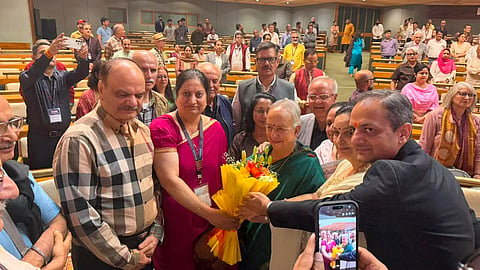
Moments like this were the real story behind the Global Kashmiri Pandit Conclave held at the Sher-i-Kashmir International Conference Centre in Srinagar on June 13 and 14, 2026 but these were not captured by the media. The conference hall is built on the banks of the same Dal Lake that thousands of Pandits once called home.
The event, titled Pragaash, meaning ‘the first light’, was the first of its kind. For a week, displaced Kashmiri Pandits from India, the United States, Europe, and the Middle East toured temples, ashrams, and heritage sites across the valley before converging at SKICC for two days of discussions on return, rehabilitation, and cultural revival. Lieutenant Governor Manoj Sinha called it "a historic moment." Chief Minister Omar Abdullah hosted the visiting delegation for dinner, an act described by the community as "a meaningful step towards reconciliation."
The conclave closed with a resolution calling for a township in Rainawari, one of the historic centres of Pandit habitation in Srinagar, as a hub for returning families. The resolution is heavy on emotion, good optics but leaves more questions than answers.
A Community in Two Places at Once
The numbers behind this story are stark. According to political scientist Alexander Evans, approximately 95 percent of Kashmiri Pandits - between 160,000 and 170,000 people - left the valley in 1990. Today, only 808 Pandit families remain there. Over 62,000 displaced families are still registered as migrants, 40,000 of them in Jammu, surviving on a government sustenance of Rs 2,500 per person per month. Many live in the Jagti migrant colony, 20 kilometres from Jammu city, their settlement there marking their third relocation since 1990.
From Jagti, the conclave looked very different than it did from SKICC.
Members of Panun Kashmir, a prominent community organisation based in Jammu, rejected the event outright, calling it a "recurring exercise" that sidelines the central question of Kashmiri Pandit killings and displacement while presenting a curated image of reconciliation for an overseas audience. Their frustration animated a legitimate question: why were Pandits living in migrant camps absent from the conversation?
This divide exposes a deeper disagreement over what ‘return’ means. For a Pandit professional who has built a career in New York or Pune, visiting Kashmir can mean cultural tourism, a heritage pilgrimage, even a business opportunity. For a family in Jagti who has been relocated three times in 36 years, return is more than a sentiment. It is an urgent, practical need for security, housing, and legal restoration of their properties. The conclave brought together the first group. The second watched from a distance.
The Other Side of the Same Loss
What made the conclave more nuanced was the voice of CM's Advisor Nasir Aslam Wani, a Kashmiri Muslim, who addressed the gathering directly.
"A storm came that affected everyone," Wani said, adding that while Kashmiri Pandits bore the brunt of displacement, Kashmiri Muslims too suffered through three decades of militancy, crackdowns, and instability. His words were not intended to deflect responsibility, but to ask for a shared reckoning. "It would be wrong to hold an entire society responsible for the actions of a few," he said, before announcing plans to revive the Apex Committee on Pandit return. "Kashmir cannot be complete without Kashmiri Pandits."
This was not just political diplomacy. Many ordinary Kashmiri Muslims genuinely want their Pandit neighbours back. The valley's cultural memory is poorer without the Sanskrit scholars, the classical musicians, the Shaivite priests, the poets who once gave this land much of its spiritual texture.
On the street level, reconciliation, though rare, is an evolving phenomenon – taking place in living rooms and in old friendships that survived the distance and politics of hate. However, a serious institutional framework on which this can be structured remains missing.
What Pragaash Must Become
The word Pragaash, like its meaning, was the beginning – the first light that awaits the guarantee of warmth. The conclave, too, is just a beginning and meaningless if the light let in cannot be allowed to become warm enough.
Speeches and resolutions, however sincere, are the easy part. The harder work of restoring properties, ensuring physical security, building homes, reviving the Apex Committee, and bringing the families of Jagti on board requires political will, sustained funding, and patience.
Thirty-six years of absence does not end with a two-day conference. But it has to start somewhere. That beginning imbues some optimism.
Have you liked the news article?
Support us now:
https://www.gofundme.com/manage/jammu-kashmirs-sole-independent-voice-under-threat