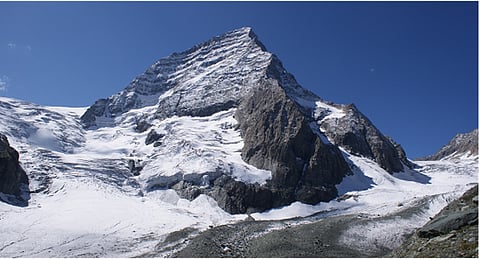


As the world observed Global Glaciers Day on March 18-19, it is worth turning attention to a region where the consequences of glacier loss are neither distant nor theoretical.
In Jammu and Kashmir, the retreat of ice is unfolding alongside a long history of geopolitical contestation, creating a layered crisis that is environmental, social, and strategic at once.
For decades, international discourse on Jammu and Kashmir has been dominated by questions of conflict, sovereignty, and political rights. While these remain central, they have overshadowed a quieter but equally consequential transformation underway in the region’s natural systems. The rapid melting of Himalayan glaciers is emerging as a defining challenge of our time, one that intersects directly with human security, livelihoods, and regional stability.
The Himalayas are often described as Asia’s “water towers,” feeding some of the world’s most important river systems, including the Indus, Ganga, and Brahmaputra. These rivers sustain nearly two billion people across South Asia and beyond. Yet the glaciers that nourish them are retreating at an alarming rate. Scientific assessments warn that, if current warming trends continue, a substantial portion of the Himalayan glacier mass could be lost by the end of the century.
In Jammu and Kashmir, this global trend has already assumed a distinctly local and urgent character. Glaciers such as Kolahoi, once regarded as the lifeline of the Valley’s hydrology, have experienced significant mass loss over the past decades. Estimates suggest that many glaciers in the region have shrunk by 25 to 30 percent since the mid-20th century, with projections indicating that up to 70 percent could be lost under high-emission scenarios.
These changes are not confined to remote mountain landscapes. They are increasingly visible in everyday life. Reduced summer river flows are affecting irrigation patterns, while erratic water availability is disrupting agricultural cycles. Farmers are facing growing uncertainty, with crop yields becoming less predictable and water stress intensifying in both rural and urban areas.
The ecological consequences are equally severe. Changing hydrological cycles are altering the timing and volume of river flows, undermining the delicate balance of ecosystems that depend on them. Wetlands such as Wular Lake are shrinking due to reduced inflows and increased sedimentation, weakening their role in biodiversity conservation and flood regulation. The cumulative effect is a gradual but unmistakable degradation of the region’s ecological resilience.
Vulnerable J&K
What makes Jammu and Kashmir particularly vulnerable is the context in which these environmental shifts are occurring. The region is not only ecologically fragile but also heavily militarized. High-altitude deployments, especially in sensitive areas such as the Siachen Glacier, introduce additional pressures on already stressed ecosystems. Military activities, including troop movements, infrastructure development, and logistical operations, contribute to waste accumulation, fuel emissions, and land disturbance.
These environmental costs are rarely factored into broader climate discussions. Framed within national security imperatives, they remain largely invisible in policy debates. Yet their cumulative impact is significant, accelerating local ecological decline and compounding the effects of global warming.
Alongside militarization, rapid infrastructure development is adding another layer of strain. Road construction, hydropower projects, and tourism infrastructure in glacier-fed basins often proceed without comprehensive climate impact assessments. These interventions disrupt fragile landscapes, alter natural drainage patterns, and increase the risk of landslides. Black carbon emissions from diesel engines and fuel combustion further exacerbate the problem by accelerating glacier melt through increased heat absorption.
The interplay between conflict and environmental stress is not merely coincidental; it is deeply structural. In conflict-affected regions, governance tends to be fragmented, with institutional priorities shifting toward immediate security concerns at the expense of long-term environmental management. As a result, critical areas such as glacier monitoring, water governance, and disaster preparedness often remain underdeveloped.
Governance Gap
This governance gap becomes particularly dangerous in the context of emerging risks such as Glacial Lake Outburst Floods. As glaciers retreat, they leave behind expanding proglacial lakes that are often unstable. A sudden breach can release massive volumes of water, causing catastrophic flooding downstream. In a region where infrastructure is already vulnerable and response capacities are limited; such events could trigger large-scale humanitarian crises.
The lack of coordinated early warning systems and cross-border data sharing further amplifies these risks. Himalayan river systems traverse political boundaries, linking upstream environmental changes in Jammu and Kashmir with downstream impacts across South Asia. This inter-connectedness underscores the urgent need for cooperative environmental governance, even in politically sensitive contexts.
The social dimensions of this crisis are equally profound. Agriculture in Kashmir remains heavily dependent on glacier-fed irrigation. As water sources become less reliable, farmers are forced to adapt to shorter growing seasons and more frequent crop failures. Increased reliance on groundwater is placing additional pressure on already-strained resources.
Livelihood insecurity is intensifying, particularly among communities with limited adaptive capacity. Women, who often shoulder the responsibility of water collection and household food security, are disproportionately affected by increasing scarcity. Climate stress, therefore, is not just an environmental issue; it is also a question of social justice and equity.
When these environmental and social pressures intersect with ongoing political instability, the risks multiply. Infrastructure damaged during periods of conflict can disrupt water systems, while climate-induced disasters can overwhelm already constrained response mechanisms. In such contexts, the distinction between natural and human-induced crises becomes increasingly blurred.
A flood triggered by a glacial lake outburst, for instance, can have cascading effects on transport networks, communication systems, and economic activity. These disruptions can, in turn, exacerbate existing political tensions, creating a feedback loop in which environmental stress and conflict reinforce one another.
Actionable Pathways
Despite the scale of the challenge, the trajectory is not irreversible. There are clear and actionable pathways for mitigation and adaptation. Reducing black carbon emissions, strengthening glacier monitoring systems, and investing in scientific research are critical first steps. The development of early warning systems for glacial lake outburst floods can significantly reduce disaster risk.
Equally important is the integration of environmental considerations into security and development planning. In regions like Jammu and Kashmir, where climate change and conflict are deeply intertwined, siloed approaches are no longer sufficient. A holistic framework that recognizes the interdependence of ecological stability and human security is essential.
At a broader level, the situation in Jammu and Kashmir offers important lessons for other conflict-affected regions facing similar challenges. It highlights how climate change can act as a force multiplier, intensifying existing vulnerabilities and creating new forms of risk. It also underscores the importance of cooperation, both within and across national boundaries, in addressing shared environmental threats.
The melting glaciers of the Himalayas are not just a regional concern; they are part of a global crisis with far-reaching implications. Yet in places like Kashmir, their impact is immediate and deeply felt. The loss of ice is not only reshaping landscapes but also redefining the contours of security, development, and human well-being.
The “ticking bomb” in the Himalayas is not a sudden event but a slow and cumulative process. Its consequences are unfolding gradually, but their scale and intensity are becoming increasingly difficult to ignore. Without decisive and coordinated action, the continued retreat of glaciers in Jammu and Kashmir will destabilize river systems, undermine ecosystems, and intensify human insecurity across South Asia.
If there is one message to carry forward from Global Glaciers Day, it is this: the crisis in Jammu and Kashmir demands urgent attention not only as an environmental issue but as a multidimensional challenge that sits at the intersection of climate, conflict, and human security.
The future of the region will not be shaped by political decisions alone. It will also depend on how effectively we respond to the changing dynamics of its natural environment. Addressing this challenge requires foresight, cooperation, and a commitment to integrating environmental sustainability into the broader discourse on peace and stability.
The costs of inaction will not remain confined to the mountains. They will flow downstream, affecting millions and reshaping the future of South Asia in ways that are only beginning to be understood.
Have you liked the news article?
Support us now:
https://www.gofundme.com/manage/jammu-kashmirs-sole-independent-voice-under-threat