

In my 25 years of reporting from the heartlands of India, I thought I knew what a drought looked like. I have stood in the cracked fields of semi-arid Marathwada region under a punishing 45-degree Celsius sun, watching farmers stare at empty skies while a ‘water train’ is flagged off to carry water to Latur where the Manjara river had gone bone-dry and the groundwater had been sucked dry a thousand feet deep.
For environmental journalists, drought has always been a summer story—a seasonal extremity of heatwaves, withered crops, cracked fields, dry dugwells, and plunged groundwater.
But, a new, silent ‘snow drought’ has been unfolding for the past few years in the high altitudes of the Himalaya, and this ‘winter drought’ of declining snowfall doesn't look like anything we’ve covered before.
Recurring snow droughts have grave repercussions both for the economy and the ecology, as over 50 million in the Indian Himalayan Region and 210 million people in the entire Hindu Kush Himalayan region depend on glaciers, rivers and springs that are replenished by winter precipitation (snowfall and rainfall), which is showing signs of decline.
Snow Drought
Snow droughts are commonly defined as below-average snowpack at a point in time and is linked to global warming. Snow drought is a phenomenon where snow water equivalent (SWE) at a particular site is significantly below average, due to insufficient snow accumulation, either due to low total precipitation, low snow fraction despite near-normal winter precipitation or high snowmelt.
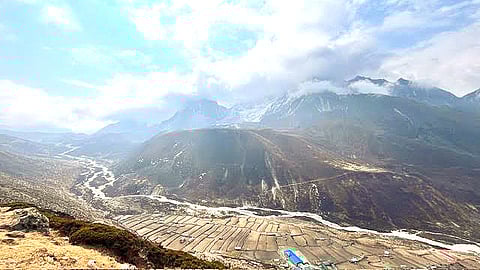
As I write this in mid-January 2026, news is pouring in from various Himalayan states, from the Pir Panjal in Jammu & Kashmir (J&K) to the high peaks of Himachal Pradesh and Uttarakhand, where mountain ranges are eerily bare due to highly deficient winter precipitation. Places like Gulmarg in J&K, which is famously referred to as the ski capital of India, should be buried under several feet of snow during the ongoing Chillai Kalan period of harshest winter, but J&K is yet to receive its proper heavy winter snowfall.
Forest fires have already started in Uttarakhand’s Nanda Devi Wildlife Forest Division in Chamoli district, while the summer season is still two months away. Dry spell and a lack of snowfall has become a serious concern among apple growers in Himachal who are staring at a loss of yield and fruit quality.
Winter snowfall is also the backbone of J&K’s agriculture, horticulture and overall water security, as majority of the orchards are rainfed, and snowfall feeds the glaciers, which in turn sustain springs, rivers, and hydropower projects in the region.
Wither Winter Snowfall?
The India Meteorological Department’s (IMD) seasonal rainfall data shows the crisis of snow drought in the Indian Himalayan Region (IHR).
So far this month, between January 1 and January 14, J&K has reported a deficient winter precipitation of minus 96 per cent. The union territory of Ladakh has had minus 63 per cent deficient snowfall. The figure for Himachal Pradesh is minus 90 per cent, but the worst affected is Uttarakhand with no rain at all in January.
States in north India, such as Punjab, Haryana, and Uttar Pradesh have also reported large deficient winter rainfall this January — minus 80 per cent, minus 86 per cent, and minus 99 per cent, respectively. This is likely to impact the rabi (winter) crops, wheat in particular as winter rains provide gentle, consistent moisture during wheat’s critical germination and vegetative growth phase.
Whereas January has largely remained a dry month so far, the last month of December 2025 was no better. As per the IMD data, Uttarakhand received no rainfall at all, Himachal Pradesh reported minus 99 per cent deficient winter precipitation, and for J&K, and Ladakh it was minus 78 per cent and minus 63 per cent, respectively, in December 2025.
The lack of winter precipitation in the Himalaya isn’t a rare phenomenon anymore. I have been consistently writing about it for the past few years. In January 2018, I wrote how the hill states — Himachal Pradesh, Uttarakhand, and J&K, in particular — are facing a double whammy of rising maximum temperatures and declining precipitation in the winter months. The story has repeated in the subsequent winter seasons and I wrote about it in 2024 and 2025.
Disturbed Pattern of Western Disturbances
The reason behind a decline in winter precipitation is the changing pattern of western disturbances. A western disturbance (WD) is an extratropical storm that originates in the Mediterranean region. An area of reduced air pressure, this disturbance carries moisture from the Mediterranean and Caspian seas east, via the subtropical westerly jet stream. This brings rain and snow to Pakistan and northern India. WDs are, therefore, crucial for the region’s water security, farming and tourism.
But, recent research studies point towards a decrease in both the intensity and frequency of western disturbances. Two years ago, in an interview, Madhavan Rajeevan, a former secretary of India’s earth sciences ministry, had explained to me the changing pattern of WDs and what it means for water security, economy and ecology of the region. The interview was published in Dialogue Earth.
WATCH Interview with climate scientist Dr M Rajeevan
According to Rajeevan, WDs are associated with the mid-latitude jet stream – strong westerly winds at around 12-15 km. The decreasing trend in winter snow or winter precipitation over the region is related to the less-frequent passage of western disturbances. Observations show this jet stream has moved north during the recent winters. It could be related to global warming (which shows everything moving poleward, including monsoons, tropical cyclones) and also Arctic Sea ice melting, said the climate scientist.
Climate modelling as part of a 2019 research study, Falling Trend of Western Disturbances in Future Climate Simulations, suggests a fall in WDs by around 15 per cent by the end of the twenty-first century. This “will cause a decrease in mean winter rainfall over Pakistan and northern India amounting to about 15% of the mean…,” warns the study.
Another 2024 study, has reported that WDs are becoming far more common in May, June, and July, months where they were previously rare. For example, WDs have been twice as common in June in the last 20 years than during the previous 50 years. This is attributed to a delayed northward retreat of the subtropical jet, which historically has occurred before the onset of the summer monsoon.
According to the researchers of the 2024 study, the most important implication is that the frequency of “monsoonal” WDs is increasing significantly, and therefore, due to climate change, catastrophic events like the 2013 Uttarakhand floods and the 2023 north India floods are becoming much more frequent. Another 2023 study has estimated a 43 per cent decline in WDs in north India between 1980 and 2019.
The changing pattern of WDs and decline in snowfall has implications for climate-induced disasters in the Himalaya, such as Glacial Lake Outburst Floods (GLOFs). GLOF is a sudden, catastrophic release of water from a glacial lake, often caused by the failure of ice or rock (moraine) dams, leading to devastating flash floods downstream, particularly in high mountain regions like the Himalayas due to climate change-induced melting of glaciers and decrease in snowfall that feeds these glaciers.
WATCH: Rising GLOFs in the Himalaya
Forecast of Western Disturbances
After a largely dry December and January, there is a forecast of back-to-back Western Disturbances in the coming two weeks, which should provide some respite to the western Himalayan states of J&K, Himachal Pradesh, and Uttarakhand.
According to private weather forecaster Athreya Shetty, three Western Disturbances are likely to affect the Himalayan states. A weak WD from January 16-18; a moderate WD in January 20-21; and a strong WD from January 22-26.
Have you liked the news article?
Support us now:
https://www.gofundme.com/manage/jammu-kashmirs-sole-independent-voice-under-threat