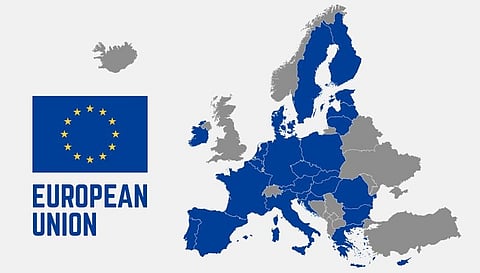


In January 2026, President Donald Trump threatened unprecedented tariff escalations against eight European nations in an effort to pressure Denmark to sell Greenland. European allies declared the move unacceptable and warned of a "trade bazooka" response, marking a dramatic escalation within NATO that threatened key industries and GDP across the continent. Though Trump backed down after NATO talks, the episode has left deep scars.
The tariff threat signals a fundamental shift in transatlantic relations. For decades, European security and prosperity rested on American guarantees. Now, that foundation is cracking. European capitals are scrambling to respond by accelerating defense spending, forging new intra-European security pacts, and questioning whether NATO can survive as currently constituted.
A Continent at a Crossroads
Europe comprises roughly 50 political entities—from continental powers like Germany, France, and Russia to microstates like Vatican City and Monaco. For decades, this mosaic has been held together by two pillars: the European Union's economic integration and NATO's security umbrella.
But that architecture is under unprecedented stress, further accentuated by China's assertive presence, the rise of new intra-European alliances, and the deliberate recalibration of relationships with major South Asian powers like India, Pakistan, and Bangladesh.
The very definition of Europe remains a geopolitical puzzle. The following standard list of nations underscores its inherent complexity:
· The Core EU & West: Germany, France, Italy, Netherlands, Belgium, Luxembourg, Austria, Ireland, Spain, Portugal, Greece, Denmark, Sweden, Finland, Poland, Czechia, Slovakia, Hungary, Slovenia, Croatia, Romania, Bulgaria, Estonia, Latvia, Lithuania, Malta, Cyprus.
· Non-EU West: United Kingdom (post-Brexit), Norway, Iceland, Switzerland, Liechtenstein.
· The Balkans & Southeast Europe: Albania, Serbia, Montenegro, Bosnia and Herzegovina, North Macedonia, Kosovo (partially recognized), Moldova.
· Eastern Europe & The Caucasus Zone: Ukraine, Belarus, Georgia, Armenia, Azerbaijan.
· The Transcontinental Giants: Russia (straddling Europe and Asia), Turkey (a NATO member with a foothold in Thrace), Kazakhstan (with territory west of the Ural River).
This patchwork is more than just a map. It represents profound divergences in historical memory, economic development, threat perception, and geopolitical aspiration. This map has not been unified by the war in Ukraine. Instead, it has been fractured and illuminated by the conflict, resulting in a steep gradient of security apprehension that decreases from Poland's eastern border to Portugal's Atlantic coast. This diversity is Europe's enduring reality and its most persistent strategic challenge.
Europe’s Evolving Relationship with America
For over seven decades, NATO made the United States the guarantor of European security, with the post-Cold War "unipolar moment" cementing this bond as the cornerstone of global stability. But the past decade has witnessed a palpable strategic "drifting", a gradual recalibration driven by forces on both sides of the Atlantic.
The "Pivot to Asia," articulated under Obama and intensified since, signaled a long-term shift toward containing China. Growing domestic impatience with bearing on Europe's defense costs crystallized under Trump, who openly questioned NATO's value and wielded tariff threats against European automakers as economic blackmail over defence spending and Iran policy. This weaponisation of trade shattered any illusion of unconditionality.
Despite Biden's restored diplomatic tone, European capitals received the message: the American security guarantee was becoming transactional. Afghanistan's chaotic withdrawal deepened doubts about U.S. strategic judgment and commitment.
"Strategic Autonomy," once viewed suspiciously in Central and Eastern Europe, has gained urgent meaning. Ukraine's invasion exposed Europe's dire military dependence on America. While NATO has been revitalized, parallel drives for European defense sovereignty have accelerated from theory to procurement reality through initiatives like the European Defence Fund, PESCO, and Rapid Deployment Capacity.
The most dramatic manifestation of this shift is Germany's Zeitenwende (turning point), which was marked by a special defense fund of 100 billion Euros and a commitment to meet the NATO goal of 2% GDP. The ambition isn't replacing NATO but building a credible European pillar that could, if necessary, operate independently.
This drift is a historic recalibration, rather than rupture. The transatlantic relationship remains strong but is becoming more balanced, inevitably giving Europe greater agency as it learns to walk on its own strategic feet, though not yet ready to run alone.
The Dragon in the Room and European Dilemmas
China’s meteoric rise is the other defining tectonic shift of the 21st century. It uses a sophisticated, multi-vector strategy to exploit internal divisions on the continent in its approach to Europe.
With Lithuania's exit and others' downgrading of participation, China's flagship "17+1" engagement platform with Central and Eastern Europe (CEE) has drastically decreased to "14+1", indicating that the entire EU is becoming aware of the political and strategic constraints placed on Chinese investment.
The bloc’s official tripartite characterisation of China as a "partner for cooperation, an economic competitor, and a systemic rival" captures the profound European ambivalence.
European unity fractures visibly on China policy. Southern EU members like Italy, Greece, and Portugal, hungry for investment post-austerity, welcomed Chinese infrastructure spending and port access (notably Piraeus).
A powerful business lobby for engagement and "decoupling-lite" has emerged because of Germany's export-oriented economy remaining deeply entwined with the Chinese market. Conversely, CEE nations and the Baltics, with their fresh memories of Soviet domination, view China largely through a security lens, aligning it with Russian authoritarianism.
To avoid becoming a vassal in a Sino-American cold war, France consistently advocates for a tougher, more sovereign European position.
In the tech cold war between the United States and China, Europe is a key battlefield. Debates over Huawei in 5G networks, Chinese acquisitions in strategic sectors (energy, robotics, AI), and Beijing’s attempts to shape global digital standards place immense pressure on European governments.
The EU’s response—developing toolkits for screening foreign investment, the anti-coercion instrument, and ambitious digital sovereignty agendas—shows a growing, if still fragmented, will to define and defend its own technological future.
China's "no limits" partnership with Russia, which has continued and grown despite Russia's brutal war in Ukraine, may have been the most significant shift. This has fundamentally poisoned Beijing’s image for many Europeans, clarifying that its authoritarian geopolitical alignment often trumps its professed respect for sovereignty and the UN charter.
It has made "de-risking" from China not just an economic imperative but a moral and strategic one for a continent defending a rules-based order in Ukraine.
The Geometry of a Multipolar Europe
The erosion of the post-Cold War order has spurred remarkable innovation in European diplomatic and strategic networking, creating a new, more complex geometry of power.
Poland has emerged as a continental military powerhouse, forging bonds with Ukraine, hosting U.S. forces, and investing heavily in defense. The Three Seas Initiative links 12 EU states from the Adriatic to Black Sea, focusing on energy, infrastructure, and digital connectivity to reduce reliance on Russia and Germany.
Finland and Sweden's NATO accession created a formidable Nordic-Baltic bloc. Through the Joint Expeditionary Force (JEF) with the UK, they present Russia with a united northern flank.
Post-Brexit, the UK re-engages Europe through security, not economics. Leadership in arming Ukraine, its JEF role, and bilateral defense pacts with Poland and others grant influence outside EU structures.
The EU granted candidate status to Ukraine and Moldova—a historic geopolitical move drawing a new frontier. Armenia, disillusioned with Russia, seeks security talks with France, the EU, and the U.S. Azerbaijan, backed by Turkey and Israel, asserts regional power often in tension with European norms.
A problematic NATO ally purchasing Russian S-400 systems, mediating Ukraine grain deals, and assertively seeking a neo-Ottoman sphere of influence in the Balkans, the Caucasus, and North Africa, Turkey, under Erdogan, masterfully plays all sides.
Deemed a pariah and existential threat for most of Europe, Russia’s influence persists through residual energy leverage, pervasive disinformation networks, and its sheer capacity for hybrid disruption in vulnerable regions like the Western Balkans.
The Indo-Pacific Pivot
As Europe seeks to diversify partnerships, secure critical supply chains, and shape the balance of power in the Indo-Pacific, Asia beyond China commands urgent attention. The engagements with India, Pakistan, and Bangladesh reflect a nuanced approach to this critical region.
The long-stalled EU-India trade agreement has gained momentum, driven by strategic logic. India, with its vast market, demographic dynamism, and growing manufacturing, is the premier alternative to China for "de-risking" supply chains. Despite frictions over human rights and India's Russia stance, the partnership is framed as a democratic counterweight in the Indo-Pacific.
The EU-India Trade and Technology Council (2022) aligns on digital governance and resilient supply chains. Cooperation extends to Indian Ocean maritime security, with France as a key advocate due to its regional territories and defense ties with India.
India's FY2026-27 defense budget surged 21.84% to ₹2.19 lakh crore, underscoring self-reliance priorities. Concurrently, the recently signed Washington-New Delhi trade agreement, offering zero-duty access for US goods while Indian exports attract an 18% tariff, presents a complex economic landscape.
Meanwhile, India deepened ties with Saudi Arabia (Doval's February 4 Riyadh visit focused on counter-terrorism) and the UAE (a January 19 pact aims to double bilateral trade to $200 billion by 2032, including defense and LNG deals).
Pakistan seeks enhanced trade and investment, particularly securing EU GSP+ status for preferential exports. Beyond security and Afghanistan, cooperation now includes climate change, digital development, and renewable energy. As an aside, Russia is not mediating Pakistan's tensions with India and Afghanistan, which Pakistan advocates resolving bilaterally as per existing agreements.
Europe pragmatically acknowledges Pakistan's China ties (CPEC) but focuses on areas where European expertise complements Pakistan's development goals.
Kazakhstan President Tokayev’s February 3-4 visit advanced a rail corridor linking Central Asia to Pakistani ports (Gwadar, Karachi) via Afghanistan—a strategic southern gateway reducing transit dependency. Whether Russia is working behind the scenes is not clear.
Europe's relationship with Bangladesh centres on trade, especially garments. As the EU's largest "Everything But Arms" beneficiary, Bangladesh achieved export-driven growth. As it graduates from Least Developed Country status, the partnership is evolving toward sustainable practices and climate adaptation, and encouraging sustainable business practices.
Bangladesh's strategic Bay of Bengal location and economic weight give it growing regional importance. Europe seeks a prosperous, democratic, stable Bangladesh. While governance and human rights concerns exist, the relationship remains forward-looking and economic, focused on maintaining crucial trade ties while encouraging development.
On January 28, 2026, the EU and ACGF launched the €15M MALA II initiative, providing Afghan MSMEs access to digital channels and green finance while strengthening financial institutions and lending. Prioritising returnees, women-led businesses, and agriculture, it builds on the first phase, which supported 55,000+ jobs and raised €68 million.
Challenges in the New World Order
The new multipolar world demands more European unity than ever, yet it actively fuels the forces of disunity. The ability to develop a single strategic response is hampered by the economic divide between the north and south, the east-west divide regarding Russia and China, and divergent perceptions of threats.
Ukraine’s fate is the continent’s defining security challenge, threatening a permanent zone of instability and militarisation along the EU borders, depleting resources and morale for years or a permanent rapprochement.
Through the green transition, strategic autonomy in defense, technology, and energy requires enormous investment. This comes at a time of economic fragility, forcing hard choices between guns, oil, and green transformation.
Simultaneously, democratic resilience is under constant assault from internal populism and polarisation, amplified by external disinformation.
Europe cannot project strength or unity abroad if it is divided at home.
Opportunities to Seize
The relentless pressure of events may eventually result in a European actor that is more cohesive, capable, and strategically aware.
The urgent break from Russian fossil fuels has turbocharged Europe’s green transition, positioning it as a potential global leader in renewable technology. Similarly, the push for digital sovereignty, while challenging, could spur innovation and a more robust homegrown tech ecosystem.
Europe, with its dense web of relationships—from the U.S. and UK to the Nordic-Baltic bloc, from the Western Balkans to emerging partnerships in the Indo-Pacific—is uniquely positioned to act as a connector, mediator, and rule-setter in a fragmented global system. Its experience with complex integration is a unique form of power.
The EU's single market continues to be a potent instrument. It has the power to regulate far beyond its borders thanks to its ability to establish international standards in environmental sustainability, competition law, data privacy (GDPR), and competition law.
A Continent at a Strategic Crossroads
From the microstates guarding their neutrality to the transcontinental giants navigating multiple identities, every European entity is being compelled to choose, adapt, and navigate an increasingly treacherous and competitive landscape in a volatile multipolarity.
The continent’s future hinges on a single monumental question: Can it reconcile its profound internal diversity with the existential imperative for strategic cohesion? To elaborate: Can France's geopolitical ambition and Germany's economic pragmatism coexist seamlessly? Can the urgency of Poland's frontline conflict with Italy's priorities in the Mediterranean? Can the EU integrate its eastern frontiers while managing a belligerent Russia and an opportunistic Turkey?
The strategic "drift" from America is not a descent into isolationism but rather a difficult journey toward a life that is more self-reliant, complex, and networked. This new, challenging reality has many facets, including the deliberate engagement with India, the nuanced recalibration with Pakistan, the development partnership with Bangladesh, Afghanistan, and others, the cautious management of China, and the constant containment of Russia.
Europe is no longer just a place where history is told or where other people compete. Once more, it is being forced to actively and firmly control its own destiny. Its success or failure will shape the nature and balance of the new world order about to emerge.
Have you liked the news article?
Support us now:
https://www.gofundme.com/manage/jammu-kashmirs-sole-independent-voice-under-threat