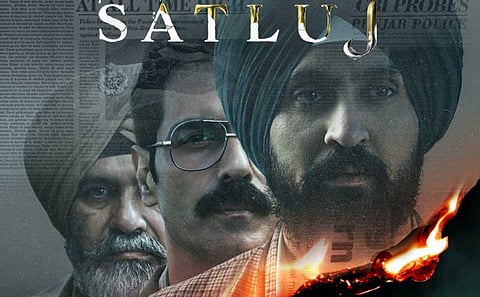


The film Punjab 95, rechristened as ‘Satluj’, was broadcast on the OTT platform Zee5 for just two days after being on the Central Board of Film Certification's (CBFC) chopping board for almost three years. Its brief release and abrupt removal from the platform have once again raised chilling questions around the role of censorship in a democracy like India: it is no longer about regulating content, it is about erasure.
The CBFC demanded a staggering 127 cuts to the film, including the removal of references to places where events took place, such as Tarn Taran, Patti and Durgiana, the number of people presumed killed (some estimates report as high as 25,000 people), the Gurbani, Punjab Police, the Indian flag, and crucially, the name of Jaswant Singh Khalra himself. As the film’s director Honey Trehan noted, the role of the CBFC should be “to certify films, not to control the narrative.”
Ultimately, though the film was released on the OTT platform without any cuts, the Indian state argued that it ought to be restricted, reasoning that it might be weaponised against the nation, hurt national security, or portray a negative image of our democracy, and ordered its immediate removal. Whatever the reason, the state made a moral determination on behalf of its citizens, about what material its constituents can and cannot engage with.
Memory as Resistance
Much of the subsequent debate that followed the film’s abrupt removal has rightly focused on the state’s disavowal of violence and repression it engineered on its own citizens, the role of cinema in holding the state to account, questions of justice, views of Punjab and Punjabis in the national imagination and so on. But a more profound question remains: when the state orders an entire era to be forgotten, what work does memory do in creating the space to remember?
Pierre Nora’s concept of lieux de memoire (sites of memory) describes that when a state uses its moral authority to mandate what citizens remember and how they remember, memory ceases to be a passive recollection of the past and transforms into an active site of resistance. It acquires what Nora terms a ‘spatial’ character, and becomes attached to places, institutions and cultural phenomena which shape how the past is remembered in the present.
Lieux de memoire arise when memory and history exist at odds with one another – at sites where history persists but memory emerges from the consciousness of a break with the past. Nora goes on to say that there is no space in the modern world for both history and memory to exist simultaneously, for history’s role is to annihilate what has in reality taken place, rather than exalt it. This is especially true of nations where history is used to “engineer” the past.
Erasing Architectures of Violence
In trying to respond to the “historiographical anxieties” that arise as a result of the tension between memory and history, nations look for and suppress those stories that complicate this task, only to fall victim to the memories they seek to master.
It is precisely these historiographical anxieties to which India has succumbed time and again, in trying to erase memories of the many violent pasts that have shaped this democratic republic. It is also what drove the censorship of Satluj, and the explicit demand that the names of places, Gurbani, Punjab police and even Jaswant Singh Khalra, be scrubbed from the film.
In laying bare the spaces where the state sculpted its architectures of violence – Khalra’s home from where he was abducted, everyday places from which young men were disappeared, the sanctum sanctorum of Sri Harmandir Sahib where hundreds were martyred, institutions of the state such as police stations where Punjabis were tortured and crematoriums where the dead were denied dignity – Satluj resists the sanitization of these lieux de memoire. It prevents the stripping away of those collective memories from these sites that give life to communities resisting forgetting, keeping the Punjab of a democratic Indian imagination anchored to the Punjab of the 90s, where state violence has so thoroughly suffused the landscape.
The Whispering Fields
As Mallika Kaur writes poignantly in her brilliant book, Faith, Gender, and Activism in the Punjab Conflict: The Wheat Fields Still Whisper (Palgrave Macmillan), even Punjab’s wheat fields carry whispers of these memories. In the process, the film that must “no longer be seen” has taken on a life of its own– it has been distributed freely online, screened in villages across Punjab, and has acquired an almost sacred character.
It has itself become a lieu de memoire– a monument of memory which history tried but failed to annihilate.
Have you liked the news article?
Support us now:
https://www.gofundme.com/manage/jammu-kashmirs-sole-independent-voice-under-threat