

For decades, Jammu and Kashmir has been an unimaginative state of an imaginary nation. Unimaginative, because her existence has been narrated only through the lexes of insurgency and bloodshed. Imaginary, because her elder siblings simply want her to exist on borrowed grammar of cartographic imagination. Yet, behind this facade of unimaginative and imaginary lies another story- the story of invisible labour. Both state and non-state violence have historically conspired to obscure the biggest violence - the violence of affluence.
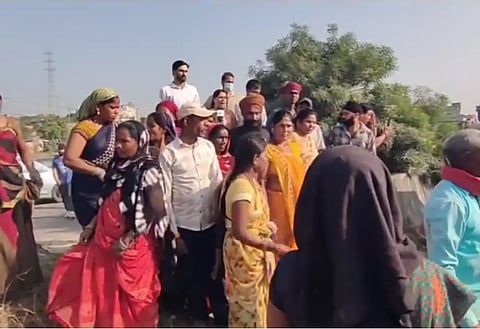
But just few weeks back, something odd occurred. The Narwal area of Jammu became a defiant stage as hundreds of migrant labourers from Uttar Pradesh, Chattisgarh, Madhya Pradesh, Odisha and Bihar marched through the streets demanding their share of recognition. Their demands were very simple but politically charged. They wanted domicile status and a claim to the land where they have lived and worked for over two or three decades.
Narwal protest was initially a response to routine eviction drive, one of many that the Jammu administration conducts against what it terms ‘encroachments.’ According to a study by Majid Farooq and Fayma Mushtaq, nearly one-fourth of the slum dwellers possess some form of legal documentation validating their right to stay. Around 44% live in rented homes, while about 28% occupy encroached public land. A small fraction resides on encroached private property. Many of these clusters stand on government-owned plots, precariously balancing existence between legality and survival.
What started as an administrative action soon turned into a protest. Slum-dwellers resisted eviction, blocked roads and raised slogans. Their message was simple: ‘We are part of Jammu.’
As camera crew arrived and visuals circulated across social media, an invisible border was drawn on the map of belonging. There was a flurry of online reactions. As per these reports, about 78% of responses dubbed the protesters as ‘outsiders’ and urged the administration to ‘throw them out of Jammu.’ Many framed the issue as parochial pride. ‘Jammu belongs to Jammuites.’
A small percentage disagreed with this internet indignation. It claimed that the migrants' goals aligned with the national commitment made in 2019 when Article 370 was repealed. The idea of ‘One Nation, One Constitution’ popped up in this straightforward online discussion. If Jammu and Kashmir genuinely asserts its claim to be a part of India, then Indians who have lived there for a long time shouldn't still be treated as outsiders.
Contested Citizenry in Post-370
A new domicile law was introduced by the central government in 2020, a year after article 370 was repealed. According to the law, non-state subjects could apply for domicile certificates if they had studied or resided in the Union Territory for at least seven years. The goal of the change was to make the promise of equal citizenship a reality. More than 83,000 domicile certificates have been granted to non-state persons by April 2025, according to government data. However, such numbers only provide a piece of the puzzle.
A ladder of access can be found beneath the statistics. Resourceful people, such as professionals, contractors, and business owners, had little trouble navigating the bureaucratic labyrinth. However, the procedure has been humiliating and exclusionary for the majority of migrant workers.
Daily wagers frequently wait for hours outside tehsildar offices only to be rejected away for not having the necessary paperwork or ‘proper’ proof of residency. Most are too poor to pay middlemen. They are also unaccustomed to using internet applications. In this situation, bureaucratic exclusion turns into a continuation of social invisibility.
Making of Jammu and Labour
If not Jammu's economy, Jammu’s lifeline is largely dependent on migrant labour. Though the state fares as a better performer in terms of minimum wages, the living conditions of these migrant workers are far from gladdening. There is a steady flow of workers from Uttar Pradesh, Bihar, Chhattisgarh and Odisha and they contribute to the city's unofficial economy by working at homes, shops, hotels and construction sites.
The majority live in temporary tents, tarpaulin-covered shelters or deserted and empty plots without access to clean water or toilets. The repeal of Article 370 was viewed by many as an opportunity for permanent residency in Jammu.
On the other hand, several Jammuites now see the abrogation of Article 370 with suspicion- as an abstract political event. Between, optimism of migrant workers and pessimism of Jammuites, lies a new exasperation.
Precarity amidst ethno-nationalism
As the Narwal protest took place, regional pride served as the foundation for the exclusion of these precariats. Most remarks on the internet were slurs or abuses directed against migrants.
It repeated fears about cultural dilution with language like 'Dogra identity' and 'preserving Jammu's demographics'. Under the pretext of ethno-cultural assertion, this thread frequently masks caste and class bias. There was a patriotic recommendation too- ‘these migrants must settle in Kashmir.’
In light of this, the Narwal protest is more than just an ignored cry for governmental recognition. It is a tenacious aspiration for recognition in a system that benefits from migrant labour but ignores it. Citizenship in post-370 Jammu is no longer a legal system.
It is the site of struggle between belonging and documentation. For most workers of Hindi hinterland, the slogan ‘One Nation, One Constitution’ has become a postponed dream.
Marx makes a profound statement in The Capital: ‘Where labour in the black skin is branded, labour in the white skin cannot emancipate itself.’ He was referring to the existence of slavery in the American South, how it disfigured the fight for free labour in the North.
The same reasoning holds true for Jammu after 370, where the people who construct the city's houses and sweep its streets are still not part of the civic imagination. Those who build the city's walls are excluded from its interior.
Jammu’s protest for permanent residency exposes nationhood’s hollowness and seeks an answer. If the region belongs to India, why can’t its people fully belong to it?
Have you liked the news article?
Support us now:
https://www.gofundme.com/manage/jammu-kashmirs-sole-independent-voice-under-threat