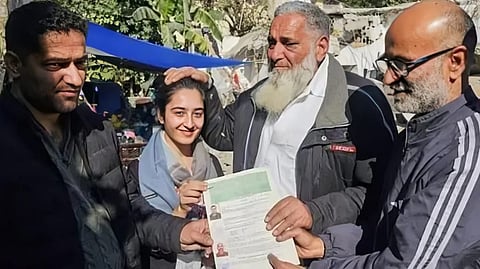


A single act of kindness that sparked a chain reaction of generosity and communal harmony in Jammu and Kashmir offers a masterclass in building bridges, fostering conciliation, solidarity, and peace. What no political decree or peace treaty could achieve, the story of a piece of land - 5 marlas (1350 square feet), to be precise – has done, as a powerful, organic model of what can be termed as 'Supra-Inter-Ethno-Religious Solidarity.'
A Journalist’s Plight and a Stranger’s Gift
The narrative finds its origin in the ordeal of Arfaz Daing, a social-media journalist originally from the Chenab Valley. According to him, his critical reporting led to the demolition of his father's home in Jammu city by the Jammu Development Authority allegedly in violation of norms.
In a region where the media often walks a tightrope, Daing’s situation symbolised the vulnerabilities faced by those who speak truth to power. The loss of a home is more than a material catastrophe. It is an assault on dignity, honour, security and the very sense of belonging.
Kuldeep Sharma, a Dogra Hindu from Jammu, saw Daing, not as a Muslim but a fellow human in profound distress. His response was astonishing in its simplicity and depth. He gifted Arfaz Daing 5 marlas of his own land (approximately 1350 square feet). In one stroke, with humanity as the pivot, he dismantled the decades of manufactured polarisation and hate, transcending the typical binaries of ‘us and them’.
Compassion Begets Compassion
If Sharma’s act was the spark, what followed was a fire of empathy that leaped across the region’s complex human geography.
First, a Kashmiri businessman from Pampore, upon hearing of Sharma’s generosity, in a magnificent gesture of reciprocity and respect, offered one Kanal of land (20 marlas) to Kuldeep Sharma. A one-way act of charity was turned into a loop of giving that brought two communities together.
Then, Mohammad Iqbal from Shopian in South Kashmir, a sub-region that has seen significant turmoil, stepped forward. He offered another 10 marlas of land to Kuldeep Sharma, deepening the investment in this nascent bond. But the chain did not end there. Witnessing this extraordinary exchange, Narender Singh from Ramban in Jammu province offered 5 marlas of land to Mohammad Iqbal.
This series of transactions is unlike any the real estate market has ever seen. No money changed hands. No contracts were driven by profit or strategic gain. The currency was compassion; the collateral was trust.
Each participant, representing different religions, religiosities, ethnicities (Dogra, Kashmiri), and two divisions (Jammu and Kashmir) became both a giver and a receiver in a sacred economy of solidarity. A new social fabric was woven, thread by thread, deed by deed.
The Historical Canvas
To appreciate the seismic nature of these gestures, one must understand the historical and political weight of the land on which this amazing story of generosity and bonhomie occurred.
Jammu and Kashmir has been the epicenter of geopolitical conflict, territorial disputes, and internal strife for over 78 years. The narrative post-1947 has often been dominated by discord, violence, and a painful process of integration, overshadowing the centuries-old traditions of syncretic culture that defined life - a civilizational fabric shaped by Hindu, Buddhist, and Muslim influences; and nurtured by the grammar of love and harmony with togetherness.
The decades that followed saw conflict, armed revolt, militarisation, and deep psychological wounds. Public discourse, both local and national, became saturated with security paradigms, political binaries, and narratives of suspicion.
Communities that had coexisted found themselves pulled apart by fear and politics. In this context, the individual human being, despite an innate capacity for empathy, often became invisible, reduced to a mere demographic datum in a larger game.
The acts of Sharma, the businessman from Pampore, Iqbal, and Singh are therefore a radical reclamation of that stolen humanity. They represent a conscious, grassroots-level undoing of imposed divisions.
This new human matrix suggests that while political histories can dictate terms of separation, the human heart is a magnanimous agency for writing the novel human history of connection. This matrix is not based on treaties or constitutional provisions alone, but on the far more durable foundation of interpersonal trust and moral courage.
Deconstructing 'Supra-Inter-Ethno-Religious Solidarity'
This episode offers a concrete, practicable concept that moves beyond vague calls for "peace and harmony." Supra-Inter-Ethno-Religious Solidarity is a term worthy of unpacking, beyond verbosity.
The concept does not pretend these differences are insignificant. It proves they are not insurmountable. This solidarity is practicable because it is demonstrated through tangible action, the gift of land, the most concrete symbol of rootedness and patrimony.
It is not expressed merely in words, social media posts, or symbolic gestures, but in the voluntary relinquishment of a tangible asset for the benefit of a perceived 'other'. This moves solidarity from the realm of sentiment into the realm of sacrifice, giving it immense moral authority and transformative power.
The Deeper Psychology
The choice of land as the medium for this solidarity is profoundly significant. In Jammu and Kashmir, as in many parts of the world, land is not only the marker of identity, history, and security but also a legacy. It is the most fought-over resource, the source of countless legal and familial disputes.
To gift land is to gift a piece of one’s own history and a stake in the future. It is the ultimate act of trust, saying, "You belong here, with us."
This chain reaction also reveals a fundamental psychological truth. Goodness is contagious. Witnessing extraordinary virtue can trigger a powerful desire in others to elevate their own moral conduct.
When Kuldeep Sharma acted, he set a new social benchmark. He inadvertently issued a challenge. This is the standard of our humanity! Who will meet it? The Kashmiri businessman, Iqbal, and Narender Singh each rose to that challenge, not out of obligation, but out of inspired emulation. They participated in a collective performance of the highest human ideals.
Furthermore, this occurred in an age of digital connectivity. While social media is often a cauldron of hate, here it played a role in spreading the story, allowing acts of localised goodness to inspire others across the region. It created a virtual community of witnesses, amplifying the positive feedback loop of compassion.
A Blueprint for Fractured Societies
Jammu and Kashmir has, through this spontaneous episode, gifted the world an incredible lesson. From Gaza to Tel Aviv, from Moscow to Kyiv, from Myanmar to the streets of polarized Western democracies, societies grapple with the ghosts of ethnic and religious conflict.
The standard toolkit includes truth and reconciliation, ushering in auto-frameworks, opening the new windows for the interfaith dialogues, and social reforms. All are crucial. Amidst this. Jammu and Kashmir’s new organic model highlights a vital component - the power of unstructured, person-to-person, material sacrifice, with a measure of sustainability.
This is a blueprint that bypasses institutions and directly targets the human heart. It suggests that healing must be interpersonal and mutual to be durable. It shows that reconciliation is not just about the victim and the victimiser but can also be pioneered by bystanders who choose to become "upstanders."
The lesson is that while political solutions address structures, human solutions address souls. Lasting peace requires both. The new human matrix emerging in J&K is a living network of soulful connections, a resilient web that can withstand political shocks because it is built on the voluntary choice to see and affirm the other.
The Ultimate Triumph
The story ends where all great human stories aspire to end, with the triumph of humanity. What mattered is humanity, which ultimately wins.
Kuldeep Sharma and the others involved are not just philanthropists; they are architects of a new moral landscape. They have demonstrated that the most potent force against the machinery of division is the simple, audacious act of unconditional giving. They have shown that solidarity, when it becomes supra-identity, possesses a revolutionary power to reshape narratives and forge new bonds.
In the rugged, beautiful, and often troubled terrain of Jammu and Kashmir, a handful of people have planted seeds of hope, literally in the soil itself. They have reminded us that the land which bears witness to conflict also holds the capacity to nurture connection.
While the story needs to be celebrated, it offers a practical concept for a futuristic blueprint for Jammu and Kashmir and the larger South Asian region - by placing shared humanity above all else, ordinary individuals can build a powerful model of solidarity.
Have you liked the news article?
Support us now:
https://www.gofundme.com/manage/jammu-kashmirs-sole-independent-voice-under-threat