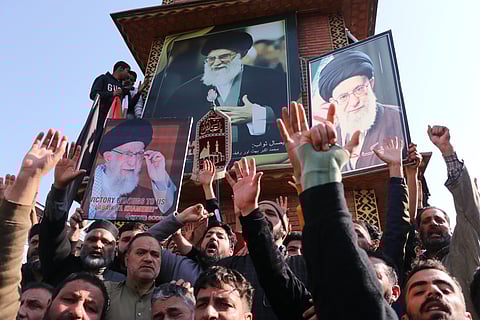


As tensions rise between Iran, Israel, and the United States, most global commentary has centred on missiles and military alliances. Yet for regions like Kashmir, far removed from the battlefield, the more immediate danger lies in economics. Wars in the Gulf do not stay confined to the Gulf. Their tremors are felt in energy markets, labour corridors, and trade routes that connect distant economies. For Kashmir, whose fragile economy is deeply intertwined with Gulf markets, the consequences could be severe.
At the heart of the crisis lies the Strait of Hormuz, through which nearly a fifth of global oil and gas exports pass each day. Any disruption in this narrow maritime artery would send energy prices soaring. For energy-importing economies like India, even modest spikes translate into higher fuel costs, rising inflation, and pressure on public finances. In Jammu and Kashmir, where economic recovery remains uneven and unemployment is high, such price shocks would quickly erode household purchasing power.
But the impact would not be limited to fuel bills. The Gulf is not only a supplier of energy to South Asia. It is also a major destination for labour and a crucial export market for traditional industries. For decades, remittances from Gulf-based workers have supported families across the subcontinent. Economic instability in the Gulf, whether through falling revenues, security concerns or reduced investment, could weaken labour markets and slow remittance flows. Even small contractions can ripple through dependent communities.
For Kashmir, the connection is even more direct. The Gulf remains one of the most important overseas markets for Kashmiri handicrafts. From hand-knotted carpets and Pashmina shawls to papier-mâché artefacts and walnut wood carvings, a substantial share of high-value exports finds buyers in the United Arab Emirates, Saudi Arabia, Qatar, and Kuwait. Affluent Gulf consumers and retailers have long provided a steady demand for these labour-intensive crafts.
Any prolonged conflict in the Gulf region threatens this demand. Rising insurance premiums, disrupted shipping lanes, and currency volatility would complicate trade logistics. Retail spending in Gulf economies, closely linked to oil revenues and investor confidence, could soften if uncertainty deepens. For Kashmiri artisans already grappling with shrinking margins, competition from machine-made imports, and fluctuating tourism flows, another external shock could prove destabilising.
There is also a psychological dimension to markets. Conflict dampens consumer confidence. Investors postpone expansion. Importers reduce orders. Even without a formal blockade of Hormuz, the mere risk of escalation can raise freight costs and delay consignments. For small exporters in Srinagar or Anantnag, such uncertainty disrupts cash cycles and stalls production.
Beyond trade and remittances, the broader macroeconomic picture adds to the concern. India is among the world’s largest energy importers. Sustained spikes in crude oil prices widen trade deficits and strain the rupee. A weaker currency makes imported raw materials more expensive. Many handicraft producers rely on imported dyes, chemicals, and packaging materials. Rising input costs without corresponding increases in export prices squeeze profitability.
Inflationary pressures also reduce discretionary spending domestically. When essential commodities become costlier, households cut back on non-essential purchases. Luxury crafts and high-end textiles often fall into that category. Thus, a conflict thousands of kilometres away can indirectly shrink local markets as well.
Stability is economically essential
Amid these risks lies an underappreciated lever: Gulf financial power. The sovereign wealth funds of Saudi Arabia, the United Arab Emirates, Qatar, and Kuwait collectively manage trillions of dollars in global assets. These funds are deeply embedded in Western markets, technology firms, and infrastructure projects. Their investment decisions carry weight. If instability threatens their long-term diversification strategies, Gulf policymakers have strong incentives to push for de-escalation. War raises defence spending, disrupts tourism, and clouds investment planning. Stability is not merely desirable for them; it is economically essential.
In an interconnected world, capital flows shape geopolitics as much as military deployments. Adjustments in investment strategies, slower allocations or shifts in partnerships can send subtle but powerful signals. Economic recalibration has historically nudged major powers toward negotiation when escalation proves too costly.
For Kashmir, however, hope alone is not a policy. New Delhi cannot afford to treat these vulnerabilities as peripheral concerns. For years, Kashmir’s economy has been managed largely through a security lens rather than a coherent economic strategy. Structural fragilities in trade diversification, credit access, and export resilience were visible long before the present Gulf crisis. Little has been done to build buffers against precisely this kind of external shock.
The handicrafts sector continues to operate with limited institutional backing, inconsistent credit availability, and weak integration with diversified global markets. E-commerce platforms remain underdeveloped, export promotion is fragmented, and artisan welfare schemes are uneven in implementation. In times of global calm, these weaknesses are less visible. In moments of geopolitical turmoil, they become painfully exposed.
If energy prices spike and Gulf demand contracts, ad hoc relief packages will not suffice. What is required is a long-term economic vision that treats Kashmir not as a subsidy-dependent frontier but as a competitive export economy. That means sustained investment in market diversification beyond the Gulf, easier working capital for small producers, logistics reform, and policy mechanisms that shield vulnerable sectors from currency and fuel volatility.
Stability in the Gulf is not an abstract strategic objective debated in distant capitals. It is directly linked to livelihoods in the Valley. Ignoring that connection would be an error with measurable economic consequences.
The unfolding Iran-Israel-US confrontation may appear distant from Dal Lake or the workshops of downtown Srinagar. In reality, the threads are tightly woven. When oil tankers slow in the Strait of Hormuz, the looms of Kashmir feel the tremor. In today’s global economy, geography offers little insulation. Stability in the Gulf is not just a Middle Eastern concern. It is a lifeline for fragile economies like the one in Kashmir.
Have you liked the news article?
Support us now:
https://www.gofundme.com/manage/jammu-kashmirs-sole-independent-voice-under-threat