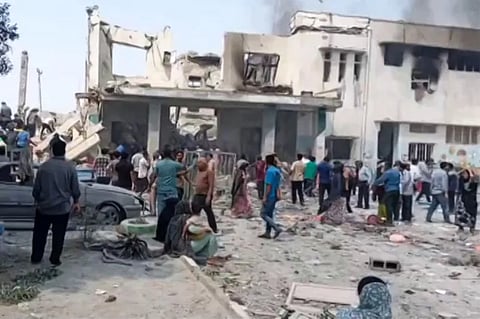


The US and Israel attacked Iran on Saturday morning. The immediate thoughts that came to mind were not only how fast this would escalate and inflame the Gulf region, and perhaps, beyond, but also whether diplomacy means anything at all to Washington.
The timing of the bombs falling on Iran is crucial. What was the immediate provocation? Less than two days after the US-Iran talks ended in Geneva inconclusively but on what observers cautiously described as a promising note, the US and Israeli forces launched coordinated strikes on Iranian territory. Peace and diplomacy were still options remaining on the table when the military strikes were preferred.
This recklessness is cold and calculated. The recent past is evidence. In June 2025, the United States struck Iran just ten days after negotiations had opened a diplomatic window, even if narrow. The US is repeating history with theatrical cruelty, raising questions about its diplomatic credibility. Can it be trusted as a negotiating partner?
A History of US-Iran Relations
In the absence of a rational explanation to the unprovoked military strikes, US president, Donald Trump, rambled, as usual, using decades of US-Iran antagonism as a shield. He profusely listed Iran’s nuclear ambitions and the long and poisoned history between the two nations. The world is supposed to believe that this historical grievance is a legitimate justification, to absorb that an uncomfortable past can permit the use of brute power.
The pieces of history that Trump relies on reveal selective amnesia. The antagonism between Washington and Tehran stretches back to 1953, when a CIA-backed coup overthrew Iran's democratically elected Prime Minister Mohammad Mosaddegh and the once-deposed monarch was back into power as Shah. In the following years, the US encouraged the nuclear ambitions of Iran and provided Iran with a nuclear reactor and uranium to fuel it, even as Shah’s regime became notorious for its tyranny on Iran’s citizens.
The 1979 Islamic Revolution deposed the US-backed Shah is deposed, and Ayatollah Khomeini took power, signalling a reversal of the bonhomie between the two countries and reframing the nuclear question.
A year later, the US faced one of its biggest challenges when Iranian students broke into the US embassy in Tehran and kidnapped 52 Americans for 444 days in protest against admitting the exiled Mohammed Raza Pahlavi, leading to the snapping off diplomatic ties with Iran and imposition of sanctions on the country.
Through the 80s, the US backed Saddam Hussein-led Iraq against Iran, resulting in prolonged war, only to turn against him when Iraq invaded Kuwait. This animosity deepened when US invaded Iraq on wrongful pretext of ‘weapons of mass destruction’ in 2003, deposed Saddam, captured him and sentenced him to death in a trial that remains lop-sided.
Back to Iran, it faced decades of sanctions, proxy conflicts across the region till US president Barack Obama initiated high-level talks with Iran. Years of multilateral negotiation produced the landmark 2015 Joint Comprehensive Plan of Action (JCPOA), but Trump unilaterally abandoned it in 2018 during his first presidency, triggering Iran to abandon its own commitments in turn.
History does not only show the scale of animosity and the perceived threats from Iran, a correct reading within a context also demonstrates the American inconsistency. And, that’s more a cause for concern.
Diplomacy Versus Power
From being a superpower to the only hegemon on the globe for decades, US as a more powerful stakeholder, was obligated to pursue with much greater maturity the goal of de-escalation with diplomacy and consistency. Its actions become a legitimate thumb rule for the rest of the world, giving any nation with sufficient firepower to strike the less powerful without provocation.
This raises another crucial question: What use is the power of the most powerful nation in the world if it can’t stop existing wars – from Ukraine to Palestine – but ignite more sparks to inflame the globe?
The question is not just rhetorical and moral. It is triggered by the ground reality that is being shaped by imbalanced and unprincipled geopolitics in today’s world. The conflict in Ukraine has completed four years with peace proposals that dissolve like specks of dust in a vast ocean of rivalry and rigidity.
The bombardment of Gaza continues relentlessly, shocking the world’s conscience and compelling the International Court of Justice to declare Israeli prime minister, Benjamin Netanyahu as guilty of war crimes and crimes against humanity. Yet, there is a timid silence from the international institutions and the international leaders, even the abject or tacit approval of turning Gaza into a mass of rubble.
Earlier this week, fighting broke out between Pakistan and Afghanistan. Last year, peace in South Asia was threatened when Pakistan and India were engaged in a four-day-war.
The rules-based world order, if it ever existed, appears dead. On its wreckage comes the strikes on Iran.
Immediate Threats
As an immediate consequence of the strikes in Iran, the fire is spilling to rest of the Gulf with Iran resorting to retaliatory strikes, with missiles landing in Qatar, Saudi Arabia, Bahrain and UAE, once again pushing the region to the brink. If this continues, it will threaten and devour human lives who will soon be forgotten about as ‘collateral damage’, irrespective of which gun or bomb killed whom.
If one were to factor in the nuclear threat in this deteriorating landscape, the world appears to be at an existential threat. The New Strategic Arms Reduction Treaty (New START) between the US and Russia ended last month without renewal. The two countries with the two largest nuclear arsenals in the world no longer have any caps on the limits of nuclear stockpiles or an inspection regime. The nuclear non-proliferation regime, which was always fragile and kept the world on tenterhooks, is now openly strained.
The world has moved a long way since Hiroshima and Nagasaki were bombed. Nuclear capabilities have expanded across the globe horizontally and vertically, making the dangers of a future possible strike far worse than what was witnessed in 1945. Throw into this the entry of Artificial Intelligence into military combat.
In such a scenario, any convergence of AI with nuclear infrastructure, along with a cocktail of misadventure, miscalculation, or an error, could turn the world into ashes. We’re not staring into an abyss. We’re looking into an apocalypse. It’s only a matter of timing, even if the world can cobble up a pause for now, unless and until we can reimagine a truly genuine rules-based world order and sustainable diplomacy.
Have you liked the news article?
Support us now:
https://www.gofundme.com/manage/jammu-kashmirs-sole-independent-voice-under-threat