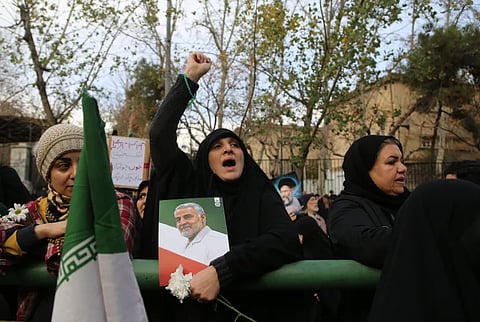


Iran returns once again to global headlines with images of fiery streets, irate mobs and a state attempting to suppress dissent. Liberal commentators are wont to read it as the last nail in the coffin of a theocratic regime, while the West dreams of controlling the Middle East and the Central Asia via Iranian upsurge. Such desires, however, do no justice to a historically layered political formation.
If suspended politics has any taker, it is Iran. Neither fully open nor fully closed. Neither conventionally democratic nor simply autocratic. This unresolved status has shaped Iranian politics and keeps unsettling both internal governance and external perception.
Its regional identity is further complicated by a troubled relationship with the Arab world, marked by cultural differences and geopolitical rivalry. Iran has mostly remained an outsider even with Islamic tinge. It is too defiant for Western incorporation and too distinctly Persian for Arab alignment.
Historically called ‘Ajam’ - The East of the Arab, Iran’s otherness gives to it a liminal position with sharp political ambiguity. In ‘The End of History,’ Francis Fukuyama attributed to Iran an unconventional democratic impulse that resisted easy dismissal. Samuel Huntington, likewise, identified Iran as a unique faultline. Even he could not neatly categorise it as either Islamic or non-Islamic.
If this reading holds, then the Islamic world itself emerges as a heterogeneous political and civilisational space, not the monolithic entity often imagined via clash of civilisations or the end of histories. It is precisely this heterogeneity that makes Iran a perennial topographical object of desire.
‘Princely’ Shifts
Let us revisit the major breach of 1925, long before the Islamic Revolution (1979), when the Pahlavi dynasty succeeded the Qajar regime. This shift was not a product of the sovereignty of the people, but rather of elite consolidation supported by imperial goals.
The senior Shah was simply a British imperialist protégé. History appears to be folding back on itself, as the same Pahlavi bloodline emerges in present political discourse in the person of a self-proclaimed democratic ‘Prince,’ Mohammad Reza Pahlavi II, who seeks a new political afterlife.
The democratic label that has been besotted on him is instructive in/of itself. He represents a familiar type of power for the United States and its allies, what Jurgen Habermas refers to as the ‘Refeudalisation’ of the public sphere, where democratic phrases conceal the return of hierarchical authority within capitalist modernity.
In this way, the ‘Prince’ serves more as a representation of a feudal-capitalist system repackaged for liberal consumption than as a democratic alternative.
Even though he is no longer in power in Iran, Mohammad Reza Pahlavi continues to be used as a stand-in for the Islamic Republic in international political and media narratives. This interest is instructive.
Rallying behind aristocratic nostalgia seems remarkably comfortable for many who claim to be committed to liberty, equality, and fraternity. Because of the comforts of exile and the strategic aspirations of global dominance, the conflict between democratic principles and hereditary authority remains largely unexamined.
The ‘Prince’ lives too far from the material concerns that dominate Iranian daily life. He does not face sanctions of the United States, as his inherited wealth is itself sanctioned by the USA. Rationed electricity, never-ending lines, and declining wages do not affect his life. Yet, he seems to have waged a war against the Iranian regime for the ‘wages’ of the people.
‘Methodical’ Imperialism
Returning to the Islamic Revolution of 1979, the crucial question is whether a theocratic Iran fulfilled its promise of responsible governance. According to developmentalist standards, the answer is no.
However, Iran's present political outburst cannot be solely attributed to poor governance. Did Iran voluntarily choose this condition? The current protests are taking place in an already crippled economy that has been methodically undermined by decades of U.S. sanctions. I call it methodical because imperialism, at times, doesn’t use coercive power. It simply uses the politics of tiredness. It tires its enemy relentlessly and consequently; the enemy becomes the enemy of its own people.
For more than four decades, US sanctions have failed to destabilise Iran's governing elite, but they have progressively eroded daily life. Inflation and scarcity are just the structural results of a prolonged economic crisis. Nonetheless, dominant global narratives habitually separate dissent from its environment, portraying disturbance as the result of internal dysfunction alone, while external pressures fade into the background.
The Liberals and some Communists have also fallen in the trap.
Iran was once part of the Western ideological milieu and had positive ties with Israel. If that geopolitical alignment had persisted, Iran would now resemble Saudi Arabia. Another theocratic regime that chooses selective ethics of international relations or that simply bends opprobrium of its people to the most lamentable comedy of the West.
Now that foreign governments, transnational media and exiled elites have appropriated Iranian protests and are projecting their own agendas into Iranian streets, we see two distinct kinds of upsurge. The other one is the mammoth pro-government people. Of course, the Western media will never show them as they have already invisibilised Palestine from the global gaze.
For those who are uncomfortable with both the Islamic Republic and the ambiguities of popular sovereignty, the figure of the ‘Prince’ becomes a useful vehicle. Dissension is alternately romanticised in the absence of opposition in Iran.
Complexities at Play
But real politics is no moral fable. It is not even a Brechtian prognosis where Bertolt Brecht would say that the government has dissolved its own people. Irony is that the government always disowns its people. Nothing new about it. But when the government disowns its people at the behest of imperial sabotage and global subterfuge, it leads to a different crisis.
It leads to the future of current Libya, Iraq and Syria. In such futures, Venezuela becomes Iran much before Iran becomes Venezuela.
Michel Foucault, the French theorist, was too smitten by the Iranian Revolution of 1979. He had described it as a political spirituality which went beyond secular liberalism and Cold War binaries. He had predicted that the revolution would offer a new order to the world.
Going by the current crisis, it is clear that political spirituality did not offer a new political grammar to the world. Quite the opposite, Iran hardened into a state power.
Yet, such historical disenchantment must not give way to a ‘refeudalised’ political order which has the potential to eat into everything of the Middle East and the world in general. An infecund dream is no good, but it’s even worse for such fecundity to materialise as a nightmare of imperial hegemony.
Have you liked the news article?
Support us now:
https://www.gofundme.com/manage/jammu-kashmirs-sole-independent-voice-under-threat