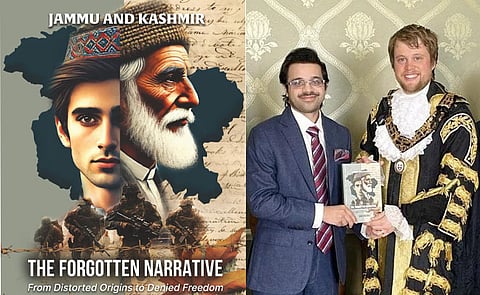


Book: Jammu and Kashmir: The Forgotten Narrative, From Distorted Origins to Denied Freedom
Author: Saud Sultan
Publisher: Grosvenor House Publishing Ltd, Surrey, UK
Pages: 254
Saud Sultan’s Jammu and Kashmir: The Forgotten Narrative, From Distorted Origins to Denied Freedom sets out to interrogate what the author sees as a carefully curated state narrative of the Kashmir conflict.
Writing from his time at Cambridge, Sultan explains that he aimed to move beyond inherited histories and officially sanctioned accounts. The book relies heavily on interviews with Kashmiri refugees and survivors, who had crossed over to Pakistan or to Pakistan-administered Jammu and Kashmir. This approach gives voice to lived experiences but also reflects clear structural limits.
Sultan did not have access to Indian archival material, including the National Archives in New Delhi or the Nehru Memorial Museum and Library at Teen Murti, now rechristened as the Prime Ministers’ Museum and Library.
On page 54, Sultan argues that India exaggerated the 1947 Pashtun tribal invasion to monopolise attention on the violence of the tribesmen, deflecting scrutiny from other armed actors and political developments already underway inside Jammu and Kashmir. But this violence is a living memory of North Kashmir’s history and cannot be denied at any cost. Importantly, there were instances where unscrupulous elements had joined them, taking advantage of the anarchic situation.
In Sopore, elders would point towards the triangular dome of the dargah of Mir Syed Ali Hamadani, from where the brass finial, the crowning ornament at the top of a dome, was taken away by a marching contingent of tribals, thinking that it was gold. There are many other stories also, which till recently were a part of folklore in North Kashmir. Therefore, many people at that time did not experience the raids as a liberation. The diversity of local responses perhaps deserved deeper exploration.
The book carefully traces political manoeuvring in the crucial months before accession. On page 68, Sultan records that on July 3, 1947, Sardar Patel initiated formal contact with Maharaja Hari Singh on behalf of the Congress, assuring him that the party was “not your enemy.” Sultan contrasts this outreach with Jawaharlal Nehru’s earlier strained and often unpleasant encounters with the Maharaja. Yet at times, the book leans too heavily on portraying Nehru and Patel as rivals. The historical record suggests that while their styles and emphases differed, both leaders were working on parallel tracks aimed at securing Kashmir for India.
This divergence is more clearly framed on page 57. Sultan writes that the Nehru group wanted Jammu and Kashmir to accede through popular political support, while the Patel group favoured integration irrespective of whether it was backed by mass consent. The distinction is real, but it sits alongside a shared strategic objective that the book sometimes underplays.
The question of when and how accession was actually secured is where Sultan’s argument intersects with some of the most unsettling material in the broader historical record. A little-known but revealing account appears in GP: 1915–1995, based on the personal notes of G. Parthasarathi, the influential diplomat and adviser to Prime Minister Indira Gandhi, authored by his son Ashok Parthasarathi.
G. Parthasarathi was also the son of Sir Gopalaswami Ayyangar, who had served as prime minister of Jammu and Kashmir from 1937 to 1943. According to the book, Ayyangar undertook a secret visit to Srinagar on September 23, 1947, during which he successfully persuaded Maharaja Hari Singh to accede to India. Upon returning to New Delhi, Nehru told Ayyangar that he could only have done it.
This revelation fundamentally reverses the familiar claim that the tribal invasion forced the Maharaja’s hand days later and that the Indian Army landed in Srinagar only after the Instrument of Accession was signed on October 26, 1947.
It was after this meeting that Meher Chand Mahajan was installed as the prime minister of Jammu and Kashmir. Khushwant Singh would later describe Mahajan as communal and biased, an assessment that further complicates claims of neutrality or emergency governance during that decisive period.
In fact, Nehru had made up his mind to retain Kashmir long ago. Reading The Discovery of India, between the lines, it becomes amply clear that Nehru had highlighted his emotional, cultural, and ancestral attachment to Kashmir. Nehru’s writing about the Himalayas and Kashmir’s “memoried loveliness of ages past” makes it difficult to imagine him allowing the region to slip away, despite repeated public commitments to a plebiscite.
Indira Gandhi’s 1948 letter from Srinagar, noting that only Sheikh Abdullah was confident of winning such a vote, and A.G. Noorani’s documentation of Nehru’s private retreat from the plebiscite idea in 1948, reinforce this reading. Sheikh Abdullah’s dismissal and imprisonment in 1953 then marked the closure of that chapter.
Administrative Preparedness
Sultan also documents how quickly India escalated administrative and military preparedness. On page 74, he cites a letter dated October 3 from Rafi Ahmed Kidwai, then minister for communications, stressing the urgency of constructing telephone and telegraph lines from Jammu to Pathankot. A wireless transmitter was installed in Jammu, while Amritsar and Srinagar already had functioning stations.
These details align with personal recollections as well. The father of a former colleague in Delhi, who served in Signals in the British Air Force and later the Indian Air Force, recalled relaying wireless messages from Srinagar to Delhi when he was posted in Jallandhar or Ludhiana in July 1947, when direct transmission was not yet possible.
On October 7, Patel wrote to Defence Minister Baldev Singh, urging immediate rail arrangements for arms and ammunition to Kashmir, while noting that Pakistan was making similar preparations. Sultan reads this as evidence of Patel’s sense of urgency and his determination to outmanoeuvre Pakistan.
Curiously, India did not foreground the Instrument of Accession when it first approached the United Nations, making later legal debates over accession appear curiously selective.
Other Non-State Actors
One of the book’s strongest sections, around page 93, urges readers to look beyond the tribal invasion narrative and examine the role of other non-state and quasi-state actors.
Sultan draws attention to Patiala state forces, Akali Sikh jathas, Dogra troops, and RSS-linked networks. He cites Col. M.N. Gulati’s account that the First Patiala Infantry and a battery of mountain artillery reached Jammu in the first fortnight of October 1947.
Christopher Birdwood’s work is also invoked to document Akali Sikh attacks on villages such as Amrey Chak, Atampur, and Kochpura, and the spread of violence across Jammu through October. The communal carnage of Punjab, Sultan argues, cast a long and largely unacknowledged shadow over Jammu.
This argument is reinforced by recent investigative reporting.
A Caravan investigation found that a single address in the Amphalla neighbourhood of Jammu housed multiple organisations linked to the Sangh. The four-hectare site was first granted in December 1916 by Pratap Singh, the Dogra ruler of Jammu and Kashmir, to a religious leader, Champa Nath, for the promotion of Vedic teaching, along with a grant of Rs 10,000 for the construction of a temple.
The finding points to the deep institutional roots and physical presence of Sangh-affiliated networks in Jammu long before 1947, complicating claims that their role in the crisis was incidental or purely reactive.
This context gains added significance when read alongside later ideological reconstructions of 1947.
In RSS: Building India through Sewa, authored by Sudhanshu Mittal, the role of the Sangh is projected as decisive. The book, described by RSS Sarkaryavah (General Secretary) Dattatreya Hosabale as a “time bomb,” claims that the 1947 Pashtun raid was thwarted not only by the Indian Army but by RSS Swayamsevaks, who penetrated enemy ranks and neutralised local sympathisers in Srinagar.
Mittal asserts that the Sangh persuaded Maharaja Hari Singh to sign the Instrument of Accession and forced the removal of Ramchandra Kak from the post of prime minister. It even claims that an RSS activist disguised as a Muslim infiltrated a “Muslim Army” camp in Srinagar and derailed invasion plans.
These assertions underline how the story of 1947 continues to be reshaped to foreground particular ideological actors.
Sultan’s focus on language and displacement on page 143 is telling. He calls Kashmiris who crossed into what is Pakistan-administered territory refugees. They, in fact, like Kashmiri Pandits, who moved to Jammu, are migrants or internally displaced persons. He also claims that they are in a better situation and taken care of, which is far from the truth.
Some 40,000 refugees had to abandon their villages on the Indian side and have been living in the camps in Muzaffarabad and elsewhere over the past 30 years.
I had visited them some years ago. They are eking out their living either by begging or physical labour. They are not registered either with the United Nations High Commissioner for Refugees or with any other non-governmental organization. Successive Indian census documents since 2001 have mentioned many villages in Kupwara and Baramulla districts, either fully or partially uninhabited.
The areas from where the people have mostly migrated include villages of Bohar, Bichwal, Bogna Keran, Malik Basti Machil, Amroi, Jabri Karna, and Teetwal in Kupwara and Hathlanga, Soura, Sumwali, Churunda, Gowalan, Singhtung, Bara, and Delanaja in Baramulla. Many also migrated from the Poonch and Rajouri districts of Jammu province as well.
Not all of Sultan’s claims are equally persuasive. On page 164, he writes that authorities in Srinagar asked mosques to lower the volume of the azan. While the prolonged closure of Jamia Masjid is well documented, regulating loudspeakers was not reported. This distinction matters in a region where symbolic acts carry heavy political weight.
Finally, the book’s physical production is disappointing. The thick, maplitho-style paper makes a 250-page volume unnecessarily heavy, and while the cover is hard, the binding is weak enough that pages loosen during ordinary reading.
For serious nonfiction, such flaws undermine durability and reader confidence. Publishers owe readers not only rigorous content but also basic material standards.
Jammu and Kashmir: The Forgotten Narrative is a provocative and necessary intervention that widens the frame of 1947 and foregrounds neglected actors and experiences. Its limitations in archival access, occasional overemphasis on political rivalries, and uneven treatment of counter-evidence mean it should be read critically rather than conclusively.
In Kashmir, the struggle has always been about more than territory. It is also a struggle over memory, and over who gets to decide which past is allowed to endure.
(This news article has been updated with name and relationship of G. Parthasarathi as son of Gopalaswamy Ayyangar instead of son-in-law in Para 9.)
Have you liked the news article?
Support us now:
https://www.gofundme.com/manage/jammu-kashmirs-sole-independent-voice-under-threat