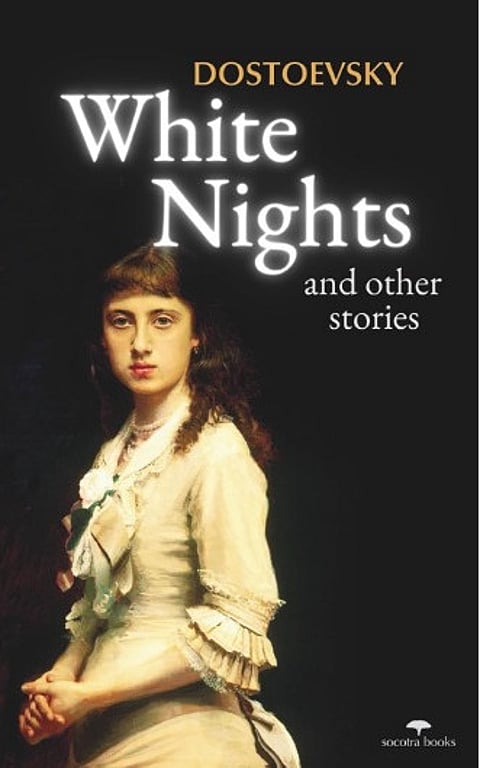


Social media nowadays is swarmed by the reels featuring Nastenka and the dreamer, characters of the White Nights by Fyodor Dostoevsky. The melancholic background music, tinged with nostalgia, tugs at the heart and seems to point toward a dark truth common to us all.
Published in 1948, this tender tale, crisp and relatively short compared to most of Dostoevsky's works, captures a sense of hopelessness that permeates St. Petersburg, whether as a reflection of the city itself, the author's imagination, or reality in general. His stream-of-consciousness is saturated with poignancy. He strikes directly at the depths of the heart and leaves it aching. The concise yet vivid prose breathes life into every scene. That's what great writers do; they leave an imprint on the heart.
Many readers perceive White Nights as a story of relationship woven together by fleeting intimacy, chance meetings, laughter, and an untimely demise. Yet, it is much more than that. It's simultaneously a story of hopelessness and hope.
It portrays the fleeting nature of human experiences and demonstrates how the outward projections of deep-seated fantasies, while offering temporary relief, can ultimately be destructive. It captures what it means to be human: unpredictable, uncertain, selfish, tragic, helpless, and complex.
It also reveals the lengths to which people will go to survive grief, regardless of morality, practicality, or the heartbreak left in their wake.
The story revolves around two people and is told in the first person. The unnamed narrator, the "dreamer," casts himself as the loneliest man living in St. Petersburg. His loneliness manifests in conversations with buildings and a life spent speaking to no one. One night, he encounters a young woman in tears, and the two strike up a friendship. A friendship characterised by volatility. Volatility that could collapse at any moment.
Nastenka, who lives with her blind grandmother, has fallen in love with a lodger, who promised to return for her after a year. Lonely and waiting for his return, she shares her troubles with the dreamer, who, for the first time, feels wanted. Although Nastenka warned him not to fall in love with her, the dreamer couldn't resist and gradually fell deeply in love with her.
Both of them would meet. At times, it seems Nastenka might choose the dreamer and build a future with him, especially when the lodger failed to show up at the appointed place. Overcome by emotion, the dreamer confesses his love. Feeling abandoned, Nastenka decides to let go of the absent lover and turn towards the dreamer instead. She tells him that he's nobler than the lodger. Together, they walk hand in hand, imagining a shared future.
Yet their moment of happiness is brief. The lodger suddenly appears. Nastenka drops her facade, running toward her lover's arms, leaving the dreamer alone in the darkness.
In a letter the following morning, she confirms her true feelings: "I love him to whom my heart has always belonged," while asking the Dreamer to remain her friend. In the end, Nastenka loved the Dreamer for rescuing her from loneliness, but she was never truly in love with him.
Spanning only four nights, the story often feels as though Nastenka used the dreamer as an emotional refuge until she could reunite with her lover. Yet, the novella possesses greater depth; that's where Fyodor Dostoevsky's genius lies.
From the beginning, the dreamer appears to suffer from what can be called an abandonment complex. He feels abandoned, despite being surrounded by life. The fantasies that he projects onto Nastenka subconsciously are his own creation. The emotional pressure within him finally finds a vent, spilling into the emotional world Nastenka carries within herself. By letting his fantasies reign unchecked and by falling in love with the woman who already loves someone else, the pathologically isolated dreamer digs his own grave.
Yet the story isn't so simple. Are human beings not naturally inclined to love those they spend meaningful time with? Can affection transform into romantic attachment? Are men more vulnerable to such emotional entanglements? Are women, even when honest about their intentions, sometimes capable of benefiting from another person's vulnerability through occasional mixed signals or emotional dependence?
Why did the dreamer become so enamoured of Nastenka despite her warning? Why did Nastenka decide she could love him when the lodger failed to appear? Why did Nastenka ditch him in the dark the moment her long-awaited lover appeared?
In grief, human beings seek refuge in others. But when two wounded people lean on each other, emotional pathology emerges. And often one suffers more than the other.
White Nights serves as a warning. We cannot afford to be lonely enough to be heartbroken by things that never truly existed. We can't afford to lose ourselves in feelings without understanding where those feelings originate. Sometimes they aren't expressions of love but coping mechanisms for deeper wounds.
It also exhibits the danger inherent in building fantasies that invite projections. It shows what a person can do to survive grief: Nastenka, who genuinely cares for the lodger, and even warns the dreamer not to fall in love with her, ultimately decides to love the dreamer, only to abandon that affection the moment the lodger returns.
It's tragic for both characters. Both make mistakes to survive grief. The story also mirrors the pathological relationships, rather than love, that often prevail in modern society: obsessions, doubts, egotism, heartbreaks, selfishness, coping mechanisms, treating humans as means rather than ends in themselves, betrayal, infidelity, frustration, depression, institutionalisation, and, in extreme cases, demise.
Dostoevsky is still relevant. Beware of the snare, lest you suffer.
Have you liked the news article?
Support us now:
https://www.gofundme.com/manage/jammu-kashmirs-sole-independent-voice-under-threat