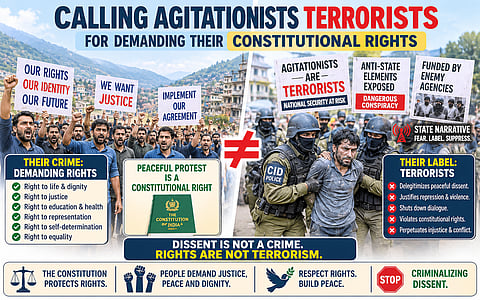


LONDON: Authorities in Pakistan-administered Jammu and Kashmir (PaJK) have recorded at least 445 entries on the Fourth Schedule, Pakistan’s anti-terrorism watchlist, according to a new briefing released by the Jammu Kashmir Human Rights Observatory (JKHRO). That is more than double the 205 people cited by United Nations experts in early September.
The briefing, updated to November 11 and addressed to the UK Parliament, the Foreign, Commonwealth and Development Office (FCDO), UN mechanisms and diplomats, says the listings form part of a wider system of controls with impacts on passports, national identity cards, bank accounts, mobile phone connections and family life, and in some cases extend to Kashmiris living abroad.
A growing list
On September 4, six UN Special Procedures mandate holders sent Pakistan a joint allegation letter. It concerned the government’s ban on the Jammu and Kashmir Joint Awami Action Committee (JAAC) and counter-terrorism measures against people linked to it. The letter cited 205 people placed on the Fourth Schedule, with reported consequences ranging from cancelled identity documents and frozen bank accounts to police reporting requirements.
JKHRO’s archive of ‘official AJK Home Department notifications’ now holds 445 entries, an increase of about 117 per cent. The group stresses that the two figures are not strictly comparable. Its total counts notification entries, and some of those are known or probable duplicates, so it should not yet be read as 445 separate people. Urdu-language outlet JK Voices reported the doubling of the UN’s initial figure.
The listings are heavily concentrated. Poonch district, which includes Rawalakot, the centre of the protest movement, accounts for 179 entries, or 40.2 per cent. Sudhnoti follows with 63. The five largest districts (Poonch, Sudhnoti, Bagh, Muzaffarabad and Kotli) together account for three-quarters of all entries.
The briefing also refers to a separate, unverified report that 802 people have been placed on the Passport Control List (PCL) in connection with the situation in the region. JKHRO says that figure should be treated as reported, not confirmed, until an official register is published.
According to the archive, at least 15 advocates or solicitors and four journalists are among those listed. The journalists named are Danish Irshad, Azra Alam, Muhammad Riaz Khan and Ajmal Shaheen.
The most troubling entry, the group says, is a notification dated September 29 that reportedly lists six members of one extended family, including a child aged about four years and two months. JKHRO says that if the listing was deliberate, it amounts to punishment by association. If it was a mistake, it reveals a serious failure of the data checks that are supposed to happen before such information is shared across government systems.
The briefing cites a confidential Home Department record dated July 8. The record asked for nine people to be removed from the PCL and for their identity cards, bank accounts and SIM cards to be unblocked. JKHRO says this shows that the authorities can switch restrictions on and off across several systems at once.
Similar measures have been reported against public figures. An opinion piece in JK Voices says that Akram Sohail, a retired AJK government secretary and poet, has had his identity card blocked for four months, his pension suspended, his bank account closed and his SIM deactivated after being placed under the Anti-Terrorism Act. The piece says he has received no official notification or explanation.
Fifteen entries record a home address outside Pakistan and Pakistan-administered Kashmir, spread across seven countries. Nine are in the United Kingdom, and one each is in Australia, Canada, Hungary, Italy, Spain and the United States. JKHRO stresses that living abroad is not evidence of wrongdoing. It warns, however, that a security classification in AJK can affect return travel, passport renewal, property, banking and lawful advocacy overseas.
The briefing highlights the case of Daalat Ali, a Rochdale councillor and Pahari-language writer. As Kashmir Times reported at the end of October, he was briefly held during a visit in October and then prevented from boarding his return flight to the UK. JKHRO cautions that the legal basis for the restriction has not been made public and that the case should not be described as a confirmed Fourth Schedule listing.
The group has also received an account, which it has not yet verified, about a British-born public servant of Kashmiri heritage. The person was reportedly arrested at Islamabad airport, then released, and has been on passport-control and Federal Investigation Agency stop lists since August, unable to return to Britain. Members of the UK diaspora have held a 24-hour sit-in outside 10 Downing Street in support of the Rawalakot protesters.
JKHRO describes the pattern as a possible case of transnational repression and has asked the FCDO to set up a confidential channel for affected British citizens and residents.
Separately, the UN Working Group on Enforced or Involuntary Disappearances has taken urgent action over Shoukat Nawaz Mir, a Muzaffarabad resident. According to information submitted to the Working Group, he was detained while travelling to the Rawalakot sit-in and taken to an undisclosed location.
The Working Group forwarded the case to the Government of Pakistan on September 23 under its urgent action procedure and registered it as case No. 10017638. In a letter dated November 11, Chair-Rapporteur Grażyna Baranowska confirmed that the body considered the case at its 140th session.
Habeas corpus proceedings have been filed in the High Court of Azad Jammu and Kashmir, but Mir was not produced on the recorded hearing dates. As of November 12, JKHRO said he had still not been brought before any court, and his whereabouts, condition and legal status remained unknown.
JK Voices has also reported on detainees denied production in court, including Mir. JKHRO noted that the UN intervention is not a judicial finding of responsibility.
The new figures come during the most violent stretch yet of the protest movement, which began in June. On November 3, the Home Department placed nine more people associated with the JAAC on the Fourth Schedule under the Anti-Terrorism Act. The notification did not set out individual allegations.
Two days later, on November 5, security forces moved to clear the months-long sit-in at the Rawalakot bus terminal and reopen roads. Initial reports put the toll at three civilians dead and at least 18 injured. Later reports suggested as many as seven deaths, while the JAAC counts five. Police said armed protesters fired on officers. They later announced that Naik Bostan Khan of the Sindh Rangers, who was wounded that day, had died.
The JAAC says about 150 people have been killed since June. That figure has not been verified, and the competing casualty counts cannot be reconciled.
JAAC said that three young men were killed at Farooq-e-Azam Chowk in what he described as a drone strike. It denied that there were armed groups among the protesters and called for an independent commission and access for journalists. His claims have not been independently verified.
On November 12, gunfire in Rawalakot reportedly killed a girl and injured another. The JAAC named the dead girl as Ayesha Saqib and blamed security forces. District police said she was seriously injured, not killed, and accused gunmen linked to the JAAC of firing on officers.
On November 8, the JAAC offered talks at a neutral venue with independent observers. It also wrote to army chief Field Marshal Asim Munir asking him to halt operations. Its demands include an end to firing, a verified list of detainees and where they are held, the return of bodies, medical treatment for the injured, restored mobile and internet services, and an independent, time-limited inquiry into all deaths. The following day, a JAAC call for a shutdown brought partial strikes to six districts, including Muzaffarabad, Mirpur and Kotli.
At a gathering in Islamabad, PaJK leaders called for calm but remained divided over the causes of the crisis. President Najeeb Naqvi said the Rawalakot issue would be resolved peacefully. Prime Minister Iftikhar Ali Gillani said almost all residents wanted peace and blamed unnamed elements for exploiting public anger. Assembly Speaker Chaudhry Tariq Farooq rejected force as a solution.
The Human Rights Commission of Pakistan has urged dialogue and unrestricted access for the media. As of this week, no framework for talks or independent investigation had been agreed.
JKHRO is calling on Pakistan and the PaJK government to give a full, itemised answer to the UN’s question on the legal basis for each listing. It also wants them to publish the criteria and review outcomes for the Fourth Schedule and travel-ban lists, and to release a deduplicated count broken down by district, country and age group.
It urges the immediate suspension and review of all listings of children and all listings based solely on family ties, and an independent audit to reconcile the 445 entries with the reported 802-person passport list.
The group acknowledges limits in its data. The archive is built from notifications and does not include reasons, restrictions or removals for every person, and its counts of professionals and overseas residents are minimum figures. The PaJK and Pakistani authorities have not publicly responded to the briefing’s findings.
Have you liked the news article?
Support us now:
https://www.gofundme.com/manage/jammu-kashmirs-sole-independent-voice-under-threat