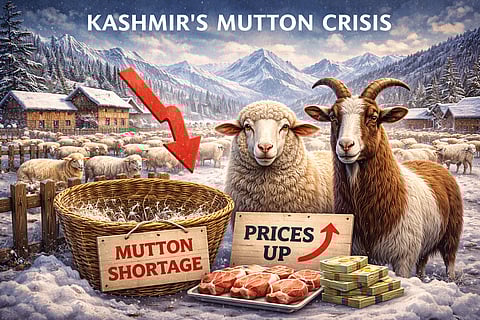


Lesser-known villages in the scorching deserts of Rajasthan hide within their bosom an alarming story that may have profound implications for Kashmir's mutton supply and resultant health crisis.
The villages of Loharki, Khetolai, Odhaniya, and Chacha located within the Pokhran Field Firing Range (PFFR) in the Jaisalmer district of Rajasthan are home to traditional sheep-rearing communities, particularly among the Raika pastoralists, who sit just kilometers from India's nuclear test sites.
These same desert regions now supply a significant portion of the 14 lakh sheep and goats that Kashmir imports annually.
Adding complexity to the mutton supply crisis of Jammu and Kashmir is the legacy of nuclear testing. Since 1945, nuclear tests conducted globally have caused lasting damage to local biospheres and environments, with effects ranging from immediate ecosystem destruction to long-term radioactive contamination of soil, groundwater, and marine environments, impacting both humans and livestock.
The Nuclear Legacy
In 1974, India conducted its first nuclear test, codenamed ‘Smiling Buddha’, approximately 10 kilometers from Khetolai. Many villagers were unaware until they heard about the explosion on radio. The larger tests in 1998 came with warnings, but their scope was enormous.
What followed in subsequent years and decades, according to testimonies gathered by journalists and independent researchers, paints a harrowing picture.
Residents and local doctors report a startling pattern of health anomalies in subsequent years after the nuclear tests. Blood, throat, and stomach cancers became commonplace. Children were born with severe genetic abnormalities, birth defects, and developmental delays. The pastoral communities' lifeline – the livestock exhibited strange tumors, skin infections, and reproductive failures. Crops reportedly whitened and failed.
"Almost every family in Pokhran or nearby areas seems to have a tragedy about a loved one who died unexpectedly of cancer," stated Dr Dhruv Pal, a physician practicing in the area, as reported by The Citizen. "The land and dwellings were devastated, diseases followed shortly."
Birth defects continue to appear in children born years after the tests, suggesting genetic damage passed down through generations.
While India and Pakistan maintain that 1998 nuclear tests in Pokhran and Baluchistan's Chagai district were safely contained, local accounts on both sides of the borders contradict this.
In the Chagai area too, residents and activists persistently report birth defects, and other illnesses, attributing them to radiation; however, the lack of freely available, independent scientific data leaves these critical health concerns unverified.
The Bio-Accumulation Hypothesis
The scientific concern centres on bio-accumulation: radioactive isotopes like Cesium-137 and Strontium-90, with half-lives of 30 and 29 years respectively, can enter the food chain through contaminated soil, water, and vegetation. These isotopes accumulate in the tissues of grazing animals and ultimately in humans who consume their meat.
Nuclear tests conducted globally since 1945 have caused lasting damage to local biospheres, with effects ranging from immediate ecosystem destruction to long-term radioactive contamination of soil, groundwater, and environments, impacting both humans and livestock for generations.
This concern becomes acute for Kashmir, which faces a staggering trade imbalance in mutton. The region produces only 30,000 tonnes of mutton locally but consumes approximately 60,000 tonnes annually. To bridge this gap, Kashmir imports around 14 lakh sheep and goats each year, draining between Rs 1,000 and Rs 1,400 crore from the local economy.
According to Mehraej Ahmad Ganaie, a senior official of the Mutton Dealers Association Kashmir (MDAK), the major supply chain runs from "Ujlan-Jaisalmer, Jaipal Basti, Jaisalmer, and Sikar areas of Rajasthan," besides Haryana, Gujarat, and Uttar Pradesh. The geographic overlap between nuclear test sites and sheep-sourcing regions raises urgent, unanswered questions.
Beyond the radiological concerns, the quality and safety of meat from animals subjected to immense stress during long-distance transportation in frequently unregulated conditions present immediate risks. Stress compromises animal immunity and meat quality, raising contamination and disease risks.
The Regulatory Gap
While the Food Safety and Standards Authority of India (FSSAI) oversees food safety and focuses on preventing contamination through environmental sources and regulating post-slaughter irradiation of meat products, radiation levels in food and livestock fall under the Atomic Energy Regulatory Board (AERB) and the Department of Animal Husbandry & Dairy (DAHD).
However, no comprehensive, independent study has addressed whether livestock from Pokhran-adjacent areas carry radiological contamination or whether such animals constitute the majority of imports entering Kashmir's food chain.
The official position remains unchanged, citing a lack of conclusive, government-approved studies establishing direct causal links. The absence of independent, longitudinal, and transparent research creates a gaping hole in the food safety net for Kashmir.
The sheer volume of anecdotal evidence from Pokhran creates reasonable doubt that official dismissals cannot adequately address. While the people of Khetolai lack scientific proof to secure redress, Kashmiris equally lack the scientific assurance that they can consume imported mutton without fear.
Health Crisis
Despite recent reports about contaminated and sub-standard mutton supply in Jammu and Kashmir, the Omar Abdullah-led coalition government has yet to offer clear answers. The quality and safety of meat derived from animals subjected to the immense stress of long-distance transportation in frequently unregulated conditions are immediate concerns. Animal immunity and meat quality are compromised by stress, which raises contamination and disease risks.
In the light of Pokhran revelations, the government must also clarify whether sheep imports arriving primarily through Delhi mandis originate substantially from Rajasthan's Pokhran areas. The Jammu and Kashmir administration must commission independent, transparent scientific investigations to assess radiological safety parameters.
For Kashmir's Health Department, this is not a political issue but a paramount public health imperative. The fundamental question remains unanswered: Is the mutton on Kashmiri plates carrying a silent, invisible burden of radiological bio-accumulation?
The issue is not about targeting trading communities or creating sensationalism, but rather alerting health authorities to shift from reactive care to proactive, evidence-based health security. This requires integrating environmental health data into public health planning, building capacity for monitoring long-term health trends, and advocating for policies that prioritise ecological and community resilience.
(To be continued)
Have you liked the news article?
Support us now:
https://www.gofundme.com/manage/jammu-kashmirs-sole-independent-voice-under-threat