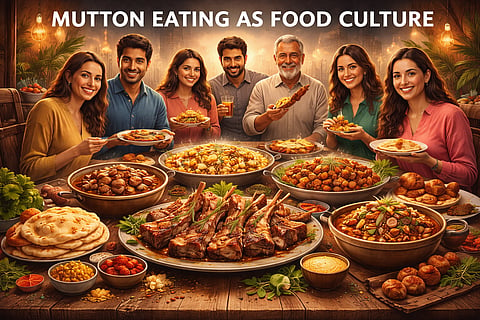


Jammu and Kashmir imports massive quantities of goat and sheep annually, draining hundreds of crores from the local economy, while local production meets only half the demand. Adding alarming complexity, significant imports originate near nuclear test sites, raising unanswered public health concerns about potential radioactive contamination from testing's documented long-term environmental damage.
This systemic crisis demands urgent attention and strategic transformation of the pastoral sector for achieving mutton self-sufficiency while improving local economies and meeting environmental goals.
Mutton self-sufficiency is an ambitious but entirely doable goal. From the cellular level of genetics to the community level of collective action, it requires a coordinated, multi-pronged offensive that targets the deficit's underlying causes on all fronts.
Pillar One: Genetic Revolution and Scientific Breed Improvement
The journey to plenty begins with the genetic blueprint of the animal. The huge demand gap cannot be filled solely by slow, traditional breeding of local varieties. The crucial first step is a genetic revolution guided by science.
The government's decision to import exotic meat breeds with high yields and rapid growth, such as the Dutch Texel and South African Dorper, is correct and must be aggressively scaled. These breeds are intended to enhance local stock through deliberate cross-breeding by combining their climate adaptation with the exotic breed’s superior muscle growth and feed conversion efficiency.
In order to rapidly spread these improved genetics to the most remote farms, this needs to be paired with a huge Artificial Insemination (AI) network that is supported by the government.
A parallel and transformative research focus should be on introducing the Fec-B (Fecundity Booroola) gene into the local flock, which could push lambing rates towards 120%, a quantum leap in productivity. The engine that will sustain this genetic upgrade for generations is the establishment of elite "Nucleus Breeding Farms" for the production and distribution of certified, high-genetic-merit rams to farmers.
Pillar Two: Nutritional Security and Fodder Innovation
After genetics, the scarcity and poor quality of year-round feed are the single greatest constraint. A state-wide “Fodder Mission” is as critical as any breeding program, as a champion breed cannot perform on a poor diet.
There are three goals for this mission. First, reclaim and scientifically manage pastures through strict rotation to restore degraded grasslands and prevent overgrazing with strict pasture rotation. Second, establish Fodder Bank networks at district/block levels to stockpile silage and hay as winter buffers against seasonal weight loss. Third, leverage local resources for innovative, sustainable solutions, especially to meet the challenges of harsh and frozen winters.
Kashmir's agricultural by-products, like apple pomace from orchards, urea-treated rice and wheat straw, tree leaves, and lake weeds, can be transformed into nutritious feed or compact "complete feed blocks," turning waste into wealth while reducing costs and creating a circular economy based on local resources.
Pillar Three: “Mutton Banks” as a Community Solution
The fragmentation of the sheep industry in J&K is the sector's structural flaw. Numerous smallholders with small flocks are unable to effectively invest, innovate, or access markets.
The establishment of Sheep-Rearing Cooperatives, also known as "Mutton Banks," is the most transformative response to this problem. Consider a model in which fifty small farmers in a village pool their sheep (or an equivalent amount of capital) into a community-owned cooperative business.
This cooperative can employ professional managers, veterinarians, and expert herders to implement scientific breeding, optimized feeding, and preventive healthcare at scale, raising lambs efficiently and distributing dividends to member-owners from fattened stock sales.
There are significant advantages to this model. It elevates shepherding from a subsistence occupation to a community-owned agribusiness, empowering marginal farmers, especially women, giving them ownership and a stable income. Management and animal care jobs are created locally.
The cooperative can keep a dedicated breeding flock, preventing the common practice of selling off the best animals for slaughter during festival peak times, to help conserve breeding stock. As a self-replicating franchise, the model can organically spread the revolution.
Pillar Four: Policy Catalysis and Industrial Value Addition
For the private and cooperative sectors to thrive, the government needs to play the role of strategic enabler by developing the policy environment and infrastructure. A simple but powerful policy is to incentivise Integrated Farming Systems.
Small flocks of sheep can be encouraged and supported by apple orchard owners who have large tracts of land. The sheep graze on the orchard grass and are fed apple pomace, while their manure provides rich, organic fertilizer for the trees. A beautiful, long-lasting, and profitable symbiotic loop is created as a result.
Kashmir's sheep industry wastes valuable by-products like blood, offal, bones, fat, and pelts, amounting to the discarding of materials worth crores annually. Rendering plants should process offal into meat and bone meal for feed, tanneries should convert pelts into quality leather, and facilities should produce tallow for soaps, gelatin from bones, and blood meal fertilizer. This vertical integration would capture the animal's full value, create industrial jobs, provide farmers additional revenue, and make the enterprise more profitable and resilient.
In conclusion, the market requires organization. A licensing system for suppliers of sacrificial animals during Eid can help protect elite breeding stock from being culled. Producer cooperatives can connect directly with retailers and consumers through "Farmers' Markets" or online platforms, eliminating exploitative middlemen and ensuring a fair price for the farmer.
Health Department’s Critical Role
This model transforms the J&K Health Department from a passive gatekeeper into an active steward of public health through proactive, science-based strategies.
It should establish a specialized Zoonotic Disease and Food Safety Unit staffed by veterinarians, epidemiologists, food scientists, and public health specialists using a One Health approach to integrate surveillance across human, animal, and environmental health.
Second, implement a rigorous three-tier inspection protocol enforcing safety at every point. Tier 1 requires transforming entry points into advanced quarantine centers where every imported livestock shipment undergoes documentary checks, clinical and serological screening for diseases like Brucellosis.
Critically, independent radiological testing for Cesium-137 and Strontium-90 in tissue samples, with transparent public reporting to address Pokhran concerns and ensure accountability. The radiological screening imperative is non-negotiable for public trust and transparency.
Tier 2 mandates modernisation and licensing of all slaughter facilities with trained inspectors conducting ante-mortem and post-mortem examinations, hygiene audits, ensuring clean water and proper waste disposal, and verified halal certification covering animal welfare.
Tier 3 extends regulation to butcher shops, markets, and restaurants through unannounced inspections and random sampling for microbial contamination, chemical residues, and adulteration.
Finally, the department could empower citizens through media campaigns, workshops, and school programs teaching meat quality identification, safe storage, and proper cooking methods, supported by a toll-free hotline and mobile app for reporting violations, making every citizen a guardian of public health.
Reclaiming the Wool Value Chain
While Kashmir's mutton crisis dominates attention, its wool sector represents untapped potential. The region produces 7.9 million kilograms annually (22.9% of India's total) but exports much of this ‘white gold’ as raw material to Punjab and other states, which process and sell finished products back to Kashmir at massive markups, leaving the region with minimal value capture.
Wool must follow the same strategy as mutton: aggressively move up the value chain.
To reclaim this wealth, modernise from shearing onward by establishing block-level mechanized shearing and grading centers where herders can be trained to separate fine from coarse fleece, immediately raising raw material value. The government should encourage decentralized mini-textile clusters in wool-rich areas housing small-scale units for scouring, carding, spinning, dyeing, and weaving to keep employment and profits local while reviving artisanal traditions.
A rigorous "Pashmina Authenticity and Traceability" program must be a flagship initiative. The legendary Kashmiri Pashmina, from the Changthangi goat, is plagued by counterfeit blends. Using QR codes or RFID tags linked to a central database, a digital traceability system that follows the wool from the herder in Changthang to the final shawl in a showroom would safeguard the brand, reassure global consumers of its authenticity, and ensure that the premium prices paid for genuine Pashmina go back to the nomadic herders who live in harsh high-altitude conditions to produce it.
Finally, the government must actively facilitate collaborations between master weavers and national/international fashion designers to modernise appeal, while developing direct online marketing platforms and premium craft expo participation to connect artisan cooperatives with global boutiques and consumers, eliminating the layers of intermediaries that siphon off most of the profit.
Fabric of the Future
Jammu and Kashmir's mutton and wool crisis place the region squarely at a crossroads. An economic drain that exacerbates cultural apprehension and leaves public health at the mercy of unreliable, far-off supply chains is one way to proceed. The other path leads to empowered, dignified self-reliance.
The decision is simple. The plan for change is a multifaceted strategy that calls for vision, perseverance, and coordinated action which demands combining advanced genetics with cooperative models, viewing sheep as portfolios of valuable products beyond meat, establishing transparent Health Department inspections with science-based data, and metamorphosing wool from a raw fibre supplier to a globally recognized luxury brand.
By modernizing husbandry, J&K can create prosperous rural communities, preserve Wazwaan and shawl heritage, and build economic resilience. Kashmir possesses land, animals, and skilled people—the potential is evident.
For a culture that so profoundly celebrates the communal feast, securing the means to produce that feast sustainably, safely, and profitably is the ultimate act of self-preservation. It is about ensuring that the aroma of Rogan Josh continues to tell a story of resilience, health, and prosperity for generations to come - a future in which they truly own the feast in all of its meanings.
(Concluded)
Have you liked the news article?
Support us now:
https://www.gofundme.com/manage/jammu-kashmirs-sole-independent-voice-under-threat