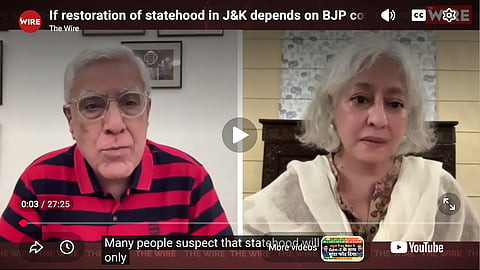


NEW DELHI: Seven years after Jammu and Kashmir lost its special constitutional status and was downgraded from a state to a Union Territory, former government interlocutor Radha Kumar argues that the prolonged delay in restoring statehood has eroded democratic accountability, weakened governance and deepened public alienation.
In an interview with journalist Karan Thapar, Kumar said the Centre had repeatedly assured both Parliament and the Supreme Court that statehood would be restored, yet those commitments remain unfulfilled.
Asked whether the Modi government had gone back on its promise made before the Supreme Court in 2023, she replied, "Yes, no question."
She noted that the first assurances came in Parliament in November 2019 and were repeated "at least a dozen, if not two dozen times" by Prime Minister Narendra Modi and Union Home Minister Amit Shah.
Kumar argues that the debate has moved beyond Article 370 itself to the larger question of restoring democratic government. While many now regard the reversal of Article 370 as politically unlikely, she says there is no constitutional or political justification for indefinitely withholding statehood.
She describes the 2019 decisions as unprecedented in independent India's constitutional history. Article 370, she writes, was first hollowed out through executive action before being legislatively dismantled. At the same time, Jammu and Kashmir became the first Indian state since Delhi in 1956 to lose its statehood, and the decision was taken without consulting its elected representatives or people.
"The two actions comprised a breathtaking violation of India's constitutional principles and the basic structure of the Union," Kumar said, arguing that they undermined India's federal framework and democratic traditions.
Kumar also challenges the security rationale advanced by the Centre.
In the interview, Thapar asked whether continuing militant attacks justified delaying statehood. She rejected the argument outright.
"You could equally argue that by having a very heavy-handed security approach... arresting people under PSA and UAPA... is a guarantee of generating more violence," she said. "When people are not allowed to express their dissent in constitutional terms, they may very well take to unconstitutional means."
She argued that militancy originating from across the Line of Control cannot be defeated by denying democratic rights to people within Jammu and Kashmir.
"You cannot stop that by subjugating the people of Jammu and Kashmir," she said, adding that the challenge could only be addressed either through improving relations with Pakistan or by creating an effective deterrent. According to Kumar, the government has achieved neither.
Kumar says seven years of direct central rule have failed to deliver the promised economic gains. Citing the Jammu and Kashmir Economic Survey 2025-26, she notes that the region's per capita income, measured as a share of the national average, has fallen from 79.9 percent in 2013-14 to 76.6 percent, a decline of 3.3 percentage points. Graduate unemployment has climbed to 23.9 percent, nearly twice the national average.
Curbs Over Civil Liberties, Detentions, Communication Blockade
She also recalls that over 5,000 political leaders and activists were detained immediately after the constitutional changes, while an unprecedented communications blackout and sweeping curbs on civil liberties accompanied the reorganisation of the former state.
Asked by Thapar how Kashmiris view the loss of statehood, Kumar replied that the sense of grievance remains profound.
"They are furious. They are embittered, and they are very, very sad," she said, adding that the anger is directed not only at the loss of statehood but also at the symbolic loss of the region's special constitutional position.
A central theme of both the interview and her article is what Kumar describes as the disappearance of democratic accountability under the Union Territory arrangement.
Although Assembly elections were held in 2024, she argues that the elected government exercises little meaningful authority. Under the 2024 Transaction of Business Rules, she notes, the Lieutenant Governor controls the administration, police, government prosecutors and now even emergency powers over telecommunications.
When Thapar asked what powers Chief Minister Omar Abdullah actually possesses, Kumar responded bluntly:
"Precious few."
She said Abdullah had once remarked that he would not contest elections merely to become a municipal councillor, but added that "that's pretty much what his administration has been reduced to."
Kumar argues that an elected government without executive authority cannot be held accountable by the public.
She also points to what she calls a series of troubling "firsts" for Jammu and Kashmir over the past decade.
Loss of Statehood and Special Status
According to Kumar, it became the first state to lose both its special status and statehood, the first to witness extensive deployment of pellet guns against civilians, and the first to undergo a delimitation exercise that created additional Hindu-majority constituencies, some with populations below 50,000.
The continuing use of stringent laws also concerns her. During the interview, Kumar said the Jammu and Kashmir High Court has increasingly criticised misuse of the Public Safety Act and the Unlawful Activities (Prevention) Act while granting bail.
"I recorded at least 20 cases of them passing really critical strictures on the police while granting bail," she said. Yet, she added, "the government has not said a word."
Kumar believes the restoration of statehood has become the minimum democratic demand in Jammu and Kashmir. The National Conference has now made it the centrepiece of its political campaign, replacing earlier emphasis on Article 370.
Asked by Thapar whether statehood would only be restored if the BJP first formed a government in Jammu and Kashmir, Kumar dismissed the possibility with characteristic candour.
"If that is indeed the intention, then I don't know how many hundreds of years will have to pass before Jammu and Kashmir gets statehood, because it is absolutely not on the cards."
Have you liked the news article?
Support us now:
https://www.gofundme.com/manage/jammu-kashmirs-sole-independent-voice-under-threat