

An injured young man lifted a flute and played Vaishnava Jana To, the hymn Mahatma Gandhi loved most, at 10 Janpath on Wednesday, 14 October. He is known online as the creator behind the YouTube channel “Peeing Human”, and he had come to Rahul Gandhi’s press conference with the marks of the Delhi Police still on him. When he lowered the flute, he said: “Nafrat ka jawab pyar se diya jaega.” (hatred will be answered with love).
Athira, a student from Kerala, said police beatings had left her deaf in one ear. Another protester said something harsher. “Detention centres remind me of the Nazi times. There should be Nuremberg trials in India,” he said.
The protests began over the Election Commission’s Special Intensive Revision (SIR) of electoral rolls which has excluded 133 million voters, and protesters want Chief Election Commissioner Gyanesh Kumar to resign. On October 10 alone, about 7,000 people were reportedly detained in Delhi. Amnesty International put the figure above 5,000. The UN human rights office urged the release of people it described as arbitrarily detained. India’s foreign ministry called that “extreme selectivity” and said police had acted according to law.
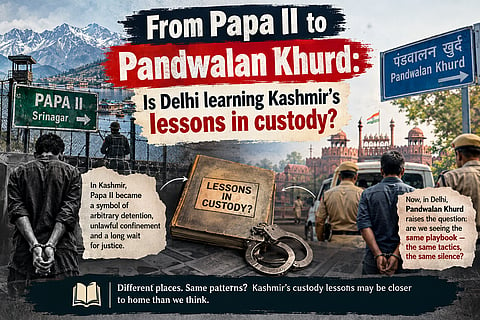
One of the places the detainees were taken was a community centre in Pandwalan Khurd, a village on Delhi’s south-western edge about 40 km from Connaught Place. The chilling accounts from protestors, lawyers, journalists and other passersby taken there now raise an uncomfortable question: Is Pandwalan Khurd Delhi’s Papa II?
Not yet, and not by a very long distance. The longer answer is that the method on display in Delhi will be familiar to anyone who has read Kashmir’s archive of custodial torture, and that is reason enough to look at the two together.
The most detailed account of that night comes from a journalist who was inside it. M Rajshekhar was photographing a small march by the Disha Students’ Organisation near Connaught Place at about 4.00 PM on Sunday, October 11, when police bundled the protesters into buses and a convict van. He was picked up with them.
At the Regal Cinema holding point, a senior officer told the detainees they would be taken to a police station “for some time and then let off”. Then came what Rajshekhar calls the selections. Officers did not load people row by row; they pointed at individuals. “We will take Bhagat Singh in later,” one said of a young protester. “We will teach them a lesson,” another said of the march’s leaders.
The van was boarded from the back, into mesh-walled compartments. Rajshekhar watched three policemen beat “almost everyone who boarded after me” — punches to the abdomen, elbows into the back, kicks. One youngster was shoved to the floor and beaten there. When a cry went up, the senior officer told his men to stop. Rajshekhar calls this “performative”, a gesture meant “to keep the group trusting”. Lawyer and activist Arjun Unnikrishnan put it plainly: “We were brutally, brutally assaulted in the bus where there was no place to run.”
Alt News spoke to others taken to the same destination in two vans (Alt News). It was pitch dark and divided by grilles into four cages, each meant for about six people and holding ten or twelve. Police told them “Aur nahi marenge”, just before the blows resumed.
Tarang Balani, 23, said officers removed his glasses first, then punched, kicked and elbowed him until a knee to the body sent him sprawling into the aisle. He said another man’s face was smashed into a pole, and a man who refused to hand over his phone was beaten “as if they had a personal grudge”.
Hemansh Kashyap, 27, an IIT graduate, says he was slapped again and again until his glasses flew off. A man of 19 or 20 said he was struck in the genitals.
Four minors were in the van. Detainees said all four were assaulted. Earlier, near Connaught Place, a woman’s bangles were broken as officers pulled at her, and her wrists bled.
Most officers wore no name tags. One unnamed official offered the detainees a moral ‘sermon’: “Bacchon, police ki maar ka bura nahi maante.”
Both accounts give a list of serious injuries: One had a broken arm, reportedly from sticks; one had blood on his nose; a young Sikh man had chest pain and a possible fractured rib. The man with the broken arm saw a doctor only at 9:15 PM.
Lawyers were initially kept out, phones were seized without receipts, and the officer in charge said: “If the police in CP took your phones, why are you asking me?” Only after lawyers and the PUCL arrived did police turn conciliatory.
Reacting to these accounts, Rajshekhar summed up the pattern: “Selections; followed by words that keep detainees trusting; and then systematic, deliberate beatings as each detainee enters the transport.” Delhi Police had not answered his questions. Police have maintained more generally that protesters were uncooperative and that force was sometimes needed.
Pandwalan Khurd was not a one-off. A Reuters analysis published on October 14 found that protests across India had risen from 10,642 in 2016 to 18,629 in 2026 by October 2.
In August 2026, more than 200 demonstrations were met with police force, the highest for any month in a decade. Most of this year’s big Delhi marches were organised by the “Cockroach” youth movement, the Cockroach Janta Party (CJP), first over exam leaks in July and now over the electoral rolls.
In July, police had used pellet shotguns, tear gas, batons and electric shock devices in breach of international standards. Delhi Police denied using stun guns or pellet guns, and the government told the Supreme Court that “anti-social elements with criminal antecedents” had turned violent.
The mindset behind the batons is on record. In the Status of Policing in India Report 2025, cited by Reuters, 71% of police personnel surveyed said police should be allowed to use force “without any fear of punishment”. The National Crime Records Bureau counted 66 deaths from lathi charges between 2014 and 2024. In July, police parked AI-powered “Ikshana” surveillance vans at the protest site to scan faces. In October, Reuters saw officers wearing body cameras.
The grammar of police brutalities in Delhi is reminiscent of Kashmir’s interrogation centres.
In the early 1990s, selection in Kashmir happened in the open, in what were called identification parades. During a cordon-and-search operation, men and boys were herded into a square and held there from morning till sunset. Then hooded informers, called CAT, or “renegades,” walked the lines and pointed. One nod - and the person could be dead meat or a bag of broken bones.
In May 1993, The Independent’s Tim McGirk reporting from Srinagar, saw boys as young as 10 shoved forward one by one. Those singled out, he wrote, were “all too often” found the next morning “tortured and killed”.
The 2019 report Torture: Indian State’s Instrument of Control in Indian-administered Jammu & Kashmir, by the Association of Parents of Disappeared Persons (APDP) and the Jammu Kashmir Coalition of Civil Society (JKCCS), records the same machinery case by case. Imran Malik (a pseudonym), then an active militant, was “identified by CAT (renegades) during a crackdown” in December 1990 and tortured naked for 15 hours. Rouf Ahmed Bhat, a businessman picked up in November 1991, believes he was named by a school friend who had become an ex-militant.
Many of those selected ended up at Papa II, a Border Security Force interrogation centre officially called the Fair View Guest House, on Gupkar Road at the foot of the Zabarwan hills. Locals said few people left it alive.
Kashmir was home to a slew of torture chambers and names like ‘Butcher House’, ‘Cargo’, ‘Hari Niwas Palace’ and ‘Kawoosa House’ continue to torment the public memory, but Papa 2 was “the most notorious alleged torture chamber of them all.” The JKCCS report names it in over a dozen of its 432 testimonies. Most of them were civilians, including 27 minors. Only one-fourth of them had affiliation or links with militant groups.
Mehraj-ud-Din Kalwal (Case 234), detained in January 1995, was made to lie naked in the snow until his skin turned black, then burned with hot iron rods and given current to his toes and genitals. Detainees who asked for a doctor were made to sit in the snow until they said they felt better.
Altaf Hussain (Case 73), a JKLF political worker detained in 1991. Five or six men trampled him, then hung him from the ceiling and beat him with lathis until his feet turned black. Electric shocks went to his hands, chest, feet and genitals for 30 minutes until he passed out. He was forced to drink water until he could drink no more. For 25 days he was tortured morning and evening, for two and a half to four hours at a time.
Mohammad Shafi Pandith (Case 286), an auto-rickshaw driver who had left militancy was stripped, blindfolded and beaten for six hours a day. He says syringes of petrol were forced into his rectum and rats were put inside his trousers.
Muhammad Syed Dhobi (Case 305) survived about 26 interrogation centres and spent ten months in Papa II, which he called “the worst of them all”. Cells built for two or three held ten. Inmates were let out to the toilet once in 24 hours, so many took medicine to induce constipation; he recalls one bathroom for 365 inmates. Interrogators made them urinate into a bottle and drink it.
Mohammad Qalander Khatana (Case 350), from Kalaroos in Kupwara, says his flesh was cut from his buttocks, and he was forced to eat it. His legs were broken and later amputated. When he woke, fellow detainees had bound his wounds with their own shirts.
Manufacturing ‘Crossfire’
Several news reports have documented other cases.
Masroof Sultan, a 19-year-old student was pulled off a bus by BSF. He was stripped and beaten until his ribs and right leg broke. As he was driven away, a guard lifted the blindfold so he could see his mother weeping outside: “Take a look at your mother. It’s the last time you’ll see her.”
At Papa II, still naked, he was doused with cold water. A metal ring went round his penis and two more round his toes. “They’d hold live, electric wires against these rings, touching them, tick-tick, like that, for two or three seconds, until blood started coming from my nose.” Then soldiers tied him to a tree by a deserted flood channel and fired on the count of three.
An Independent report quotes him:
'I could hear the men cocking their guns. Then the officer said: 'One-two-three . . . and all together they fired. I was lifted into the air and fell sideways. I began crawling, so the officer told a soldier to shoot me in the heart. Twice he shot - and all my breath was going. Then the soldier kicked me in the head and said: 'He's alive, sir.' I heard the officer reply: 'Shoot him in the head.'
'He took two more shots. Missed the first one and then got me in the neck. Then he stole my jumper and left. The full moon was in my eyes, and I was so thirsty. There was dirty water down in the flood canal, and I wanted to crawl down, but I couldn't understand why nothing worked. My legs, my arms, nothing.'
Sultan was later rescued by Kashmiri police who had been told by the BSF to collect the body of yet another crossfire victim. They found him alive and rushed him to hospital. The report quotes police officials and human rights activists as saying ‘such incidents are common place.
Not everyone survived to testify. Fayaz Ahmad Shah, known as “Fayaz Boxer”, had passed through Papa II in 1991. In 1994 he died in army custody elsewhere in Srinagar. The army said poisoning; police later recorded an accident, though the autopsy found bruising on the back of his head. In 2007 the State Human Rights Commission ruled it a custodial death and recommended compensation of about $1,534. His brother was still waiting for it in 2018.
Papa II closed in 1996. Its next occupants were chief ministers - first Mufti Mohammad Sayeed, then his daughter Mehbooba Mufti. The adjoining Hari Niwas palace, another interrogation site, was repainted into a state guest house.
Fairness requires saying clearly what separates the two places. Kashmir in 1990 was in armed revolt. Thousands of young men crossed the Line of Control for weapons training, and militant groups killed civilians, politicians and soldiers. The state answered with the Armed Forces (Special Powers) Act (AFSPA), which lets soldiers use lethal force and shields them from prosecution unless the central government sanctions it, resulting in a dismal human rights track record. Between 2001 and 2016, the state government asked for sanction in 50 cases. The defence ministry refused 47 and left three pending.
An insurgency does not license torture. International humanitarian law bans it absolutely, in war as in peace, and India’s Constitution guarantees life and liberty under Article 21 without an exception for disturbed areas.
Human Rights Watch found in 1996 that torture in Kashmir was used “systematically” to extract confessions and to punish suspected sympathisers, and that more than 100 documented disappearances in custody had produced no prosecution.
Delhi in October 2026 is entirely different. Nobody is carrying a rifle. The protesters are students, Gen Z content creators, lawyers, activists and opposition party workers. Their demand is about the electoral roll, and their chosen symbols are national flags, slogans, songs, Gandhi’s favourite hymn and a promise to answer hatred with love.
Against that, broken arms and a deafened ear are serious, even as they are not electric wires on genitals or a firing squad by a flood channel. Pandwalan Khurd was a community centre held for an evening. Papa II was a building where people went in and did not come out. Measured against Kashmir, Delhi’s brutality is minor.
Yet some weapons have already made the journey. Pellet shotguns became notorious in Kashmir, and a 2016 expert committee reviewed them after severe injuries there but stopped short of a ban.
Still, the comparison is worth making, because the direction of travel matters. Delhi is India’s capital and home to national institutions, Supreme Court, embassies, the UN and the country’s largest press corps. If selection, false reassurance and beatings out of sight can happen there to unarmed students in a Gandhian protest, the question is what happens where nobody is watching.
For decades Kashmir was treated as a special case, a conflict zone with its own rules. Kashmir still remains several notches above the rest, but the methods have spread.
In 2023, at least 70 people had been killed, about 35,000 displaced and more than 1,700 houses destroyed when ethnic violence between Meitei and Kuki communities broke out in Manipur. Kuki residents accused the police of siding with Meitei mobs and sometimes joining them. Manipur police denied bias. The internet was cut off across the state. Human Rights Watch took note of the ‘partisan involvement by security forces.’
Uttar Pradesh’s ‘Bulldozer, Encounter Raj’
The same template, slightly different in style, can be traced to Uttar Pradesh under chief minister Yogi Adityanath.
After gangster Vikas Dubey’s men killed eight police officers, Yogi Adityanath’s government bulldozed Dubey’s house live on television, and police then shot Dubey dead. The bulldozer became a mascot, and Adityanath took up the nickname “Bulldozer Baba”. The bulldozers have mostly turned on Muslim homes. Activist Jawed Mohammad’s 20-year-old home was declared “illegal” and flattened on live broadcast. His daughter, Afreen Fatima, asked what it is like “to have your soul destroyed by the state? And sometimes, your home, too?”
The template spread to Madhya Pradesh, Gujarat, Assam, Haryana, Delhi, Jammu and Kashmir, and even Congress-run Karnataka. The bulldozers reached the capital, too. In April 2022, after communal clashes in Delhi’s Jahangirpuri, nine bulldozers flattened mostly Muslim homes and kiosks. The Supreme Court ordered a halt, but witnesses say demolition went on for about an hour and a half afterwards, in full view of television cameras. CPI(M) leader Brinda Karat stood in front of the machines waving the order.
In Kashmir, the same logic now arrives with explosives. After the attack that killed 26 men at Pahalgam in April 2025, soldiers demolished several houses of suspected militants or those named Over Ground Workers. Figuring as ‘suspect’ in the police list is enough to invite this collective punishment.
Uttar Pradesh’s Bulldozer regime is matched by ‘Encounter Raj.’ Between January 2017 and April 2023, UP police reported 183 people killed in 10,900 “shootouts”. More than 5,000 others were shot in what police call “half-encounters”, usually a bullet to the leg. Mukesh Rajbhar was 17 when police killed him in January 2018. His post-mortem found a gunshot wound in his upper back, which the official inquiry did not address. Lakshman Yadav was preparing to contest a village election when police shot him in October 2019. Four of his eight wounds bore close-range marks, and the test for gunshot residue on his hands came back negative.
The pattern is the Kashmir “crossfire” story told again in the plains. The dead man is named the accused, the inquiry closes, and nobody is charged.
Kashmir’s repression has not ended. It has become quieter. The identification parade has given way to surveillance, and the electrode to the explosions of a family home.
The people who might record such things are themselves under watch – journalists, human rights activists, lawyers. Because the press is silenced, nobody outside really knows what happens in Kashmir now. The absence of reports is not evidence of an absence of abuse.
Nor is there any sign of justice for the past. Of the 432 victims in the JKCCS study, only 27 ever went to the State Human Rights Commission. In 2017 the state government rejected almost 75% of the Commission’s recommendations, and the report found no case in which an official was punished on its advice.
So, is Pandwalan Khurd the Papa II of Delhi?
No. One was a community centre where students were beaten and held for an evening; the other was a house from which many never returned.
But the methods spring from the same fountainhead, replicating the same grammar in Delhi, Uttar Pradesh, Manipur and elsewhere.
What Kashmir teaches is how such a grammar grows when there is no accountability: first a beating and torture, then a cell, then a story about “encounter” that will never be verified.
The more important lesson from Kashmir is that when public anger is unheeded and crushed, the only roads it can lead to are a violent backlash, as happened in the past, or despondency, as in the present. Both produce dangerous results. Public anger is spilling out on the roads in India. To contain it with brutality or by using the misplaced ‘security threat’ jargon would be folly.
Have you liked the news article?
Support us now:
https://www.gofundme.com/manage/jammu-kashmirs-sole-independent-voice-under-threat