

For most societies, prison is the final destination of the criminal justice system, where a prisoner is destined to get punishment and a chance to reform his life. An individual is accused, investigated, tried, convicted and, if found guilty, imprisoned. The prison walls mark the beginning of punishment.
In Kashmir, however, the sequence has increasingly been reversed.
Here, incarceration often begins long before guilt is established. It starts with preventive detention laws, sweeping counterterrorism legislation, surveillance of everyday life, extensive policing, restrictions on movement, and legal processes that can keep people behind bars for years without conviction.
The prison is not merely a building where sentences are served. It is the visible endpoint of a much larger system through which political and social life is regulated.
Scholars describe such systems as carceral regimes. In these settings, imprisonment is no longer simply a judicial consequence of criminal conduct. Instead, it becomes one of the principal instruments through which the state governs society.
Understanding contemporary Kashmir requires looking beyond prison walls.
Much of the discussion surrounding Jammu and Kashmir since the constitutional changes of August 2019 has focused on questions of federalism, security, elections and political representation.
While these issues remain important, far less attention has been devoted to the institutional framework that has steadily expanded alongside them: preventive detention, counterterrorism laws, surveillance, administrative restrictions, and the transfer of detainees to prisons located hundreds of kilometres away from their homes.
The available data reveal the scale of this transformation.
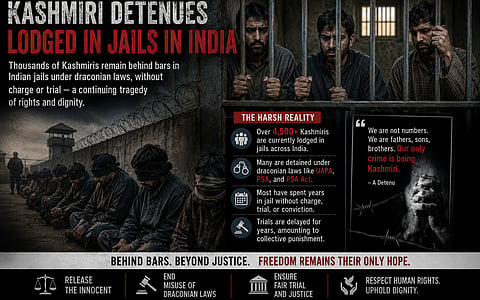
Between 2019 and 2023, Jammu and Kashmir accounted for 3,662 arrests under the Unlawful Activities (Prevention) Act (UAPA), representing roughly 35 percent of all UAPA arrests in India. In 2023 alone, the region recorded 1,206 such arrests, amounting to nearly 42 percent of all UAPA arrests across the country, despite constituting only a small fraction of India's population.
Yet convictions during the same period remained strikingly low.
Only 23 convictions were recorded.
The obvious question, therefore, is whether the primary function of these arrests is prosecution or prolonged detention itself.
The prison population offers another important clue. Official figures obtained through the Right to Information Act show that nearly 91 percent of prisoners in Jammu and Kashmir are undertrials. They have not been convicted of any offence. They remain incarcerated while awaiting legal proceedings that often stretch over months or even years.
Character of Punishment
In such circumstances, detention itself assumes the character of punishment.
The Public Safety Act (PSA) further strengthens this architecture. The law permits preventive detention without many of the safeguards associated with ordinary criminal trials. Bail is largely unavailable in the conventional sense. Authorities may withhold portions of the grounds of detention on the grounds of "public interest." Judicial review is generally confined to examining procedural compliance rather than testing the substance of the allegations. The detention itself rests largely on what the law terms the "subjective satisfaction" of the executive authority.
Supporters argue that such powers are essential in dealing with prolonged security challenges and militancy. Critics respond that extraordinary powers, originally justified as exceptional measures, have gradually become routine tools of governance, extending well beyond genuinely exceptional situations.
Perhaps the least discussed dimension of this system is what may be called distance punishment.
Over the past several years, hundreds of Kashmiri detainees have been lodged in prisons located in Uttar Pradesh, Haryana, Delhi and other parts of India. Officially, these transfers are administrative decisions. Their social consequences, however, are profound.
I witnessed this personally.
Following the developments of August 2019, I was among those transferred to Agra Central Jail, where I remained incarcerated for four months. During my imprisonment, I met numerous Kashmiri detainees whose families never came to visit them. The reason was not indifference or abandonment. Quite simply, they could not afford the journey.
Travelling from Kashmir to Agra involved expensive transportation, accommodation, several days away from work, and navigating an unfamiliar prison bureaucracy in another state. Elderly parents were physically unable to travel. Wives struggled to manage households alone. Young children grew up separated from fathers whom they could rarely meet.
The burden of imprisonment extended far beyond the prisoner.
Distance itself became part of the punishment.
This illustrates why prisons alone cannot explain Kashmir's contemporary reality. Imprisonment represents only one stage in a broader continuum of control.
The process often begins with expansive legal provisions capable of converting political expression, association, or suspicion into criminal investigation. It is reinforced through surveillance technologies, extensive policing, military presence, administrative restrictions on movement, prolonged judicial processes, and finally incarceration. Each institution complements the others, creating an integrated system rather than isolated legal measures.
The prison, therefore, is not an exception within governance. It has increasingly become one of its defining features.
History offers important lessons. Colonial administrations in Ireland, Algeria and several other territories relied not only on military force but also on preventive detention, emergency regulations and political imprisonment to manage dissent. Historical contexts are never identical, and simplistic comparisons should be avoided. Nevertheless, these experiences demonstrate how systems created in the name of security can gradually evolve into broader mechanisms for regulating political life.
This evolution matters because its consequences extend well beyond those who occupy prison cells.
Cumulative Impact
When large numbers of people remain imprisoned without timely trials, families become unintended victims. When legal uncertainty replaces judicial certainty, public confidence in institutions weakens. When exceptional laws become routine instruments of governance, fear itself begins to influence everyday social and political behaviour.
The cumulative impact is not merely legal. It is psychological, economic and social.
Entire communities begin adjusting their conduct in anticipation of surveillance or detention. Families experience prolonged financial hardship. Young people grow up witnessing uncertainty as an ordinary feature of civic life. Over time, imprisonment ceases to be viewed as an exceptional response to crime and instead becomes embedded within the political landscape itself.
For this reason, Kashmir's prison system cannot be understood merely by counting detainees or measuring prison capacity.
It must be examined as part of a wider carceral framework in which law, policing, surveillance, bureaucracy and incarceration operate together to shape the relationship between the state and society.
The debate on Kashmir has long revolved around territory, sovereignty and security. Those questions remain significant and will undoubtedly continue to dominate political discourse. Yet an equally pressing question deserves greater attention.
What happens to a society when exceptional laws become ordinary? What happens when thousands remain undertrial for years without conviction? What happens when the hidden costs of detention are borne not only by prisoners but by parents, spouses and children living with separation, financial hardship and uncertainty?
These questions go to the heart of Kashmir's future.
The prison today is no longer simply a place where individuals are confined.
It has become one of the principal ways through which power is exercised over society itself.
To understand contemporary Kashmir, we must therefore look beyond the prison walls.
It is there, within the legal architecture, the administrative machinery and the lived experiences of thousands of ordinary families, that the true contours of Kashmir's evolving carceral regime become visible.
Have you liked the news article?
Support us now:
https://www.gofundme.com/manage/jammu-kashmirs-sole-independent-voice-under-threat