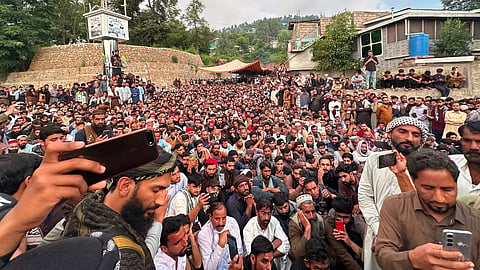


MUZAFFARABAD: A fresh political initiative to resolve the escalating crisis in Pakistan-administered Jammu and Kashmir (PaJK) has run into resistance from the Jammu Kashmir Joint Awami Action Committee (JAAC).
Authorities have also intensified restrictions and reportedly directed residents of three Rawalakot neighbourhoods to vacate their homes ahead of a possible security operation.
A consultative conference of political leaders and prominent figures from Poonch, held in Islamabad on Monday, announced the formation of a six-member committee headed by former president Sardar Masood Khan to facilitate negotiations and prepare a comprehensive framework for dialogue within five days.
The conference called for a peaceful resolution of the Rawalakot sit-in, implementation of the October 2025 Agreement between the Pakistan government and the JAAC, compensation for families affected by the violence, and reopening of roads blocked by security forces.
However, the Poonch chapter of the JAAC strongly objected to the conference declaration, accusing its participants of endorsing the official narrative by portraying the popular rights movement as violent and anti-state.
The initiative comes amid mounting public anxiety over a possible security operation in Rawalakot and the inclusion of another 75 people, including Rawalakot Municipal Corporation Mayor Abdul Naeem Khan, in the Fourth Schedule under anti-terrorism provisions.
Political Leaders Call De-escalation
Organised by the Jammu and Kashmir Peoples' Party (JKPP), the Islamabad conference brought together former president Masood Khan, former president and prime minister Sardar Muhammad Yaqoob Khan, former prime minister Sardar Tanveer Ilyas Khan, former legislator Sardar Hassan Ibrahim Khan and former Jamaat-e-Islami chief Dr Khalid Mahmood, among others.
Addressing the gathering, Masood Khan called for simultaneous termination of the protest in Rawalakot and the security forces' operation.
“The ongoing protest in Rawalakot and the security operation should end simultaneously,” Khan said, stressing that both sides needed to take measures to create conditions conducive to negotiations.
He also proposed establishing a legal mechanism to remove the JAAC from the list of proscribed organisations.
Khan suggested adopting a phased rehabilitation programme for young people allegedly carrying weapons to facilitate their return to normal civilian life.
He called for the publication of a government white paper detailing progress on the Action Committee's 38 demands.
“The government should clarify which demands have been fully implemented, which have been partially addressed and which remain pending,” he said.
The former president also advocated engaging Pakistan's political parties and sending government representatives abroad to address concerns among foreign governments and the Kashmiri diaspora.
He stressed the need to provide the Action Committee with a politically acceptable route back into negotiations and devise a compensation mechanism for families of those who were not directly involved in attacks on security personnel.
Military Operation No Solution
The joint declaration issued after the conference categorically opposed a military solution to the crisis.
“No military operation can provide a solution to the problem. A political and negotiated approach must be adopted to resolve the issue of the sit-in,” the declaration stated.
The six-member mediation committee comprises Masood Khan, Muhammad Yaqoob Khan, Tanveer Ilyas Khan, Brigadier Muhammad Khan, Dr Khalid Mahmood and Hassan Ibrahim Khan.
The conference demanded immediate implementation of the October 2025 agreement and compensation for families that had suffered loss of life during the unrest.
It also called for reopening entry points to Poonch and Sudhnoti districts and dismantling security checkpoints.
The declaration acknowledged that road closures had caused considerable hardship to residents, while the suspension of mobile communications and closure of educational institutions had compounded their difficulties.
However, the participants also condemned the presence of armed individuals in Rawalakot and called for enforcement of the law.
The declaration reaffirmed the region's historical, cultural and religious relationship with Pakistan, referring to the July 19, 1947, resolution advocating accession to Pakistan and the October 24, 1947, proclamation establishing the government of Azad Jammu and Kashmir.
Action Committee Rejects Declaration
The JAAC's Poonch chapter reacted sharply, accusing the conference participants of failing to take an unequivocal position on civilian deaths and security forces' actions.
“Instead of taking a clear position on civilian killings and the actions of security forces, the conference has issued a declaration that strengthens the state narrative,” the committee said in a statement.
It questioned the apparent contradiction between demanding implementation of the October 2025 agreement and accepting the government's designation of the JAAC as a proscribed organisation.
“If the conference demands implementation of the October 2025 agreement, why has it failed to take a clear position against the proscription of the organisation that signed that agreement?” the committee asked.
The JAAC pointed out that it was not a banned organisation when the Pakistan government negotiated and signed the agreement with its representatives.
It also accused the political leaders of remaining silent over civilian deaths during incidents on June 7 and 9 and subsequently endorsing attempts to portray the movement as anti-state.
“This movement is not confined to Poonch. It extends from Bhimber to Taobat and includes Kashmiris living overseas,” the statement said.
The committee described the declaration as contradictory and opportunistic, insisting that implementation of the agreement and recognition of legitimate public demands should form the basis of any negotiations.
Rawalakot Mayor Among 75 on Fourth Schedule
Meanwhile, the authorities have intensified their crackdown on individuals associated with the public rights movement by placing another 75 people on the Fourth Schedule under the region's anti-terrorism legislation.
Among them is Abdul Naeem Khan, the elected mayor of Rawalakot Municipal Corporation. Authorities had previously sealed his private business establishment.
Khan has a long history of involvement in local traders' politics. Following his election as mayor approximately four years ago, he relinquished leadership of his faction of the Rawalakot traders' association, paving the way for Umar Nazir Kashmiri to become its acting president.
Inclusion in the Fourth Schedule subjects individuals to enhanced surveillance and potentially severe restrictions on financial transactions, travel and other civil liberties.
As previously reported by Kashmir Times, the UK-based Jammu Kashmir Human Rights Observatory documented at least 445 Fourth Schedule entries in its briefing updated on November 11. The figure was more than double the 205 individuals cited by United Nations experts in early September.
The organisation's findings also documented restrictions affecting identity cards, passports, bank accounts and mobile phone connections, with some measures extending to Kashmiris residing overseas.
Residents Asked to Vacate Homes
Adding to public anxiety are reports that security forces have directed residents of Naseem Town, Model Town and Djibouti Town in Rawalakot to vacate their houses ahead of a possible operation against protesters.
A delegation representing residents of the three neighbourhoods met the Rawalakot deputy commissioner to convey their concerns.
“Where are people supposed to go after leaving their ancestral homes? If the administration wants residents to relocate, it must first arrange alternative accommodation,” members of the delegation told the authorities, according to local accounts.
The delegation expressed its inability to comply with the evacuation instructions under the prevailing circumstances.
The administration has yet to issue a detailed public explanation concerning the proposed operation or arrangements for the potentially displaced civilian population.
Meanwhile, videos circulating on social media purportedly showed a complete shutdown in Abbaspur and demonstrations elsewhere in Poonch on November 22 in response to a protest call issued by the JAAC.
Rangers Officer Killed
Tensions in Rawalakot escalated further following a shooting incident near the Matiyal Mara bus terminal on November 17.
According to police, armed individuals opened fire on law enforcement personnel, critically injuring Pakistan Rangers Deputy Superintendent Barkat.
The officer sustained a bullet injury to his head and was subsequently taken to the Combined Military Hospital in Rawalakot, where he succumbed to his injuries.
Police later claimed that four armed individuals had been killed in retaliatory action. However, the initial official press release made no mention of these deaths.
The identities of the four individuals were not immediately disclosed, and their reported deaths could not be independently verified.
The JAAC rejected the police account, accusing security forces of targeting civilians around the bus terminal for several days. It alleged that a young girl had earlier been killed in firing by security personnel.
The committee maintained that authorities had been attempting to dismantle the protest camp since November 5.
“Our movement is peaceful. Attempts are being made to portray it as an armed struggle through the use of force against protesters,” the committee maintained.
Earlier, on November 8, the JAAC had approached Pakistan's army chief, Field Marshal Asim Munir, proposing negotiations at a neutral venue in the presence of observers.
It had also demanded an independent investigation into civilian deaths, disclosure of the whereabouts of detained activists and restoration of communication services.
The Rawalakot agitation has continued for nearly six months, with the movement demanding economic relief, affordable electricity, subsidised flour, political accountability and greater control over local resources.
Islamabad Unveils Development Package
Against the backdrop of continuing unrest in Poonch, Pakistan Prime Minister Shehbaz Sharif, Pakistan Muslim League-Nawaz (PML-N) president Nawaz Sharif, Deputy Prime Minister Ishaq Dar and Punjab Chief Minister Maryam Nawaz visited Muzaffarabad on November 18.
During the visit, PaJK Prime Minister Sardar Iftikhar Ali Gillani presented a Rs 14.75 billion development programme for the first 100 days of his government.
Gillani acknowledged that repeated changes of government had undermined public confidence in the region's political and administrative institutions.
“Four governments have changed during the past five years. This has affected people's confidence in the system of governance,” Gillani said.
He pledged to restore public confidence through merit-based recruitment, development projects and improvements in public services.
The programme envisages the establishment of three cardiac catheterisation laboratories and two stroke treatment centres, upgrading primary healthcare facilities and introducing mobile clinics modelled on a similar initiative in Punjab.
The government also announced plans to launch the Suthra Kashmir sanitation programme in eight district headquarters and introduce an affordable housing scheme.
Two separate scholarship programmes will be introduced for deserving students pursuing higher education in public universities and leading private institutions.
The government also intends to provide vocational training and business loans to young people.
Under the transport component, the Green Bus Service already operational in Mirpur and Muzaffarabad will be extended to six more cities.
Tourism infrastructure, road connectivity, modernisation of government guest houses and beautification of divisional headquarters also feature in the development programme.
President Dr Muhammad Najeeb Naqi and Legislative Assembly Speaker Chaudhry Tariq Farooq attended the meeting, during which Pakistan's federal leadership assured financial and administrative cooperation.
Rathua Haryam Bridge Inaugurated
During the visit, Shehbaz Sharif also inaugurated the Rathua Haryam bridge in the presence of Nawaz Sharif, President Naqi and Prime Minister Gillani.
Describing the project as an important milestone in the region's development, Sharif said the bridge would improve connectivity between Mirpur and surrounding areas, facilitate travel and stimulate commercial activity.
The announcement of development projects comes at a time when the government faces mounting criticism over restrictions on civil liberties and its handling of the public rights movement.
In another significant development, the PaJK Supreme Court delivered its reserved judgment on several appeals concerning quotas in government employment and admissions to educational institutions.
A two-member bench headed by Chief Justice Raja Saeed Akram Khan upheld, with modifications, an earlier High Court ruling concerning open-merit recruitment.
Under the judgment, all government posts in Grade 16 and above will be filled through open competition among eligible state subjects.
Recruitment to posts in Grades 1 to 7 will be conducted on merit within the respective constituencies, while appointments in Grades 8 to 15 will be made on a district-wide merit basis.
For divisional institutions, recruitment in Grades 1 to 15 will be conducted among eligible candidates belonging to the respective divisions.
All positions in state-level institutions headquartered in Muzaffarabad will be filled through open merit among eligible state subjects.
The court also overturned the High Court's directions concerning admissions to federal and provincial educational institutions in Pakistan, ruling that nominations to educational and professional training institutions must be governed by the applicable laws.
Recruitments and admissions lawfully completed before the judgment will remain unaffected.
Selection processes already underway will be completed under the legal provisions applicable when the respective vacancies were advertised.
The court also invalidated an August 18, 2025, press release issued by the Public Service Commission and directed that pending recruitment processes be completed in accordance with the law.
It clarified that legislation governing employment quotas and educational admissions falls within the jurisdiction of the legislature.
Uncertainty Over Dialogue
While the government has sought to project economic development and administrative reforms as instruments for restoring public confidence, developments in Rawalakot point to a deepening political crisis.
The proposed mediation committee faces the immediate challenge of securing the confidence of the JAAC, which considers its proscription and the continuing security operations fundamental obstacles to meaningful negotiations.
The committee's ability to initiate dialogue within the proposed five-day period will depend largely on whether the authorities and protest organisers can agree on measures to reduce tensions.
For residents of Poonch, however, the immediate concerns remain the safety of civilians, reopening of roads, restoration of communications and an end to the prolonged confrontation.
Have you liked the news article?
Support us now:
https://www.gofundme.com/manage/jammu-kashmirs-sole-independent-voice-under-threat