

SRINAGAR: Parveena Begum, 45, from Kandi village in Rafiabad, Baramulla, does not follow the news from Iran or Israel. But she knows what it means. "We used to cook on firewood in a Dambur when we didn't have gas," she says. "Now, with LPG (Liquified Petroleum Gas) cylinder prices rising and supplies uncertain, we are going back to that way."
Her neighbour Naseema, 55, has run into another problem. "Because of continuous rainfall over the past few days, even our stored firewood has finished," she says. "Now it is very difficult to find dry wood anywhere."
On the ground in Kashmir, geopolitics goes beyond the headlines, transforming into wet wood and empty cylinders.
The Price Rises and Endless Queues
A 14-kg household LPG cylinder now costs Rs 1,029 across the Kashmir Valley, up Rs 60 from the previous Rs 969. The 19-kg commercial cylinder has gone up by Rs 142.50 — from Rs 2,046 to Rs 2,188.50. The increase was confirmed by Jagmohan Singh Raina, owner of Kashmir Gas Agency.
Industry executives have attributed the hike to instability in global energy supply. Worries are growing about key supply routes, including the Strait of Hormuz, and their disruption has begun rippling across India and reaching Kashmir’s valleys and villages.
Nationally, Indian authorities have urged LPG customers to avoid panic bookings and, where possible, shift to piped natural gas. That advice has done little to calm nerves in Kashmir.
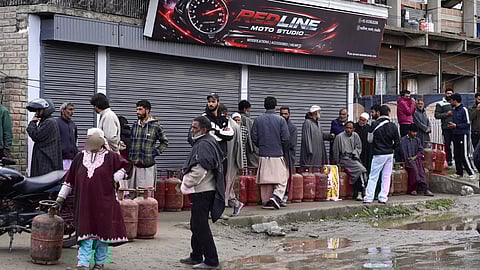
Outside gas agencies across the Valley, long queues have become a familiar sight. Households that earlier managed on one cylinder are now trying to stock an extra one. The surge in demand, driven by both panic and confirmed shortage, has put pressure on a system that had limited room to spare.
Farooq Ahmad Lone, who runs Lone Gas Agency in Wadura, Sopore, says supply has not actually stopped.
"Earlier, we used to receive 368 cylinders in one truck. Now it has increased to around 468," he says. But the demand has outpaced even the increase. Every day, between 500 and 700 people gather outside his agency, including, he says, people who already have gas at home.
“Last Ramadan, we sold around 4,500 cylinders. This year, by mid-March, we have already crossed 6,700 bookings."
To manage the rush, authorities have introduced limits. Refills are now allowed only after 45 days in rural areas and 25 days in urban areas. But according to Lone, many consumers are not booking in advance. "They come directly when they see a vehicle, which creates chaos."
The Contrasting Villages
The rural areas in Kashmir, with distant access to LPG agencies, present a picture of contrast. Panic buying in the urban areas is leaving the villages completely devoid of the cylinders.
Parvaiz Ahmad, a village-level distributor from Wanpora, Anantnag, describes a near-complete breakdown at his end. "Since the shortage announcement, I have not received a single cylinder from the agency," he says.
He used to distribute around 200 cylinders to nearly 250 registered households. Now, supply at the village level has stopped, and people are making the journey to agencies themselves.
During Eid, the pressure on his community was especially sharp. "Households keep calling me, asking when gas will arrive. But I have no answer for them."
“People travel long distances, wait for hours at agencies, and still many return empty-handed,” he adds.
For daily wage workers, he says, queuing at an agency means losing a full day's income with no guarantee of returning with anything. "This is my only source of income, and I have not sold even one cylinder since the shortage began."
Naseema, from Rafiabad, has watched even the vehicles come and go without stopping. "On March 19, I waited for the Shalimar Gas Agency vehicle in Soin Syednar village. It did not stop. We returned empty-handed.
"If the government says there is no shortage, then why are cylinders not reaching villages like before?" she questions.
The Official Stand
Officially, the situation is under control. The Divisional Commissioner has stated that Kashmir holds more than 15 days of petrol and diesel reserves, and around 13 days of LPG stock, within the region's 15 to 20-day storage capacity. Jammu and Kashmir has more than 12.6 lakh LPG connections, many added through the Ujjwala scheme, and a bottling capacity of around 185 thousand metric tonnes per year.
But that buffer, which is adequate under normal demand, offers little room when consumption spikes suddenly. Officials have urged consumers to hold off on panic buying. The gap between that message and lived experience is, however, stoking anxiety.
Local Success and Global Disruptions
Jammu and Kashmir's vulnerability to this kind of disruption is partly the result of its own success. The Ujjwala scheme has brought LPG into more than 12.6 lakh homes across Jammu and Kashmir, a transformation in how the region cooks, heats water and gets through winter.
But that dependence has outgrown the infrastructure built to support it.
The region's bottling capacity is about 185 thousand metric tonnes per year, with storage that can hold between 15 and 20 days of supply under normal conditions. When demand spikes, that buffer disappears quickly. A region that moved away from firewood now finds itself exposed every time the world's energy supply becomes unpredictable.
That unpredictability is driven by a remote war: the Strait of Hormuz, the waterway through which a significant share of the world's oil and gas moves, and which sits at the centre of the Iran-Israel tensions is driving the current anxiety.
What begins as a geopolitical standoff travel through supply chains, pricing decisions and public rumour before arriving, finally, in a village in Rafiabad or a lane in Sopore.
The Cost of Cooking
For families like Mehraj-ud-Din's, the pressure is accumulating from multiple directions. Mehraj, 43, a painter from Amargrah, Sopore, says one cylinder now costs around Rs 1,100 when factoring in the hike. "Earlier, we could somehow adjust. But with inflation in food and other essentials, it is becoming very hard."
His household's consumption has also changed. A cylinder that once lasted nearly two months now lasts barely one, partly because electricity became costly after smart meters were installed, pushing the family to rely more on gas. "Now both options are costly," he says. "There is always tension that gas may not be available in the coming days."
For Parveena Begum and Naseema in Rafiabad, the same logic has led back to the Dambur (also commonly known as Daan or Daan-e-Chulha), the traditional wood-burning stove. Smart meters made electricity expensive. Gas has become uncertain. Firewood, even wet firewood in a rainy March, feels like the only thing left.
"Electricity bills are too high because of smart meters, so firewood feels more affordable," Parveena says.
Have you liked the news article?
Support us now:
https://www.gofundme.com/manage/jammu-kashmirs-sole-independent-voice-under-threat