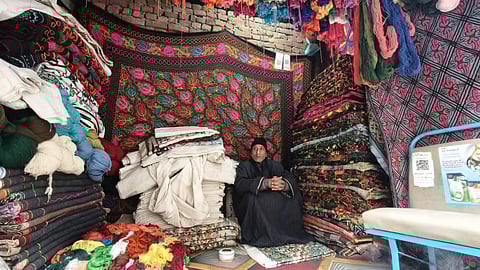


The smell of raw wool, earthy and damp, mixed with the sharp, nutty scent of walnut shells and the faint, metallic hint of dye fills a small, sunlit room in Kadipora, a locality in Anantnag’s old lanes that seem to be caught in a time warp.
Masood Wagay, better known as Bita Wagay, holds a stretched piece of thick, grey felt in his hands, broad and mapped with the calluses of a lifetime, as they move with a slow, deliberate certainty inside his home cum workshop. On the right, the Aari – a hooked needle anchored in a simple wooden handle – dips and rises, pulling a brilliant crimson thread through the dense fabric. Each pull makes that soft, punching sound. Each stitch is a small, tight knot in a chain, a link in a story that is almost five centuries old.
Such workshops once thrived with a rhythmic chorus of needles breaking the silence of the dead winters. Today, there’s just the whisper of the punch that rents the air in a quiet room, like a lonely echo of a centuries-old story.
“Look at this,” Masood says, not looking up, his voice reduced to a low rumble due to years of chain-smoking. His finger traces a pattern emerging from the grey - the elegant, serrated outline of a Chinar leaf. This tree bears witness to everything in this valley, the pains, art, culture, even the untold literature. “We put it in our work, so it is never forgotten,” he says in a matter-of-fact manner.
He pauses, the needle hovering, and his voice turning melancholic, “But who will remember us? Who will remember this?”
Masood Wagay is one of the master artisans of the Gabba, the vibrant, embroidered rug that was once the warm, beating heart of every common Kashmiri home. To sit with him is to understand that this is not merely about the disappearance of a craft. It is about the slow, painful silencing of a language – a language spoken in wool and thread, telling stories of home, of nature, of resilience.
The rhythmic chorus of Aari needles that once echoed through these districts is now reduced to faint, individual pulses. Men like Masood are stitching against time, and the thread is running out. The beauty they weave can no longer pay the bills. It can fetch a government certificate but keep the kitchen empty.
The story of the Gabba is one of a craft born from the ingenious thrift of Kashmiri women, nurtured by kings, and now threatened by the cheap, mechanical drone of power looms from distant industrial towns. And, in a land where politics draws hard lines, it is also about a silent, stubborn thread that continues to connect people on both sides of bitterly divided territories. On both sides, despite its decline, artisans continue to weave the same patterns, sing the same sad, beautiful songs.
Gabba story born in practicality, not in palaces
To understand Gabba, one must first forget the notion of luxury. Its genesis is rooted not in palaces, but in practicality, in the simple, acute need for warmth during the harsh Kashmir winter. Its soul lies in the concept of nothing wasted.
For centuries, the humble Chaeder – a thick wool blanket – was a household staple. After years of use, when it grew thin and worn, it was not discarded. These old blankets were collected, washed clean in the cold river water, and then felted. This process of milling, pressing, and matting the fibres transformed the soft, fraying wool into a tough, new canvas. It was recycled in its purest form, centuries before the term became a slogan.
This sturdy, recycled felt was then dyed using what the valley provided: walnut shells for rich browns, pomegranate rind for a vibrant crimson, indigo for deep blues and saffron for golden yellows. The dyed felt was layered and given a cotton backing. Then, the transformation from fabric to heirloom began.
Using the Aari, artisans, often women working in village clusters, would cover this canvas in dense, chain-stitch embroidery. This is where Gabba parted ways with its more famous cousin, the Kashmiri Carpet, or Kaleen. Carpets followed the taleem, a precise, coded script dictating every knot and colour for often courtly patrons. Gabba was freehand. It was folk art. The designs emerged from life: the majestic Chinar leaf, the delicate saffron flower, stylised geometric patterns (jaalis), and narrative scenes (Badnas) of Shikaras in Dal Lake, wedding processions, or birds in flight.
“A Gabba was the pride of a simple home,” says Prof Altaf Kashmiri, a cultural historian based in Yaripora, Kulgam adding, “It was affordable art and still is. A family would save for it, cherish it, pass it down. It was on the floor, on the beds, telling our stories underfoot. It was the warmth of our history."
It was, in essence, participatory democracy in craft. If boosted, it can still be so. While Sultan Zain-ul-Abidin (Budshah) in the 15th century is celebrated for bringing Persian masters to refine Kashmir’s Carpet and Shawl weaving, Gabba flourished in the shadow of that royal patronage. It was the people’s art, a testament to a culture that found beauty in necessity and made heritage from the everyday. But Anantnag has the distinction that Gabba-making art of Kashmir started from Kadipora.
‘Certificates, awards don’t get us our meals’
Anantnag district, especially the areas around Kadipora and Sarnal, besides Anchidora, Chee and Anzwala remain the stubborn, slowing heart of the Gabba and other Aari-work craft. The workshops are small, family-run spaces where the air is still thick with wool and dust. But the buzz of activity is gone.
Masood Wagay has been an 'approved artisan' with the government’s Handicrafts Department for years. The title, he explains, feels like a cruel joke. "They register us. They come, they take our photo for their files, they write our number in a big book,” he says, his voice gaining an edge. They show these numbers in meetings. We have so many thousand artisans. But what reaches our hands? Nothing that can fill a stomach.”
He lays down his Aari. “The schemes are like giving a starving man a single peanut. It is an insult. We need work, a proper market, a fair price. Not just certificates and photos.”
He points to a finished, high-end Gabba rolled up in the corner. It is stunning with a burst of intricate florals and geometric borders. “This took my wife and me, working together, over a week. Maybe we sell it for 6,000 rupees. From that, take the cost of wool, thread, dye, and backing. What are we left with? Maybe 200 rupees a day if it sells immediately.”
But it sits here for months. “Meanwhile, my neighbour, who drives a battery-supported autorickshaw earns more in a day than I do in days together. My son looks at my hands, at this struggle, and he says, ‘Papa, I will not do this.’ And I cannot blame him,” Masood says.
A short drive away, in a workshop in Sarnal, Ghulam Nabi Malhar tells the same story with a weary sadness. His fingers, stained with dye, move almost autonomously over a piece. He is also an approved artisan, a master with over 40 years in the craft.
“The government talks of loans,” Ghulam Nabi says. “They offer maybe two lakh rupees. But a loan for what? To buy materials for a product that has no market? Many who take these loans are honest people, but they are forced to use that money just to survive, to feed their families. They might buy something else or fix their houses. The craft dies a little more.”
“The heart is willing, but the stomach is empty,” Ghulam Nabi says, highlighting the irony of the profession marked by a gap between passion and profits.
An official from the Anantnag Handicrafts office, who did not want to be named, outlines the support system. There are training centres, he says, producing new artisans, mostly women. Loans are available with interest subsidies of 7%. Over 3,974 Gabba artisans are registered in the district alone. The numbers, he insists, show a system that works.
But in the dust-filled silence of the workshops, those numbers feel hollow. “They have a pension for politicians,” Masood Wagay states bluntly. “What pension is there for the man who makes the beauty of this valley with his own hands? We struggle to preserve the deep-rooted culture and conserve centuries-old art? Aren't we the ambassadors? If I cut my finger while working, who pays? If I get sick from the wool dust, who cares? Except for the Golden Card, which is not for all ailments and everybody possesses this.”
“We are like the old Chaeder they used to make Gabba from. Used, worn, and then forgotten,” he says, adding that although handicraft artisans have some access to social security or even accident insurance through government schemes, primarily linked to the PAHCHAN identity card program, rather than a dedicated, comprehensive health insurance scheme, here, in Jammu and Kashmir, the scheme itself is mired in confusion.
Cheap Copies, Lost Youth, and Broken Lines
The forces unravelling the Gabba are clear to every man and woman who still tries to make it.
The first and most formidable enemy is the market. Walk into any furniture or home goods store in Srinagar, or in the lanes of Anantnag, and you will see them - bright, garish rugs with “Kashmiri design” stamped on the tag. They are made on power looms in places such as Punjab, produced for pennies, and sold for a fraction of a real Gabba’s price. They are flat, soulless, and perfect. A handmade Gabba has texture, soul, and slight, human imperfections - the very qualities that now count against it.
“The machine has killed us,” Ghulam Nabi says simply. “A family will come, they will see a machine rug for 1,200 rupees and a real Gabba for 3,000. They do not see the weeks of our lives in it. They see only the price tag.”
The second enemy is time itself. With no money in the craft, the young want nothing to do with it. The knowledge that was passed from mother to daughter, from master to apprentice in a quiet, unbroken line for generations, is hitting a wall. This loss is absolute.
The ultimate testament to the craft’s pinnacle was Mohammad Akram Bhat from Anantnag, the only artisan to ever receive a National Award for Gabba making, who died a few years ago. His passing was not just the loss of a master. It was the severing of a living link to the highest possible standard, a repository of unmatched skill and nuance that has no successor.
“My grandchildren are educated,” Ghulam Nabi says, a note of pride and sorrow mixing in his voice. “They have smartphones, they see the world. They want jobs with a salary, with respect. To them, this needle is a symbol of poverty, not pride.”
This loss is more than technical. The craft was always accompanied by its own soundtrack – the Sufi verses and folk songs that artisans would sing to keep rhythm.
Ghulam Nabi Malhar, for instance, finds solace in the lyrics of great Kashmiri poets like Rasul Mir, Mehmood Gami, Naim Sob, Shams Faqir, and is particularly moved by the poetry of Wahab Khar for the vertical divinity. The poetry would fill the room, their themes of love, loss, and the divine mirroring the patience of the work.
“We would sing to pass the long hours, to keep the heart light,” Masood recalls. Now, the workshops are mostly silent. When an old artisan dies, he does not just take his skill with him to his grave. He takes a repository of songs, stories, and motifs that vanish forever.
The third, profoundly political challenge is the fractured land itself.
The Gabba craft is not confined to the Kashmir Valley. In the Muzaffarabad areas across the Line of Control (LoC), the line that divides the two Kashmirs, artisans from the same cultural stream continue similar work. They use the same Aari, stitch the same Chinar leaves and saffron flowers.
But the political divide makes unity, shared marketing, or even simple cultural exchange impossible. A craft that embodies a shared Kashmiri identity is trapped by the very politics that seek to define that identity in narrow, contesting terms.
Yet, there is a powerful, unspoken truth here. Without ever meeting, artisans on both sides of the divide are speaking the same language of thread. They are, in their way, keeping a connection alive. In a land of conflict, the humble Gabba becomes a quiet statement. Our culture, our memory, is deeper than your divisions, they tell the world!
Glimmers of Hope in a Dark Valley
All is not yet lost. Though few, stubborn artisans, designers, and activists are fighting to reweave the future. Their plans are practical, and their hope is cautious.
The most critical step is to make Gabba relevant again. This does not mean changing its core but letting the design breathe. Institutions such as the School of Design in Srinagar are working with artisans, introducing them to concepts for the modern home. The idea is to use the Gabba stitch on new products like striking wall hangings with more minimalist patterns, tablet sleeves, cushion covers, even bold statement pieces for boutique hotels. The craft is moving from the floor to the wall, from the strictly traditional to the contemporary, without losing its soul.
“We must show the artisan that his skill can make something a young person in Delhi or London would want,” says Gulzar Ahmad, a young Anantnag-based designer who works closely with Kadipora families. “It is not about dumbing it down. It is about translating it.”
Another powerful idea is experience. In a world hungry for authenticity, the workshop itself is a treasure. Imagine a traveller coming to Kadipora, Anantnag not just to buy, but to learn Gabba-making - to spend a day carding wool, feeling the felt, and learning to make a single chain stitch while listening to the story of the craft.
This 'experiential tourism' turns a purchase into a memory, and a memory into a deeper value no machine-made product can ever touch. The artisan becomes a teacher, a storyteller, not just a labourer, who needs to be encouraged and fostered.
The story of Gabba itself is its strongest selling point. In an age obsessed with sustainability, here is a craft that is the original upcycle – centuries of green practice. It is the story of human hands, patience, recycling and cultural survival. This story needs to be told, loudly and cleverly, through social media, through collaborations with ethical brands, and at international design fairs.
The Geographical Indication (GI) tag, which Gabba possesses, must be a stamp of a powerful story, not just a legal formality.
But none of this works unless the artisan can live. As Masood and Ghulam Nabi plead, support must be real. A comprehensive social security net – health insurance, accident cover, a small pension – would provide the dignity that allows creativity to flourish. Scholarships for artisans’ children that are not easy to access tell families that their heritage is valued, that this skill is worthy of respect, Masood suggests.
Yes, there are institutional efforts. The Department of Handicrafts under government of Jammu and Kashmir has established 7 training centres for elementary Gabba skills in Anantnag district alone, with about 20 artisans, mainly women, passing out annually from each centre. The government sometimes provides chances to sell at exhibitions and give live demonstrations.
But as Ghulam Nabi stresses, these need to be part of a larger mission. They should promote Gabba as the cultural economy of the valley, besides the inherited legacy and the oral literature associated with the Gabba making.
More importantly, Anantnag's 2044 master plan can position the Artisan Corridor as the central mechanism for promoting Gabba making and other traditional arts, making it an ideal catalyst.
By embedding this medieval craft into the developmental fabric through the Mattan Loop (connecting crafts hubs from Mattan Adda through Kadipora, Sarnal, Kransoo, and Paibugh, back to Mattan), the Chee Loop (Linking Chee through Anchidora, Anzwala, Aang Matipora, and Shamsipora, returning to Mattan, with a strategic cross-connection at Laizbal) and Western Corridor (starting from Khanabal through Seepan, Guree, Nabuk, Veer, Gadi Seer, to Zirpara Bejbehara), the locals are proposing a plan that directly connects Gabba-practicing villages and elevates female artisans from marginalised producers to recognised cultural custodians.
Artisan Corridors in Jammu and Kashmir have the potential for a powerful cultural-economic revival and can safeguard ancestral knowledge by placing artisans at the centre of progress, ensuring their skills are celebrated, innovated, and passed on. The corridors will foster micro-economies, enhance local identity, and create a resilient ecosystem where tradition fuels prosperity.
And perhaps, in small ways, the craft can even bridge divides. While politics is rigid, culture can be fluid. NGOs or cultural bodies could create virtual museums, showing Gabbas from both sides of the LoC, highlighting the shared heritage. It would be a quiet reminder that the patterns of the heart often ignore the lines on a map.
The Last Stitch?
The stakes could not be clearer. We are not just talking about losing a rug. We are talking about losing a language, a memory system, a centuries-old dialogue between a people and their land.
The legacy of masters like Mohammad Akram Bhat, the lone national awardee, now lives only in memory and in the pieces he left behind. It is a haunting reminder of the heights this craft can reach, and the depth of the void its disappearance would create.
The Gabba is a metaphor for Kashmir itself; taking what is worn, broken, or discarded and weaving it back into something whole, warm, and breathtakingly beautiful.
As the afternoon light slants through the window of his Kadipora home-set workshop, Masood Wagay picks up his Aari again. He selects a thread the colour of sunflower petals. He adjusts the heavy felt on his lap. For a moment, he is silent. Then, he begins to hum, very softly. It is an old folk tune, a love song. The hooked needle dips and rises. Punch, Punch, Punch!
Each stitch is a defiance. Each knot is a hope that someone, somewhere, will see not just a rug, but a heart beating in wool and thread. He is stitching against oblivion. The question that hangs in the wool-dust is for all of us.
Will we listen to the fading rhythm, and will we act before the last thread is cut?
Have you liked the news article?
Support us now:
https://www.gofundme.com/manage/jammu-kashmirs-sole-independent-voice-under-threat