

In early April of 2025, I spent a week on holiday in Kashmir. Since then, not a day has passed in which I have not thought about the status of the valley and the lives of those who call it home. It is both my own silence– sharing what I witnessed and have learned since then – and the silence imposed on journalists, scholars, and ordinary people alike who live in the region, that sustains my moral unrest.
Immediately after my trip, I returned to work in Gujarat, the historically conservative, and notoriously pro-Modi state in Western India. At the time, I felt unsure of how to broach the subject of Kashmir. I did not want to spread misinformation or speak on behalf of people whose lives I had barely seen. I also did not want to be confronted with vitriol and condemnation for the conclusions I was drawing, if I was not fortified in fact. To speak of Kashmir, even as a privileged outsider, is to anticipate a passionate, often dogmatic response.
It was also only one week after my return from Kashmir that the Pahalgam attack in the Betaab Valley shifted public conversations about the region’s status from either awkward, suppressive, predetermined, or tourist-centric, to enraged or enthusiastically pro-militarisation. The flagrant anti-Pakistan, pro-war rhetoric gave both implicit and explicit license for anti-Muslim and anti-Kashmiri sentiment to run rampant across the country.
As the months passed, I continued to see or hear only fragments of how Kashmiris are experiencing yet another worsening chapter in a long history marked by state violence. The Indian government’s sweeping raids, mass detentions, flattening of homes, and the targeting of journalists and literature reflect a systematic effort to suffocate Kashmiri truth.
After reading in recent months about a Kashmiri man who set himself ablaze, seemingly in response to the Indian military’s raids of civilian homes, I found myself reflecting on how these circumstances echo other crises of injustice and human rights violations around the world.
I thus feel it necessary to recount my own very brief glimpse of life in the region, and to situate it within some broader context.
Bearing Witness to Militarisation
Before departing on my trip, I was broadly familiar with the territory’s history and had read recent reports of human rights violations since the 2019 Reorganisation Act, which stripped Kashmir of its semi-autonomous status. I was also particularly moved by the solidarity expressed by Kashmiris with the Palestinian struggle. The comparisons always felt especially poignant and consequential.
Even so, visiting as a tourist rather than in a journalistic or research capacity, I assumed there would be very real limits to what I might witness or critically learn in such a short time frame. My itinerary was oriented towards touristic sites in major cities like Srinagar and Sonamarg.
While I had planned to spend time with locals, I did not expect it would be appropriate or feasible to initiate conversations on such charged subjects. I was unprepared for how plain the militarisation would be. Had I understood it beyond theory, I would not have been so surprised by what I saw – and what I saw was so little, relatively speaking.
The Indian government’s securitisation and systematic obstruction of daily life for those living in Kashmir is so palpable, visible, and encompassing, that even within the constraints of a six-day, tourist-centered trip, as a white, American foreigner, I could not ignore it. The conditions indicated the physical and psychological ways in which Kashmiris live under the ongoing grip of military control.
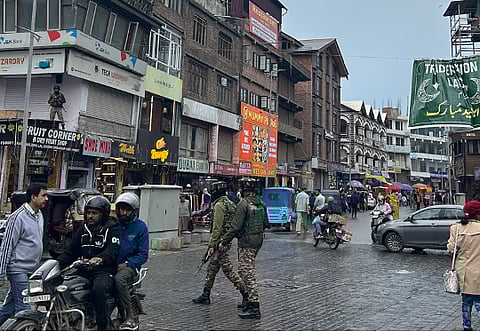
The most visible and immediate manifestation of this is found in the overwhelming presence of soldiers and officers. Kashmir has long been recognized as one of the most militarised zones in the world, with estimates suggesting over 500,000 to 700,000 Indian troops are spread throughout the ‘administered’ territories. Armed policemen or military personnel, often holding automatic weapons, are present on every major street corner.
The pervasiveness of armed forces and police not only suggests a state of constant public surveillance, but also actualises a state of constant intimidation. I quickly internalised the message I assume the Indian government intends to send to the Kashmiri public: this area is controlled, securitised, and those in uniform have the discretion to enforce the law as they see fit. I have later learned they possess the authority to determine who and what constitutes a security threat with little, if any, oversight.
The sheer abundance of units was striking. I saw what appeared to be nearly a dozen different uniforms, representing various factions of the Indian army as well as state and local police forces. The Indian Army deploys regular soldiers, special forces, and various units of the Central Armed Police Forces: the Border Security Force, the Central Reserve Police Force, the Sashastra Seema Bal, and the Indo-Tibetan Border Police, among others.
Collectively, soldiers and officers roam public squares, stand armed on street corners, line roads, monitor checkpoints, direct traffic, and observe civilians atop balconies and rooftops. They are not present in every neighbourhood, but they are never far away.
On my first day in Srinagar, while walking around Lal Chowk, a bustling shopping area, I witnessed an officer physically strike a civilian. A military guard yelled at a rickshaw driver to move from where he was parked near a sidewalk. Upon waiting for just a few seconds for him to respond, the officer hit him in the back with his baton. The driver recoiled in pain. He looked over sixty.
I was stunned and ready to object, but no one in the surrounding area seemed seriously concerned or surprised. Nearby folks kept their eyes down or walked on without a glance, signaling to me that this kind of harassment is not only commonplace, but that it is unsafe and perhaps futile to speak out against it.
Later in the week, I saw another man, this time a young street vendor, get hit over the head by a baton and then kicked, as an agitated officer directed him to move. Another soldier near him observed and laughed. The lack of response from passers-by for this humiliation and assault felt like another confirmation that to object to this kind of injustice is to potentially submit oneself to the same treatment or worse – to be punished by a man with his gun slung across his chest and his finger resting incessantly on the trigger.
I have since learned that seeking justice against such an officer is nearly impossible in a legal system where the accused will almost certainly be seen as more credible than a Kashmiri victim, and where the laws themselves are structured to guarantee impunity. I felt deeply conflicted in those moments, and in some ways still regret having been a bystander to what I have come to understand is, in context, a relatively mundane act of state violence.
I experienced another instance of an officer abusing his authority during a rickshaw ride to Pari Mahal, nestled in Zabarwan Hills. Before entering the main road that led to the hilltop garden, our vehicle was stopped at what seemed to function as a checkpoint.
An Indian military officer approached the rickshaw and began aggressively demanding payment from my driver. Their discussion quickly escalated into an argument. I could only understand parts of it due to the language barrier, but in essence, the guard was insisting the driver pay him 500 Rupees to allow us to continue up the road – twice the price of my entire fare. My driver contested this and refused to pay.
It was only when another officer arrived, looked into the back of the rickshaw, and saw me, that he insisted the first officer de-escalate. I was then instructed to step out of the vehicle and walk through a small security checkpoint while the driver proceeded in the rickshaw. After I returned to my seat, the driver expressed frustration with how such practices had become routine police arbitrarily shaking down locals with no legitimate reason.
I presume, though I cannot confirm, that it was only my apparent foreignness (being white) that convinced the officers to let my driver pass freely. This incident revealed another seemingly daily injustice Kashmiris are subjected under the control of Indian security forces.
I also deduced that openly photographing the officers – who regularly stared at me as one of the few foreign tourists – would also prove to be a means to be stopped, questioned, and/or cause some kind of agitation. As much as I wanted to subtly document their ubiquity, I found myself acting in alignment with their gaze, capturing personnel only in what I thought could appear an attempt to photograph their surroundings.
(To be concluded)
Have you liked the news article?
Support us now:
https://www.gofundme.com/manage/jammu-kashmirs-sole-independent-voice-under-threat