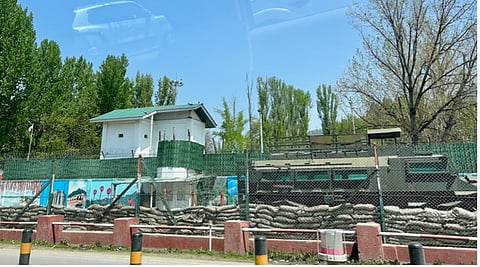


Driving across the valley proved to be both endlessly scenic and jarring. In the springtime in Kashmir, one passes sprawling mustard fields, gorgeous mountains, historic mosques, and quaint towns and villages, alongside metal highway posts where sniper rifles peer through tiny openings fixed on passing cars. Military checkpoints and what seemed like fortified training camps line the major roads and separate neighborhoods. Cement walls and watchtowers covered in thick barbed wire, along with metal barricades that block streets or restrict the flow of traffic, appear small fractures in an otherwise breathtaking landscape.
Declarations of ‘Peace’
Signs and billboards equating the military with “peace” and “protection” were scattered across public infrastructure and metal barriers, in a manner that felt almost too conspicuous. The declarations struck me less as a campaign aimed at civilians and more as a mask designed for its visitors – ground reality painted over with some rhetorical justification.
I thought of the G20 summit held in Kashmir just a few years earlier. It was difficult to imagine how anyone could look at a young boy as I did, standing beside a barbed-wire fortress with a guard holding an AK rifle at his side, and interpret that scene as a portrait of safety.
The farther I was driven from the main city and onto major highways– toward more residential towns like Anantnag–the more intensive the securitisation became. I often found myself trying to make sense of what I was seeing and how to place the tone of banality surrounding it all: How frequent were the stops? The checkpoints? How much did this disrupt day-to-day life? How frequent were outbursts of violence? And how do circumstances that are so obvious, yet remain so heavily contested, safely emerge as a topic of conversation?
By the end of my second day in Kashmir, I discovered it was commonplace to pass military tanks and officers pointing their weapons along the road. I was seeing the surface infrastructure of how the Indian government exercises control over Kashmiris and their lands.
India-Israel Military Partnership
On the third day of my trip, I asked one of my taxi drivers about the presence of soldiers and the military bases around Kashmir. I was aware, in part, that this was a sensitive topic and he would have no reason to trust my intent. Still, given the sheer abundance of officers along the highway, I thought it would be neutral enough to raise—not a question about state violence per se, but about what visitors observe.
In some roundabout way, I asked him whether Indian tourists from other parts of the country ever remark on the stark differences between the relative freedom they enjoy at home to the realities of Kashmir’s militarisation. Did they find the conditions abnormal or alarming?
His demeanor changed almost instantly. He shook his head and closed off the conversation; his smile tightened into a straight, unreadable line. I regretted asking my question until later in the drive, when he called my attention to a group of soldiers as I was gazing out of the window.
He pointed out their particular uniforms, and mentioned that they had trained with Israelis. I double checked with him to make sure I hadn’t misunderstood and I wasn’t projecting my own associations onto his words. He repeated himself and added that the nearby military camp had hosted Israeli soldiers previously and that the partnership between the Indian and Israeli militaries is strong. For many years, he said, Israeli generals have come to bases in the valley, or Indian units are sent to train in Israel.
His remarks offered a clarifying and sobering link to hundreds – perhaps thousands – of videos and testimonies I had previously digested documenting the IDF’s inhumane tactics in occupied Palestine. Later, I confirmed the uniforms we saw were likely those of Indian Garud commandos.
I did additional reading that night and found plenty of documentation showing that the military partnership between the two governments extends far beyond arms deals. For decades, Israeli military and intelligence officers have been sent to Kashmir to train Indian forces in advanced “security tactics,” while Indian units have been sent to Israel to learn methods the Israeli Offensive Forces (IOF) has tested and exercises daily against Palestinians.
I was especially alarmed to learn that at one point, following the Indian government’s move to strip Kashmir’s autonomous status, Israeli human rights groups initiated a concerted effort to prevent Israeli training of an Indian military unit because of their documented human rights abuses against Kashmiris. It was a clarifying indicator of the trajectory and nature of how the Indian armed forces operate in the region.
While the history stretches back decades, and the scope of Israeli-Indian military cooperation extends far beyond the Kashmir valley, it remains the principal testing ground for which India imports Israel’s advanced methods of occupation. Despite mounting evidence of genocide, war crimes, and crimes against humanity – including apartheid and systematic torture – committed by the Israeli forces against Palestinians, the two governments continue to deepen what they describe as a “strategic partnership,” underpinned by their ethno-state imaginaries.
State Surveillance
While in Kashmir, I also experienced a negligible hint of technological surveillance. Since 2009, the Indian government has required all phones in Kashmir to operate using postpaid sims or local prepaid SIMs, which require additional documentation. This rule is unique to the territory. This meant that the prepaid SIM I acquired in Delhi did not work upon my arrival, so I had to obtain an additional SIM card once I left the Srinagar airport. The Indian government says this is a security measure, as it is easier to trace postpaid numbers compared to prepaid ones.
While this was not alarming so much as mildly inconvenient, what I couldn’t help noticing was how my WhatsApp messages were delayed while in Kashmir. Every message remained undelivered (showing one checkmark instead of two) until approximately 5-10 minutes after being sent, regardless of the recipient's location or my own. The same was true for another person I traveled with. My internet connectivity was otherwise not delayed.
In the week after my return, the same oddity persisted. It is only after about six days of being back in Ahmedabad, Gujarat, that my messages began sending normally again. A report confirmed my suspicion of Indian government monitoring Whatsapp messages. Locals repeatedly told me that cellphones and online messaging platforms are regularly surveilled and that it is unsafe to express opinions that seem even mildly in contempt of the state. To do so can result in detentions and/or deportations, they told.
There is a long precedent of online monitoring and arrests based solely on sharing content that the government deems a threat or spreads anti-nationalist misinformation. In September of this year, the Director General of the Jammu & Kashmir Police reportedly directed officers to intensify their surveillance of “anti-national elements,” and increase “area domination efforts,” with regards to Kashmiri’s social media posts.
So, while my messaging delay was ultimately benign, it signaled to me a systemic problem. Certainly, this was nothing comparable to the total communication blackout India imposed on Jammu & Kashmir in August 2019, internet was inoperable for six months, fixed line internet for over five-hundred days, mobile networks and even landlines barred from several weeks to two months.
Human Rights Watch described the shutdown as a concerted effort to, “prevent Kashmiris from organizing protests after the government revoked the state’s constitutional autonomous status.” That particular year and a half shutdown of the internet was so long users saw their WhatsApp accounts deactivated due to inactivity. It should go without saying that a government that shuts down access to public communication, is a government that does not want people to be able to reach one another or a larger audience.
A November 2025, UN report indicated that the Indian government has once again restricted access to mobile internet services and online communications, including recent suspensions of upwards of 8,000 X accounts, for which independent media and journalists are included.
(To be concluded)
Have you liked the news article?
Support us now:
https://www.gofundme.com/manage/jammu-kashmirs-sole-independent-voice-under-threat