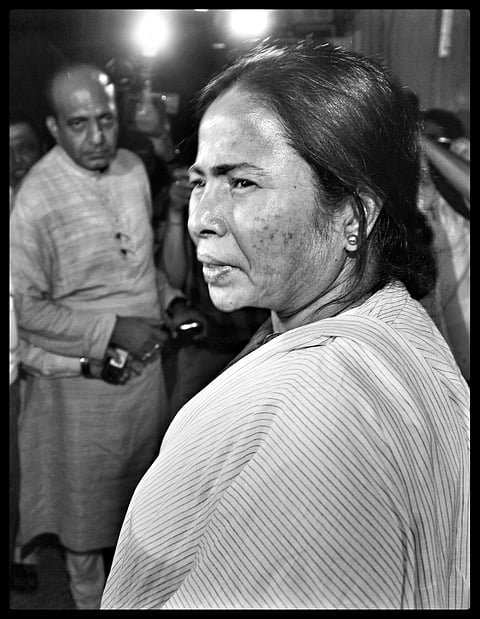


The elections in West Bengal are over. Results arrive on 4th May, alongside four other states - Tamil Nadu, Puducherry, Kerala and Assam. While outcomes elsewhere are largely predictable, West Bengal remains the true battleground between Mamata Banerjee's – in her home turf – and PM Modi Narendra Modi and his lieutenant Amit Shah.
Poll-bound Bengal, bordering Bangladesh, was flooded with 2,400 companies of CAPF (100-250 personnel per company). Post-poll, some 700 companies have been retained for two months, as Home Minister Shah announced.
The Bengali Psyche
Exit poll are out – varying and unclear – but the numbers will be wrong. The Bengali psyche is not overt, unlike UP or Bihar. Bengalis love to cancel their stated preferences on voting day. Social media buzz and street-corner ‘adda’, fondly called the rock, can indicate trends, but never the exact outcome. That quiet cunning is an ingrained behavioural pattern. It cannot be broken.
There is a wind of change. But TMC looks likely to scrape through. Anti-incumbency exists but is neutralised by the SIR controversy. First-time voters, particularly in urban areas, remain the large, confused variable.
Grassroots Hindus will stay with TMC. Middle-class Hindus will shift to BJP. The Muslim vote is in flux. Having felt neglected by TMC, it looks set to splinter toward Indian Secular Front (ISF), Humayun Kabir’s party and Communist Party of India (Marxists), which ultimately helps BJP. Dividing the Muslim vote across ISF, Humayun Kabir's faction, and CPI(M) is precisely BJP's strategy this cycle, reportedly backed by thousands of crores spent in Bengal.
The Numbers Tell a Story
This election stands apart for two significant reasons.
First, 27.16 lakh genuine voters were deleted under the SIR process on grounds of discrepancy. Yet average turnout across the first two phases hit 93%, a record high with 31 lakh more votes cast compared to 2021. The arithmetic deserves scrutiny.
Breaking down the 294 constituencies, 96 seats show a distinct pattern. Of these, 48 seats account for 28% of all deletions - predominantly Muslim-dominated areas - and recorded lower turnout, directly attributable to SIR. The remaining 246 seats, with mixed or Hindu-majority demographics, saw turnout rise.
It would be unfair, however, to say only Muslims were deleted. The process is software-driven and also eliminated many Hindus - voters with 20, 30, even 50 years of electoral history, now reapplying under Form 6 as fresh registrants.
Women turned out at around 94%, men at 92%, registering a 2% gap. This either reflects standing loyalty to the white sari-clad Mamata with her modest Hawai chappals, or BJP's women-empowerment pitch - the monetary scheme model tested in Maharashtra, Bihar, and Gujarat. Whether greed, politics, or Bengaliness wins is the question.
What happens next? There are two likely scenarios.
Scenario 1: TMC wins narrowly with 150 to 160 seats
Horse-trading begins immediately. Operation Lotus kicks in, and TMC MLAs will be processed through what the opposition calls the "washing machine" operated, predictably, by Gujarati businessmen ensconced at the Novotel and Hyatt along Kolkata's bypass.
Scenario 2: TMC wins by a large margin
Post-poll violence is imminent. Patterns suggest it will be initiated by the losing side. Violence then gives Governor R.N. Ravi the constitutional pretext to recommend President's Rule under Article 356, a provision Bengal has experienced before, as have Bihar, Kashmir, and the Northeast.
When Manipur burns, Bengal needs "more protection" is Amit Shah's logic. It is the logic of a man who obsesses with BJP-in-power, not country-first. On the ground, there are questions: who is BJP fighting? That the armoured vehicles dispatched bore registration numbers JK-02, JK-01, and JK-05, signaling their Jammu and Kashmir connection, is noticed by Bengalis. So are the racist slurs used by Shah and his coterie.
The R.N. Ravi Factor
The role of the West Bengal Governor, R.N. Ravi may have been crucial in these elections. Ravi, a 1976-batch IPS officer who retired as Special Director of the Intelligence Bureau, is a North East hand who once tracked the Naxalite movement in Bengal, where it intersected with SIMI. He developed networks inside Bangladesh and in sensitive districts: Nadia, Barasat, Bongaon, Habra, Malda, Dinajpur. He knows this terrain, and he knows which levers to pull – from cross-border connections down to which Bihari rickshaw puller to tap and which Bihari Muslim to run as an asset.
His record as a negotiator and governor, however, is poor. The Naga peace process under him stagnated and grew more complicated and he drew flak for interfering the affairs of the popular government. In Nagaland, the Kohima Press Club press boycotted his farewell citing his complete refusal to interact with media throughout his tenure, either as governor or interlocutor. In Meghalaya, he was widely disliked.
With Ravi now at the helm in Bengal, the BSF's proposed "snake and crocodile" strategy along the land and riverine border, ostensibly to check infiltration, will be another lever in play. Notably, current BSF Director General Praveen Kumar also comes from IB, where he served as Special Director.
The Ground Picture
BJP's 2026 election budget for Bengal is reportedly ₹15,000 crore.
Kolkata city turnout is higher this time. Educated-class areas are moving toward CPI(M). Non-Bengali pockets — Jains, Marwaris, Gujaratis (the O-Bangali of local parlance) and Bihari slum clusters will go to the BJP. But the major middle-class vote and much of the Muslim community, on current ground reading, are holding with TMC.
TMC will win. The EVM malfunction allegations from BJP ironically expose the seats they know they've lost - Roopa Ganguly, Arjun Singh, Suvendu Adhikari are the giveaways. Adhikari himself claimed TMC procured 750 fake silicone fingers for multiple voting, then illustrated the point with a Google image download.
CPI(M) will gain seats and stage a slow comeback. Congress and ISF will cut into both TMC and BJP votes, ISF being the bigger headache for Mamata. Urban turnout lags, rural constituencies in Purba Bardhaman and Hooghly lead - Galsi at 85.11%, Ausgram and Jamalpur at 84.87%. At the other end, Maheshtala at 70.10%, Rajarhat Gopalpur at 70.82%. Bhawanipur, where Mamata herself contests, stands at 75.66%.
What 4th May Holds
With every expert's number crunched, one must ultimately defer to the Bengali intellect to find the real story. Didi or Dada? The answer will arrive by 4th evening, Suvendu Adhikari's CM dreams notwithstanding.
Bangladesh will remain a challenge regardless. Dinesh Trivedi, once a Mamata loyalist, former Minister of State for External Affairs in the UPA government, has been dispatched as India's political appointee, a signal of how entangled the two stories remain.
Change may be longed for. But perhaps the BJP will remain in the opposition this time, ready to storm the gates next time.
Have you liked the news article?
Support us now:
https://www.gofundme.com/manage/jammu-kashmirs-sole-independent-voice-under-threat