

The empire has acquired a new name for hunger: terrorism.
In Pakistan-administered Jammu and Kashmir (PaJK), also called ‘Azad Jammu and Kashmir locally, people have demanded flour, fuel, affordable electricity, representation, accountable government, and the elementary right not to be shot for speaking. Pakistan’s ruling order has replied with its oldest sacrament: the accusation of treason. Somewhere in Rawalpindi, a uniformed genius has apparently discovered that a wheat subsidy is insurgency, an electricity bill is a foreign conspiracy, and a Kashmiri asking to choose his own representatives is a national-security emergency.
This is not misrule. It is a method.
First, manufacture the grievance. Then criminalise the protest. Then congratulate yourself for saving the state from the citizens you have starved, overbilled, insulted, and finally provoked. PaJK has now been dragged into Pakistan’s national theatre of accusation, where “Azad” is less a constitutional promise than a cruel administrative joke.
A Movement Mobilised From Ground
The Joint Awami Action Committee (JAAC) did not descend from fantasy, Delhi, Tel Aviv, or the fever swamp of state propaganda. It rose from the ground: from inflated electricity bills, food and fuel prices, unemployment, elite privilege, broken promises, manipulated representation, and a political structure designed to make Kashmiri agency ornamental while real power remains elsewhere. In 2023, JAAC placed 38 demands before the authorities, including subsidies for food and fuel and an end to the twelve refugee seats in the PaJK Legislative Assembly. The answer, eventually, was not politics. It was a ban under
anti-terrorism laws.
That is the whole biography of the Pakistani state in miniature: when it cannot answer, it outlaws.
Twelve Refugee Seats
The twelve refugee seats are the core of the fraud. They are advertised as sacred concern for displaced Kashmiris from across the Line of Control. But for many residents of PaJK, they function as Islamabad’s lever inside Muzaffarabad. In a 45-seat assembly, twelve seats amount to nearly a quarter of the legislature, reserved for people who do not live in the territory and cannot be contested by those who do. The refugee is not protected; he is instrumentalised. The resident Kashmiri is not represented; he is managed. Between them stands the state, performing its oldest trick: divide the wounded, then arrest those who refuse to bleed according to protocol.
PaJK is not a province of Pakistan. It is not sovereign either. It is a semi-autonomous part of the internationally disputed territory of Kashmir, governed through its own Interim Constitution, with Pakistan controlling foreign affairs, defense, and finances. Its future, like that of Jammu and Kashmir on the other side, is supposed to be determined by the will of its people. Yet the same state that lectures the world about Kashmiri self-determination cannot tolerate Kashmiris practicing it in Rawalakot, Kotli, Barnala, Mirpur, Dadyal, or Muzaffarabad.
This is hypocrisy in its purest form.
Double Standards
A Kashmiri who protests India is useful. He is placed on posters, invited to conferences, wrapped in flags, and supplied with adjectives. A Kashmiri who protests Islamabad becomes suspicious, manipulated, seditious, dangerous. There are good Kashmiris and bad Kashmiris. The good ones bleed in the right direction. The bad ones ask questions at
home.
Since June, the state’s reply has been batons, bullets, arrests, sedition cases, internet restrictions, blockades, and the suffocating vocabulary of “public order.” Public order is the favorite phrase of regimes that have already stolen justice. People have been killed. Families have watched relatives being arrested. Marches toward Muzaffarabad have been blocked. JAAC leaders have been hunted. Shaukat Nawaz Mir has been arrested. Rewards have been announced for wanted activists, as though political dissent were a criminal bounty hunt.
And then came the diaspora.
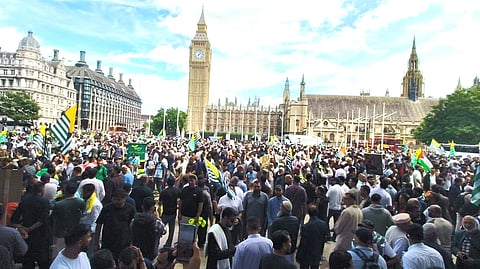
London March
On July 5, the most prominent rallies erupted in the United Kingdom, where thousands of British Kashmiris marched, raised their voices, and carried the issue into Westminster. Similar large demonstrations took place in Canada, including outside the CBC in downtown Toronto, and across Europe and the wider world, as Kashmiris answered JAAC’s call for worldwide rallies. Youth, children, families, and grieving relatives stood in public view to say what Pakistan’s establishment wants buried: PaJK is burning. This matters because the slogan has turned. The accusation is no longer aimed only at Delhi. It has turned back toward Islamabad.
And with that turn, an entire industry of selective conscience has gone mute.
Where are the professional Kashmir lobbyists? Where are the emergency panels, the human-rights entrepreneurs, the speechmakers who can locate oppression instantly when India is accused but require archaeological equipment when Pakistan is implicated? Their silence is not confusion. It is confession.
Pakistan’s Kashmir narrative abroad rests on principles it violates at home. Self-determination cannot be exported like diplomatic merchandise while being rationed in Rawalakot. Dignity cannot be invoked at the United Nations and suspended in Dadyal. Justice cannot be demanded for Kashmiris under Indian rule while Kashmiris under Pakistani administration are beaten, banned, detained, blockaded, or branded
terrorists for demanding the same.
Accountability versus Control
The rulers may think banning JAAC, postponing accountability, manipulating representation, and calling citizens terrorists will preserve control. It will do the opposite. It will teach Kashmiris the distinction Pakistan’s rulers most fear: the difference between a people and a state.
PaJK is not rejecting ordinary Pakistanis. It is rejecting the orphanage model of citizenship, where rulers offer slogans in exchange for silence.
In Pakistan today, “terrorist” increasingly means a citizen who has exhausted fear before the state has exhausted lies. That is why PaJK matters. It has exposed the fraud at the center of the system: Pakistan’s rulers do not fear terrorism nearly as much as they fear politics.
And politics, once it learns to stand upright, is very difficult to disappear.
Have you liked the news article?
Support us now:
https://www.gofundme.com/manage/jammu-kashmirs-sole-independent-voice-under-threat