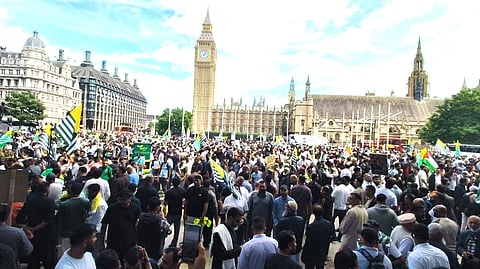


Last Sunday, an estimated 10,000 members of the Kashmiri diaspora gathered in London for what organisers called the “Kashmir Million March.” The crowd moved from Parliament Square to the Pakistan High Commission, protesting a sweeping crackdown in Pakistan-administered Azad Jammu and Kashmir (PaJK) that has seen dozens of protesters dead and thousands of activists, mainly civilians, detained, mostly under vague or unexplained charges.
The London march was the largest diaspora mobilisation in decades. Yet despite its scale and passion, the march delivered a message that was confused—and, in crucial ways, strategically self-defeating.
A Movement Pulled Off Course
The protests in PaJK began with clear, grounded grievances. Since early June, the Jammu Kashmir Joint Awami Action Committee (JAAC) has led a people’s movement focused on electricity shortages, rising living costs, and the absence of meaningful political representation. Talks with Islamabad, brokered by the military, collapsed as the army feared losing its control over the legislative process—a process it has manipulated without fail for its ever-changing short-term goals, which yield nothing but continued despair and dissatisfaction.
The state’s response to these demands and the resultant public demonstrations was swift and severe: proscribing the JAAC under anti-terror laws, suspending internet services, deploying paramilitary forces, and carrying out mass arrests. Clashes in Rawalakot left dozens of civilians dead; in Mirpur, Pakistan Rangers opened fire on demonstrators. Worse, the state police and the paramilitary forces have enforced a low-intensity economic blockade by embargoing essential food items and medications by blocking the movement of trucks into the territory. The local administration that is totally controlled by the military has shown little initiative or desire to seek mitigation to the resultant humanitarian crises.
The London march was intended to spotlight these abuses, which it did. But along with slogans of ‘Inquilab’, ‘Justice’ and ‘Oust Rangers’ what could be also heard were chants of azadi and calls for independence. As is often the case with India and Pakistan, Indian media capitalised on this opportunity, producing prime-time reports and discussions on the dire human rights and humanitarian situation—something Pakistani media has done faithfully for decades talking about human rights violations, killings and mass arrests on the Indian side of Jammu and Kashmir.
The Cost of Misplaced Slogans
This rhetorical drift matters. It hands Pakistani authorities the very pretext they seek: to recast a socio-economic rights movement as a threat to national security, and somehow link it with Indian intelligence agencies. The all-time favourite is India’s premier agency – Research and Analysis Wing – popularly known by its acronym RAW. The RAW was instrumental in training and arming Bengali political activists in fomer East Pakistan that later became Bangladesh. Ever since, RAW has attained the status of the favourite bogeyman used to discredit all sorts of local political movements from Sindh to Balochistan, and AJK to formerly tribal areas straddling Afghanistan.
The Friends of the JAAC UK, the organisers of the rally, seemed to have recognised the danger. Hours after the demonstration concluded, they issued a prompt statement affirming that the PaJK movement is a local, peaceful campaign and “not directed against the sovereignty of Pakistan.” Their clarification, issued to head off any misgivings, showed a mature understanding of how important the march’s public messaging was to the core campaign.
In a region where the military establishment views popular mobilisation with deep suspicion, injecting azadi slogans into an already volatile situation and its weaponization by some interests can be counter-productive.
Rights Violations, Not Sovereignty Debates
Human rights organisations have been unequivocal. Amnesty International has condemned Pakistan’s actions as a “grave deterioration of fundamental rights,” citing excessive force, mass detentions, and restrictions on free assembly. The Human Rights Commission of Pakistan has expressed alarm over escalating violence. These assessments carry weight precisely because they focus on the rights of ordinary people—not on abstract sovereignty debates.
The march largely held to JAAC's common minimum agenda, shared across its politically diverse base and echoed by the diaspora, keeping attention on the concrete abuses at the heart of the movement. However, the penetration of independence rhetoric by some sections inadvertently shifted attention away from concrete abuses and toward a politically charged narrative that benefits only those seeking to delegitimise the movement.
A Stark Convergence
There is, paradoxically, one potential opening. Pakistan’s recent tactics in PaJK—killings, arrests, blackouts, paramilitary deployments—mirror long-standing Indian practices across the Line of Control. This convergence erodes the moral high ground of either side and may, however grimly, create space for pragmatic dialogue on formalising the de facto territorial status quo.
It is cold comfort for grieving families, but in the hard calculus of South Asian geopolitics, it may be the only realistic path forward.
Clarity as Strategy
The London march was an impressive display of diaspora mobilisation—and a warning against any deflection from its core purpose of rights and socio-economic justice. The organisers' own statement, ruling out any action against Pakistan's sovereignty or state institutions and rejecting attempts by India or external actors to politicise the movement, while reaffirming its human rights focus, shows an understanding that message discipline is essential.
In a political environment defined by overwhelming state power and minimal accountability, clarity is not optional. It is the movement’s best defence—and its best chance of achieving lasting change.
Have you liked the news article?
Support us now:
https://www.gofundme.com/manage/jammu-kashmirs-sole-independent-voice-under-threat