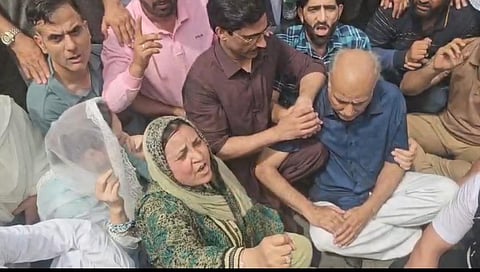

Amid the humid September weather, Jammu and Kashmir's summer capital last Wednesday witnessed the NC and BJP staging counter-protests.
The protests by the National Conference (NC) and the Bharatiya Janata Party (BJP) in Srinagar on Wednesday have exposed a contradiction at the heart of Jammu and Kashmir’s post-2019 political arrangement. The party in power in the Union Territory is demanding more powers to govern, while the principal opposition, which, ironically, also wields the actual power via New Delhi, is questioning its performance in office.
The National Conference, which runs the government in Jammu and Kashmir, protested near the BJP office demanding restoration of statehood.
The BJP, in turn, held a counter-protest targeting the Omar Abdullah government over governance and its record in office. The confrontation is more than another round of political mobilisation. It raises a fundamental question that has remained unresolved since Jammu and Kashmir lost its special constitutional position and was downgraded from a state to a Union Territory on August 5, 2019. The question is who should ultimately be held responsible for governing the region?
Ideological Differences and Power-Sharing Anomalies
The ideological differences between the BJP and the NC lie at the centre of this confrontation. For the BJP, the political reorganisation of Jammu and Kashmir in 2019 was part of a larger project to integrate the region more firmly with the Union and move away from the special constitutional arrangement that existed before August 5, 2019. For the NC, restoration of statehood has become a central political demand and a measure of whether the Centre is prepared to return the political and administrative powers that the region enjoyed as a state.
Political analysts believe the two parties have fundamentally different political ideologies.
“While the BJP believes in greater centralisation, the NC’s belief system is historically rooted in a stronger federal structure,” said Shahnawaz Hussain, a political analyst.
That ideological contest has deep roots. In October 1983, then Jammu and Kashmir Chief Minister Farooq Abdullah convened a landmark opposition meeting in Srinagar, bringing together 17 political parties and nearly 60 prominent opposition leaders. The gathering was aimed at opposing Prime Minister Indira Gandhi’s centralising policies and advocating a stronger and more decentralised federal structure in India.
Four decades later, that contest over the balance of power is playing out in a very different political setting, but with a familiar question at its centre: how much authority should rest with an elected government and how much with the Centre?
The ideological confrontation is also increasingly spilling into day-to-day governance in Jammu and Kashmir. The BJP, as the principal opposition force in Kashmir, could use its influence with the Centre to push for the resolution of issues that remain tied to the Union Territory’s administrative structure, including clarity over the Transaction of Business Rules - the rulebook governing the functioning of the administration and the division of decision-making powers.
At the same time, the NC government, despite operating within the constraints of the Union Territory framework, is being judged by voters on issues that directly affect their lives. Power tariffs are one such issue. The government could have sought greater relief for consumers from rising electricity costs, even while continuing to demand restoration of statehood and greater administrative powers.
The Citizen’s Dilemma
This is where the political contest becomes more complicated. The NC argues that it cannot be held fully responsible for governance when significant powers remain outside the elected government’s control. The BJP, meanwhile, is seeking to hold the elected government accountable for its performance.
For people in Jammu and Kashmir, however, these distinctions can appear less important.
“A consumer facing a higher electricity bill, a young person looking for employment or a resident waiting for a government service is less concerned about which institution technically holds the power to act and more interested in whether the problem is solved,” said Parvez Ahmad, a Ph.D scholar.
Have you liked the news article?
Support us now:
https://www.gofundme.com/manage/jammu-kashmirs-sole-independent-voice-under-threat
