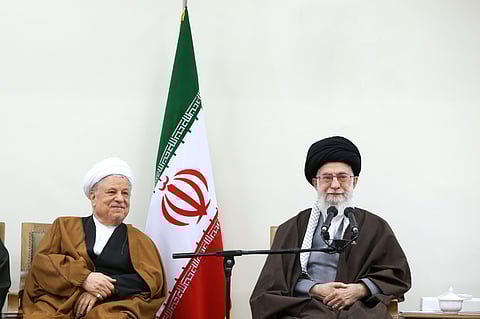

In his tweet in 2013, U.S. President Donald Trump wrote, "Remember that I predicted a long time ago that President Obama will attack Iran because of his inability to negotiate properly - not skilled!" Thirteen years later, as the U.S.-Israel struck Iran and assassinated its Supreme Leader, Ayatollah Imam Sayyid Ali Khamenei, while negotiations with Iran were still ongoing, Trump boasted that Khamenei and other Iranian leaders "couldn't evade US intelligence and the sophisticated tracking systems."
The striking contrast between these two statements, thirteen years apart, reveals the hallmarks of Trump's narcissistic personality. What he once condemned as reckless aggression, he now celebrates as personal triumph. It is at the altar of this ego that Iran's Supreme Leader, along with family members, including grandchildren, was killed, with little thought given to the chaotic consequences that would inevitably follow.
To understand why this killing carries such seismic weight, one needs to understand who Khamenei was and what he represented for Muslims across the world.
Khamenei's Significance
Ayatollah Khamenei was born in 1939 in Mashhad, a holy Shia city in northeast Iran. From his early years, he was immersed in religious scholarship and political resistance. Starting in 1963, he joined protests against the Shah's monarchy - protests that led to his imprisonment by Iran's security forces. Despite these hardships, he maintained close contact with Ayatollah Khomeini, who was living in exile, and became one of the revolution's most trusted figures.
When Khomeini returned to Iran in 1979, Khamenei was quickly appointed to the Revolutionary Council. After the council dissolved, he served as deputy defense minister and as Khomeini's representative on the Supreme Defense Council, also briefly leading the Islamic Revolutionary Guard Corps (IRGC). Khomeini was Iran's President from 1981 to 1989, guiding the country through its brutal and devastating war with Iraq, a war that claimed hundreds of thousands of lives.
When Khomeini died in 1989, Khamenei became Supreme Leader, a position he held for over three decades. During this time, he shaped Iran's military strategy, oversaw its paramilitary networks, and developed the "forward defense" doctrine: a strategy of projecting Iranian influence across the region through allies in Lebanon, Iraq, Syria, and Yemen to deter threats before they reached Iran's borders.
For his supporters, he was not merely a political leader but a religious authority whose death carries profound spiritual and symbolic meaning for Shia Muslims and other Muslims worldwide.
A Region Set Ablaze
The death of Ayatollah Khamenei has already sparked protests across the Muslim world, and fears are growing that many more innocent lives will be lost. This situation is unlikely to be resolved quickly. Iran will seek revenge and retaliate. The risk is not only of Iranian state retaliation, it is of deeper sectarian fracture.
Conflicts between Sunni and Shia Muslims, long simmering in Bahrain, Yemen, Iraq, Syria, and across the broader Middle East, will be inflamed further. Divisions within Muslim nations will deepen, and some states have already begun signalling their alignment in the emerging conflict.
These sectarian fault lines did not appear overnight. They have persisted for centuries, and the West has consistently exploited rather than eased them.
The West's Role in Triggering Chaos
Once again, the Muslim world is pivoting to chaos. Once again, this chaos is imposed from the outside.
To understand the pattern, one need only look back to 2011 and Libya. French President Nicolas Sarkozy, who was later found guilty of criminal conspiracy and sentenced to five years in prison for financial dealings with the late Libyan leader, used Gaddafi's own money to help build the political infrastructure that would destroy him.
Libya under Gaddafi had reportedly spent up to €50 million funding Sarkozy's 2007 presidential campaign. Having taken office with Gaddafi's financial backing, Sarkozy then created the Libyan rebel coalition known as the National Transitional Council, formed on February 27, 2011, in Benghazi as the self-declared "political face of the revolution." France was the first country to recognise the NTC as Libya's legitimate representative, and others quickly followed.
Muammar Gaddafi was killed on October 20, 2011 - captured by rebel forces after NATO airstrikes targeted his convoy, tortured, and executed without trial, his body left in the street. The man who had funded a Western leader's rise to power was discarded the moment he was no longer useful.
The aftermath speaks for itself. Libya today is in ruins. Once one of Africa's richest countries, it struggles to maintain the basic conditions of daily life. Gaddafi's fall did not bring democracy. It brought warlords, open slave markets, and a failed state that continues to feed chaos across the region.
The pattern in Iraq was the same. In 2003, President George W. Bush removed Saddam Hussein based on claims that proved to be false. There were no weapons of mass destruction. There were no significant links between Saddam's government and Al Qaeda. These fabrications not only led to Saddam's death but also caused the deaths of over half a million Iraqi civilians, the destabilisation of the entire region, and the conditions that gave rise to ISIS.
Afghanistan, too, followed the same arc. Trump himself once called the U.S. engagement there "a complete failure," tweeting that "we're lost in our approach" and that the country was "robbing us blind." And yet the lesson was never learned.
Peacekeeping as Performance
What makes this pattern more cynical is the simultaneous establishment of institutions designed to project an image of moral leadership.
Trump, the same leader who oversaw the assassination of Khamenei and whose administration has presided over the deaths of countless civilians, also founded the Board of Peace (BoP), an international organisation ostensibly focused on promoting peacekeeping efforts worldwide.
On one hand, lives are taken. On the other, a peace board is launched. The contradiction highlights a flawed system.
History will assess those who remain silent while powerful nations wage wars for profit and influence. The language of "strategic interests" must be understood for what it is: a polished justification for a course of destruction that leaves millions orphaned and nations in ruins.
From shifting alliances with Iran over decades to the deliberate instigation of instability across the Arab world, these powers are not partners or friends. They are the architects of a system that sacrifices innocent people, including children, for geopolitical gain.
A Warning to All
When powerful leaders operate free from institutional constraints and international law, the consequences are not abstract. They are felt in the daily lives of people in Tehran, Gaza, Jerusalem, Tripoli, and Baghdad. The logic of elimination does not stop at one border or one leader. It is a logic that is used, normalised, and can reach any nation, any leader, any people.
So watch out. You might be next.
Have you liked the news article?
Support us now:
https://www.gofundme.com/manage/jammu-kashmirs-sole-independent-voice-under-threat
