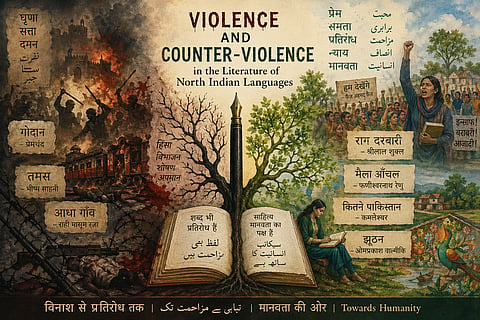


It is my proud privilege to be here this afternoon among the distinguished men and women of literature at the inaugural session of the seminar on "violence and counter-violence" in the literature of North Indian languages, for more than one reason.
First, as a peace activist, engaged in the cause of peace, communal harmony and conflict resolution who believes that culture, particularly literature, is a force multiplier for the cause of peace. In this struggle between the divine forces and forces of demon the literature is the most effective medium for promoting the cause of peace, justice, equality and human brotherhood.
Our literature, as a conscious expression of individuality has to be the mirror of divine forces. The literature of today has to be an enemy of violence, hatred, religious bigotry, class distinction, gender inequality, communal and religious sectarianism, jingoism and chauvinism. The flame of new urge for establishing world peace is kindled in a genuine littérateur, who has the vision of a new social order, giving shape to new humanity in individual and social life.
Secondly, as a journalist who realises the powerful role of the mass media in building public opinion, I suffer from a sense of guilt inasmuch as the media, both print and electronic, in the sub-continent has by and large acted as a force multiplier for war-mongers, perpetuators of violence, militarism and militarisation.
The mass media — both print and audiovisual — has unfortunately been a crucial actor in effecting the slippage between national culture and Hindu culture in the making of a hegemonic Hindu discourse.
Whether on the question of communal violence, in respect of jingoistic war cries, in demonising the religious communities or the neighbouring countries, in militarisation and nuclearization, and in creating a war hysteria, the media, with few honourable exceptions, has played a negative role. The littérateurs, I believe, have to be aware of such pitfalls.
Oxymoron: Literature and Violence
The topic of the seminar somewhat puzzles me. For I cannot visualise the role of literature in promoting violence, hatred, enmity and conflicts. How could literature, which bears close ties to life, be on the side of violence, hatred, religious bigotry, national or regional chauvinism, jingoism and conflicts?
While we talk of violence, we have to examine various forms of violence with which we are confronted today. The communal violence that we have witnessed in the sub-continent, no doubt, has been more pronounced. But there are even more deadly forms of violence which normally escape our attention.
The caste violence, class violence, domestic violence, gender violence and violence relating to the assertion of different groups for their identities and rights of self-assertion and self-determination, countered by the state violence have taken more human lives than just the communal riots in the sub-continent, leaving aside the mass killings in the wake of partition.
The littérateurs have to demonstrate their sensitivity to every kind of violence which should reflect their creative genius. The literature should in no case collaborate in constructing an ever-widening circle of suspect communities in the country, like Muslims, Kashmiri Muslims, Bangladesh Muslims, Nepali migrants, Christians, Sri Lankan Tamil refugees etc.
Similarly, the literature cannot be a force multiplier for war cries, making of bombs, militarisation, jingoism, trampling of human rights in the name of so-called national interests, demonising the neighbouring countries or distorting history. The literature cannot and should not be complicit, self-consciously or unconsciously, as a political actor in conflicts and communal or sectarian clashes. It must expose these forces in a subtle way.
I must confess my ignorance about the recent role of literature in most of the languages in North India in fighting violence and hatred and am in no position to analyse it. The views of the experts during the seminar would indeed be a much-needed source of knowledge in this regard.
Writers Who Healed Wounds of Partition
The glorious role played by the littérateurs in Urdu and Punjabi in exposing the communal marauders in their writings, in the wake of the partition of India when the flood of communal violence came with all its evil on both sides of the dividing line, can be a source of inspiration for the present generation of littérateurs.
At a time when not only the country was split but even bodies and minds were also divided, tossing moral beliefs aside, a large number of littérateurs rose to the occasion on both sides of the border.
Though affected by the orgy of communal violence, uprooted from their places of birth, these men and women of literature did not lose their cool and balance. They used their pen to blunt the attacks of swords and daggers, exposing the communal fanatics of different hues.
The writers and poets like Khwaja Ahmed Abbas, Krishan Chander, Krishna Sobti, Nanak Singh, Rajinder Singh Bedi, Ahmed Nadim Qasmi, Saadat Hassan Manto, Amrita Pritam, Majrooh, Hajira Masroor, Krishna Sobti, Qurratulain Hyder, Sahir Ludhianvi, Faiz Ahmed Faiz, Ali Sardar Jafri and many others not only exposed the real character of communal frenzy but also provided the much-needed healing touch to the hurt psyche.
Most of them forgot their sufferings and agony to join the battle against the evil forces of violence, hatred and religious bigotry. Their fiction and poetry was not propaganda but the finest species of literature, which has not lost its relevance even today. Though rooted in riot-specific moments, such gems of literature are relevant even today and are a rich addition to our literary heritage.
I wonder how far the new generation of littérateurs in North India have followed this fine example of purposeful literature mirroring the divine values of life.
The most deadly aspect of violence has been the wars waged by the nations, rulers and ruling elites in which human beings not only become the cannon fodder but also real victims.
During four thousand years of human history, the clash of words, thunder of guns, showers of bullets, and blasts of bombs have brought not only miseries to the people but have also destroyed civilisations. These wars and conflicts have taken a toll of nearly sixty billion people, costing 100 quintillion dollars.
There have been those who justified and glorified wars. The demonic cult of force has been propounded by the ideologues of fascism, which takes different garbs of politics or religion. Still, mankind has always yearned for peace. The teaching of our saints and scholars, our holy books etc. has been for peace and human brotherhood — vasudhaiv kutumbkam (the world is a family). It is this message that should be the source of inspiration for our littérateurs.
Despite such gloom the man's innate urge to overcome the tragic and reawaken his repressed self to bliss and happiness, compassion, humanism, tolerance, pluralism, artistic creativity, truth and beauty (satyam, shivam sundram) continues unabated. These must form the basis of our literature. They must join the battle to wipe out the demonic forces of ignorance, prejudice and hatred for building a new social order.
I hope your deliberations will be guided by these basic human values and I wish you success.
(This article is based on a paper read by Ved Bhasin at the inaugural session of a seminar on "Violence and Counter-Violence" in the literature of North Indian languages. The seminar and its venue are undated. Our research led us to a seminar with the same title, organized by Jammu University in collaboration with the National Academy of Letters (Sahitya Akademi) at Jammu University in October 2004. However, this could not be authenticated.)
Have you liked the news article?
Support us now:
https://www.gofundme.com/manage/jammu-kashmirs-sole-independent-voice-under-threat