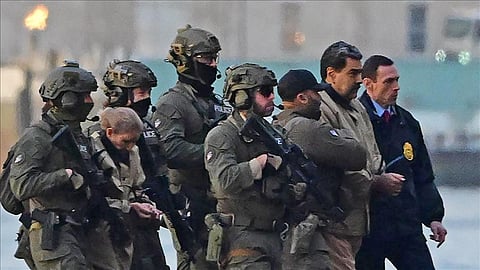


The reported capture and prosecution of Venezuelan President Nicolas Maduro by the United States marks a gravely destabilising moment for international law. Projected as a law-enforcement action grounded in criminal accountability, the episode exposes the steady normalisation of regime change cloaked in the language of legality.
The real stakes extend far beyond any single individual. They concern the integrity of sovereignty in an increasingly power-driven global order.
Economics at the Centre
Venezuela’s crisis has unfolded against a backdrop of sustained external pressure, economic sanctions, diplomatic isolation, covert and overt threats of intervention and persistent undermining of its elected government by the United States.
While allegations against Maduro are framed in terms of narcotics trafficking and weapons offences, their timing and context cannot be divorced from the convergence of military signalling, sanctions, and public rhetoric, suggesting external control over Venezuela’s economic future.
International law does not deny states their strategic interests. It insists that such interests cannot be pursued through unilateral coercion that dismantles sovereignty.
The economic subtext is impossible to ignore. Venezuela factually possesses the world’s largest proven oil reserves, placing it squarely at the centre of global energy geopolitics. History demonstrates that resource-rich states, particularly in the Global South, have often found themselves subjected to “legalised” interventions where criminal narratives follow political decisions already taken. Economic chokeholds and assertions of future control coincide with indictments, reducing legality to an instrument sans justice.
A Tiring Replay
This is not without precedent. The indictment of Saddam Hussein was presented as a moral reckoning, yet it followed a unilateral invasion justified by claims of weapons of mass destruction that later collapsed under scrutiny.
Law did not restrain power in Iraq. Libya followed a similar trajectory, where humanitarian rhetoric masked political overthrow. From Panama to Afghanistan, a consistent pattern emerges where sovereignty is breached first, legality invoked later.
What makes the Venezuelan episode particularly alarming is its audaciousness. Senior American officials have openly spoken of shaping Venezuela’s economy and governance. Such statements strip away any pretence of neutrality. Criminal law cannot be converted into a post-hoc validation tool for geopolitical ambition.
The danger extends beyond Venezuela. Each such episode is portrayed as an exception, yet each quietly becomes precedent. Smaller nations are left to absorb a stark message that sovereignty survives only at the discretion of powerful states. International law is rarely abandoned outright. It is weakened over time by repetition, selective enforcement and global acquiescence.
Silence or Caution is Acquiescence
India’s response to these developments carries more than routine diplomatic significance. While the Ministry of External Affairs has expressed deep concern and underscored peaceful dialogue, diplomatic engagement and the welfare of the Venezuelan people, reaffirming India’s commitment to sovereignty and non-intervention, this strategically calibrated posture places India at a critical juncture.
As a constitutional democracy and a long-standing voice of the Global South, India’s credibility rests on consistency. Sovereignty cannot be defended selectively, nor can strategic partnerships be permitted to dilute foundational principles.
Silence or excessive caution in moments of clear legal rupture risks being read not as neutrality, but as acquiescence. For the Global South, this matters. What is normalised against one state today may be replicated against another tomorrow.
International law survives not because powerful states respect it, but because influential middle powers insist upon it. India’s historical resistance to external interference, its own experience of colonial domination and its commitment to multilateralism impose a responsibility that extends beyond diplomatic convenience. Strategic autonomy must mean more than calibrated silence. It must mean principled engagement.
The real question, therefore, is not whether Nicolas Maduro is culpable. That determination belongs to an impartial, multilateral legal process, not a unilateral power. The real question is whether international law can retain credibility when its procedures are subordinated to strategic convenience.
Have you liked the news article?
Support us now:
https://www.gofundme.com/manage/jammu-kashmirs-sole-independent-voice-under-threat