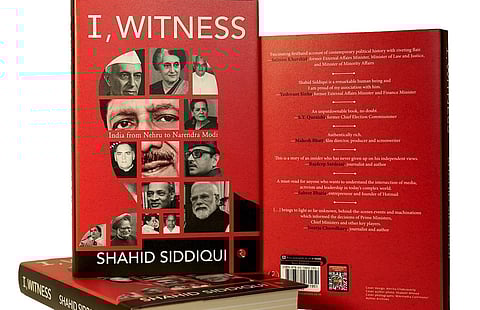


Book: I, Witness: India from Nehru to Narendra Modi
Author: Shahid Siddiqui
Pages: 448
Publisher: Rupa Publications India
Two Muslims families have dominated the cultural and intellectual landscape of the historic city of Delhi for over eight decades: the Dehlvis and the Siddiquis.
The Dehlvi family, led by Mohammad Yusuf Dehlvi, produced some of the most influential Urdu publications of the time. His sons, Yunus Dehlvi, Idris Dehlvi, and Ilyas Dehlvi, ran magazines like Shama, Shabistan, Banu, and Khilona, which shaped Urdu popular culture across the subcontinent. Yunus Dehlvi’s daughter, Sadia Dehlvi, would later emerge as a prominent writer and chronicler. Ironically, their downfall also came as quickly as their rise.
On the other side of their ancestral abode, the Lal Kuwan is the locality of Ballimaran, which is the home of the Siddiquis. Both the localities are linked by Gali Qasim Jan, the home of the famous poet Mirza Ghalib. The family was led by Maulana Abdul Waheed Siddiqui, a journalist and freedom-movement activist. They published several Urdu publications like Huma, once seen as the counterpart of Reader’s Digest. Huda, Pakeeza Aancal, Nai Dunya, etc. Shahid was the youngest among Maulana Waheed’s siblings.
The Dehlvis stayed largely within journalism and publishing. Shahid Siddiqui, however, would move across journalism, party politics, diplomacy, and what many observers might describe as political deal-making.
The latest book of Shahid Siddiqui, ”I, Witness: India from Nehru to Narendra Modi,” is part memoir, part political chronicle, and part personal testimony of a man who moved between journalism, politics, and the corridors of power for more than five decades. It narrates personal interactions with Indira Gandhi, Rajiv Gandhi, P.V. Narasimha Rao, Sonia Gandhi, Atal Bihari Vajpayee, and even Narendra Modi.
Yet, like many works that rest heavily on memory, anecdote, and proximity to power, the book oscillates between valuable firsthand recollections and questionable claims, contradictions, and historical inaccuracies. The Kashmir passages read as though the author is reconstructing a complex history from hearsay, old grudges, and retrospective certainty, often ignoring what is now available in the record.
On page 22, he quotes the Union Minister Rafi Ahmed Kidwai as prevailing on India’s first Prime Minister Jawaharlal Nehru to send troops to Kashmir in October 1947. The book even says that Nehru was dithering to send troops. Kidwai is reportedly arguing that if the Muslim-majority Kashmir Valley were not part of India, India would “succumb to the two-nation theory” and become a “Hindu Rashtra.” It is a dramatic framing, and it flatters a certain secular self-image: Kashmir as the proof of India’s plural promise, Kashmiri Muslims as a moral shield for Indian Muslims.
But as archival evidence now tells us, this is “far from the truth. The record shows that long before the formal troop deployment at the request of Maharaja Hari Singh, Nehru had made it clear he would keep Kashmir. The division of Gurdaspur and the handing over of Pathankot to India to create a linkage to Jammu and Kashmir; Nehru sending Gopalaswami Aiyangar to Kashmir in September to secure a nod from the Maharaja on accession, are all now in the public domain. In fact, it was Sardar Patel who was not initially ready for the proposal of Kashmir’s Accession to India.
Also, if Kashmir was supposedly held to protect India from becoming a Hindu majoritarian state, then 70-years later, the country’s current status should force a reconsideration. Hindutva forces have “virtually turned India into a Hindu Rashtra despite Kashmir.
On page 122, Siddiqui discusses the Jammu and Kashmir elections of 1983, where Farooq Abdullah contested in alliance with Mirwaiz Molvi Farooq. Because Siddiqui “has some axe to grind with Arun Nehru, he blames him for playing the Hindu card in Jammu and using Mufti Mohammad Sayeed to play the Muslim and separatist card in the Valley. This depicts how little research has gone into writing the book when it comes to Kashmir. Mufti was hardly any entity to stand against the mighty National Conference in those days in the Kashmir Valley.
Indira Gandhi herself used the communal card, not merely her aides. As prime minister, she stayed in Jammu for nine days and ran what was effectively a makeshift PMO from there. Earlier, in Srinagar, at a public rally in Iqbal Park, the National Conference had sent goons led by Mohammad Shafi Bhat, who later became an MP, the father of Hina Bhat, now a senior BJP leader.
Those goons occupied the front seats. When Indira started her speech, Shafi Bhat and others pulled out their pyjamas and taunted showing her their private parts.
Indira did not lose composure. She quipped that the Centre was sending so much money to Kashmir that it now seemed the National Conference government could not provide even clothes to people. But the insult and the moment mattered. Those with her say she went quiet, headed straight to the airport, and formulated a strategy to concentrate on Jammu and polarise the election. That polarisation is still haunting Kashmir politics.
The polarisation was not merely a clever trick by Arun Nehru. It was a strategic decision taken at the highest level after a public humiliation. Even when Farooq won the election, a year later, Indira dislodged him and got his brother-in-law Ghulam Mohammad Shah appointed chief minister.
Inserting Claims
Siddiqui, however, pushes a different narrative and then worsens it by inserting claims that do not fit the timeline. He suggests Arun Nehru was hobnobbing with militants in Kashmir at that time. At that time, there was no militancy in Kashmir, nor were there strong separatist sentiments in the form later seen. The major flare-up came after the rigged 1987 elections. By projecting “militants” backward into 1983, the chapter begins to feel “totally fabricated,” or at least written with a reckless disregard for chronology and political development.
The same problem recurs on page 166, where Siddiqui claims to mediate for the release of Rubaiya Sayeed with the help of Mirwaiz Molvi Mohammad Farooq. He also writes that he paid a heavy price because Nai Duniya was banned by JKLF and Lashkar-e-Taiba. In the early 90s, there was no LeT in Kashmir those days.”
Siddiqui writes that Rajiv told him he had worked out a permanent solution to Kashmir with Benazir Bhutto. Benazir allegedly agreed to accept the Line of Control as an International Border, with both sides withdrawing a large proportion of forces. Rajiv, Siddiqui says, believed peaceful borders are essential for India to realize its potential and that South Asia’s 21st century could be its peoples' century.
On page 229, Siddiqui recounts meeting Pervez Musharraf and telling him: “You must understand that Indian Muslims will never allow your machinations in Kashmir to succeed.” But Siddique forgets and does not tell readers who took Kashmir to the United Nations, and who, while signing the Instrument of Accession, put on record that once law and order were restored, the question would be referred back to the people.
In other words, Siddiqui’s moral declaration is presented without acknowledging the foundational diplomatic and legal complexities that make Kashmir unlike any ordinary “machination” story.
On page 235, Siddiqui writes that in February 2003, the Prime Minister Atal Bihari Vajpayee called Kuldeep Nayyar and him and suggested they go to Pakistan to gauge public mood under Musharraf. He then writes that within a month of their return, Vajpayee went to Srinagar and announced the Muzaffarabad bus service, astonishing Siddiqui by how soon it happened. But the Srinagar–Muzaffarabad bus was launched on April 7, 2005, flagged off by Prime Minister Manmohan Singh, nearly a year after Vajpayee had lost office. In the speech delivered by Vajapyee, he referred Insaniyat, Jamhoriyat, and Kashmiriyat and offered a talk to Pakistan.
On page 7, Siddiqui writes that Maulana Shabir Ahmed Usmani was “the only prominent Deobandi maulana who migrated to Pakistan.” He forgets a host of others like Syed Sulaiman Nadvi, Maulvi Abdul Haq, and more.
The memoir repeatedly makes large statements about Indian Muslims, and here, too, it stumbles into contradiction. On page 41, discussing the 1965 India-Pakistan war, Siddiqui writes: “For Indian Muslims this was a massive test of loyalty to the nation… a test that they passed with flying colours.” He says that after Partition, their loyalty was always doubted, and war became an opportunity to show where they stood. He paints a picture of Muslims in “every town and city” participating in preparations to face Pakistani aggression. Ironically, the same scenes played after the Pulwama bombing and India’s strikes inside Pakistan in 2019.
Then, on page 65, he undercuts his own sweeping claim while explaining the failure of his Urdu fortnightly Waqiat in the early 1970s. The magazine, he writes, did not do well because he had taken a tough line against Pakistan, and a section of Muslims in North India had “a soft corner for Pakistan.” They did not want Pakistan to break.
Siddiqui’s quoted explanation is blunt: “They still suffered from a Pakistan or Jinnah syndrome.” He adds that some believed a strong Pakistan deterred anti-Muslim Hindu groups from targeting Muslims in India. Because his magazine supported the creation of Bangladesh and condemned the Pakistan army’s atrocities, “this was not to the liking of readers.” So, he had to wind up the magazine, taking heavy financial losses. Placed side by side, the two passages create a credibility problem that the book never resolves.
Easy to Arm, Difficult to Disarm
While discussing 1971 war and the Shimla Agreement, Siddiqui writes that soon after liberation, an anti-India narrative was spreading in the newly formed country. Indira Gandhi wanted a strong leader in Dhaka to control Mukti Bahini’s armed groups, who could have become uncontrollable, spreading into the northeast and creating trouble in West Bengal and Assam. He compares this to the later American and Zia-ul-Haq experience in Afghanistan: easy to arm, difficult to disarm. She prevented that kind of situation from developing for India.
Siddiqui describes relaunching his father’s Nai Duniya in 1973 while pursuing his master’s at Delhi University. He says the tabloid “revolutionised Urdu journalism.” But there were times when this tabloid dropped to the depths of journalism by engaging in screaming headlines and emotional articles. While it made this paper sell like hot cakes, it never gave people a true picture like the modern-day TV channels. The paper thrived by cashing in on emotion, catering to “emotions and fancy stories,” not rigorous analysis.
This matters because in the book and in personal interactions, Siddiqui despised emotional politics, but in practice, he promoted it through his newspaper.
Siddiqui recounts that his father told Kuldeep Nayyar there was no future in Urdu journalism and urged him to go into English journalism, where he became a major name. Many in Delhi will tell you that this episode is associated with Maulana Hasrat Mohani, a member of the Constituent Assembly who gave similar advice to Nayyar and helped arrange his scholarship to study in the US.
Siddiqui writes about interviewing H.N. Bahuguna in 1977, when he was the finance minister in the Janata government. Bahuguna allegedly tells him: “Shahid mian, this government will not last long, we made a mistake by having this Gujarati (Morarji Desai) as the Prime Minister.” He says governance is the art of creating consensus, and the prime minister has not even heard the word.
Then the book mentions a character in Delhi circles, Maulana Jameel Ilyasi. His family has usurped a mosque at the roundabout of Kasturba Gandhi Marg. Ilyasi’s son, Sohaib Ilyasi, later ran a TV crime thriller office from a room adjacent to the prayer hall. It is Delhi’s strange layering of piety, property, and commerce in a single image.
The Maulana comes to him promising a front-page story for Nai Duniya in the days when Indira Gandhi was out of power. Maulana told him that he had taken Indira Gandhi to pray at the dargah of Khawja Bakhtiyar Kaki at Mehrauli.
Siddiqui recounts the Maulana’s description of rituals, chickpeas, chanting Allah’s name a hundred thousand times, and Indira Gandhi had slewed a pumpkin with a knife engraved with the kalima.
The Maulana claims jinns have been ordered to destroy the Morarji Desai government. Siddiqui writes, with a mix of skepticism and narrative relish: “I did not believe the Maulana for a moment… But whatever the truth Janata government collapsed within a few weeks.”
He then recounts a conversation with Rajiv Gandhi about Indira’s arrest: Rajiv told him she had decided to retire into reading and writing; Rajiv and Sonia wanted her to take a break, but her arrest “changed everything” and brought out the fighter in her.
Startling Claims
On page 175, Siddiqui writes that after the 1989 Lok Sabha results, when Congress lost seats but emerged as the largest party, it was invited by President K.R. Narayanan to form the government, and Rajiv declined. As you note, “just a Google search” would show Narayanan was president from 1997 to 2002. In 1989, the president was R. Venkataraman.
The book has a few startling claims, like on pages 182 to 184, Siddiqui narrates a sinister plot around Rajiv Gandhi’s assassination. He writes that Yasser Arafat got an inkling of a plot in Europe; the Palestinian ambassador Khalid Al Sheikh contacted Rajiv; there was information about RDX procurement; “apparently Mossad” was “allegedly somehow involved,” with ties to LTTE; the warning was conveyed to the prime minister, who took it casually. He writes that Rajiv’s travel to Moscow and Iran, and the thwarted plan to go to Baghdad to prevent the Gulf War, had annoyed the U.S. and Israel.
The book also contains one of its strongest, most damning political passages in the Babri Masjid chapter. On page 205, Siddiqui writes: he, along with a few other Muslim leaders, had urgently tried to contact the PM, the home minister, and President S. D. Sharma when news of demolition came. But were told they are unavailable.” He adds that the president called at 3.30 PM, was emotional, and he also could not reach the prime minister.
Siddiqui writes that even a senior minister like Arjun Singh said the prime minister was unavailable; Rajesh Pilot told him the prime minister refused to meet or speak with cabinet ministers that afternoon. They were told he was “either at a puja or sleeping.” Siddiqui concludes: “It was clearly part of the plan and Rao knew what was happening in Ayodhya and wanted it to go unhindered.”
On page 243, Siddiqui boasts that around the 1999 elections, he suggested to Sonia Gandhi that Manmohan Singh be the UPA alliance’s prime ministerial candidate. The UPA came into being in May 2004, after the election produced a coalition. There was no UPA in 1999.
The later chapters bring Siddiqui into the Modi era. On page 278, quoting Zafar Sareshwala, Siddiqui writes that Modi planned to build close business relations with Arab countries before becoming prime minister, invited Gulf countries to Vibrant Gujarat, and later deepened personal ties after 2014.
His interview with Modi in 2012, when he was the chief minister of Gujarat for Nai Dunya, had created waves. Siddiqui was expelled by the Samajwadi Party.
Siddiqui recounts a meeting with Amit Shah about the BJP’s policy toward Indian Muslims. Shah allegedly told him they were not interested in Muslim votes and would think about them later, adding: “Elections are won or lost on sentiments, not good work.” Siddiqui writes that Shah gave the example of Sheila Dikshit’s loss in Delhi despite “outstanding work” because sentiments were against her.
While Siddiqui has loathed Arun Nehru, Amar Singh, and Ahmed Patel in the book as they worked as wheeler-dealers and themselves were not popular leaders, he himself has also never won a popular election. He came closest in 2009, when BSP gave him a ticket in Bijnor, and he lost by 28,430 votes to Sanjay Singh Chauhan of RLD. In 1998, he contested from Muzaffarnagar on a Congress ticket; despite Sonia Gandhi and Rahul Gandhi campaigning, he finished fourth with 69,788 votes.
He was expelled from BSP in December 2009 for speaking against Mayawati; he was expelled from Samajwadi Party in July 2012 after interviewing Narendra Modi on the post-Godhra anti-Muslim riots, where Modi said, “Hang me if I am guilty.” Siddiqui positions Ahmed Patel, Sonia Gandhi’s adviser, as someone who did not want the Modi interview published and whom Siddiqui blames for his expulsion from SP.
The book also contains ideological claims that deserve attention because they reveal Siddiqui’s worldview. On page 325, he writes: “I found religious people to be much more rational, flexible and accommodating and English-educated people like former IFS Syed Shahabuddin or Ashok Singal to be much more irrational and rigid in their dispositions,” in the context of Babri Masjid negotiations.
On page 326, he describes meetings with Mohan Bhagwat and international figures, offering the idea that Indian Islam evolved as “Hindi Islam,” emphasizing accommodation and respect for other faiths, a blend of Hindu and Turko-Persian influences. He says Baghwat asked them to stop calling Hindus “kafirs,” arguing that early Ulema considered Hindus as people of the book.
On page 342, Siddiqui writes that Prime Minister Deve Gowda, in 1996, holding the home portfolio, decided to use the CBI to pressure Sitaram Kesri, who was being probed in the murder of Dr. S.K. Tanwar. Gowda held the home portfolio for only 29 days, and Inderjit Gupta took over on June 29, 1996.
Interesting Anecdotes
The book has several interesting anecdotes and tries to correct history on dynastic politics in India.
Siddiqui blames K. Kamraj and Biju Patnaik for promoting dynastic rule and absolves Nehru, writing that they wanted Nehru to include Indira in the cabinet, but Nehru refused. After Nehru’s death, he suggests, India did not “assert herself,” and Shastri and Kamraj persuaded Indira to join the cabinet.
As a student of Delhi University, Siddiqui recounts a hitchhiking tour across India, reaching Srikakulam on the border of Orissa and the then-undivided Andhra Pradesh, described as a Naxalite hotbed. He and fellow students were stopped by police; the station officer saw “a perfect opportunity to bag promotion” by staging a fake encounter to claim he killed Naxalites. They were saved when a DIG passing by wanted to use the toilet at the police station, learned what was happening, rushed to the forest, and saved the boys. In Tamil Nadu, where anti-Hindi agitation was intense, stones were thrown at them. Later, they realized their rucksack had “Bharat Yatra” written in Hindi, which had enraged the crowd.
So, what does "I, Witness" finally offer? It offers a vivid memoir of an Old Delhi insider who has lived through multiple Indias: the Urdu Delhi of publishing dynasties, the India of Indira’s ruthlessness and rumor, the Rajiv era of ambition and fragility, the Rao era of calculated silence in moments of national trauma, the coalition era of intrigue, and the Modi era of sentiment-driven majoritarian politics.
Accept the memoir as a document of how an insider sees himself and his country but refuse to treat it as a reliable record without corroboration. Siddiqui may have been close to power. The trouble is that closeness, in this book, repeatedly substitutes for accuracy.
Have you liked the news article?
Support us now:
https://www.gofundme.com/manage/jammu-kashmirs-sole-independent-voice-under-threat