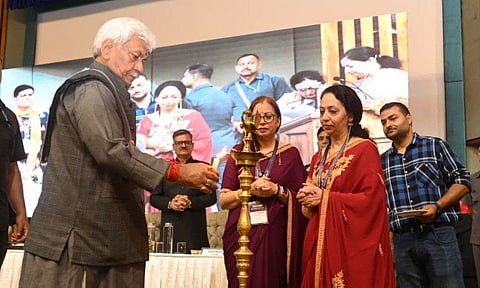


Recent conclaves and discussions involving Kashmiri Pandits in Kashmir have once again brought the events of 1989-90 into public focus. Such conversations are necessary. No society can move forward without confronting its past. Yet if these discussions are to contribute to understanding rather than deepen divisions, they must tell the whole story rather than only the part that suits a particular narrative.
For more than three decades, the migration of Kashmiri Pandits has increasingly been presented as a straightforward story of a vulnerable minority being driven out by a hostile majority. There is no doubt that many Pandits felt threatened and fearful during those turbulent months. Their displacement was a tragedy, and the loss, trauma and longing for home that many continue to carry deserve recognition and respect.
At the same time, the tragedy of 1990 cannot be understood through a single lens.
The Kashmir of that period was not a society experiencing any communal tensions. It was a society in the midst of profound political upheaval. The legitimacy of the political order had collapsed in the eyes of large sections of the population. Armed resistance was emerging, while the Indian state was preparing a massive security response. Rumours circulated widely, uncertainty deepened, and anxiety gripped people across social and political divides.
Fear was not confined to one community. Many Pandits feared for their safety and future, while Muslims too lived with growing uncertainty about what lay ahead. A sense of apprehension permeated the Valley as Kashmir entered one of the most turbulent phases in its modern history. Yet over time, the fears of one community came to dominate the public narrative, while the experiences of those who remained behind were gradually pushed to the margins.
I remember that period vividly.
Our family was involved in business, and several Kashmiri Pandits worked within our enterprises. Many left suddenly. Some informed no one of their plans, not even their employers. Their actions reflected genuine fear and uncertainty. No fair-minded person should deny that reality.
At the same time, many Kashmiris recall aspects of the migration that continue to raise difficult questions. Government assistance, official transport arrangements and departures facilitated during periods of curfew have been discussed for decades. Whether one accepts every detail of these accounts or not, it is clear that the story was far more complex than the simplistic narrative that an entire community was forced out solely by its neighbours.
The question that is rarely asked is what happened after the migration.
For many Kashmiris, the departure of the Pandit community marked the beginning of an entirely new phase of the conflict.
The 1990s witnessed the rapid militarisation of the Valley. Crackdowns became routine. Entire villages and neighbourhoods were surrounded and searched. Residents were ordered into open grounds and public spaces for identification parades. Masked informers pointed out suspected activists and sympathisers. Young men were detained, interrogated, and often subjected to abuse.
Over time, these experiences became part of everyday life. Massacres occurred in different parts of Kashmir. Families mourned loved ones killed during military operations and crackdowns. Fear became institutionalised, and an entire generation grew up under the shadow of soldiers, bunkers, raids, and checkpoints.
These events are remembered every year by Kashmiris who lived through them, yet they are often absent from mainstream discussions about 1990. The dominant narrative asks why the Pandits left, but far fewer people ask what happened to those who remained.
My own understanding of that period was shaped by my late father.
He was a man with extensive connections across Kashmir's political spectrum and was often privy to information unavailable to ordinary citizens. During the crucial months of 1990, he was told by a former Chief Minister that New Delhi was preparing for an overwhelming response to the uprising. Among the warnings he received were reports of extreme measures being contemplated for parts of Srinagar, particularly the old city.
Whether every detail of those warnings would ultimately have materialised is impossible to know. What mattered was that my father considered them credible. Once he did, his faith in the Indian state's intentions was profoundly shaken.
He often reflected on the implications of a government being willing even to contemplate such measures against its own population. For him, it raised a larger and deeply troubling question: if this was how Kashmir was to be governed, what future awaited its people?
That question would ultimately influence the direction of my own life.
My father concluded that our family needed an economic foothold outside India as insurance against an uncertain future. He selected me to help create that alternative future. What began as a precaution eventually took me to Singapore.
The opportunities I pursued, the business interests I developed, and the life I ultimately built abroad can all be traced back, in one way or another, to the events of 1990.
In that sense, the migration of Kashmiri Pandits did not merely transform the lives of those who left. It also altered the trajectories of countless Kashmiri Muslims and reshaped the social and political fabric of Kashmir itself.
Not Merely Displacement
The tragedy of the Pandit migration is therefore not merely a story of displacement. It is also a story about the unraveling of an entire society.
Unfortunately, much of the public discussion remains trapped in a framework of competing victimhood. One side speaks primarily about the suffering of Pandits, while the other focuses exclusively on the suffering of Muslims. Neither approach does justice to the complexity of what occurred.
A truthful history must acknowledge the fears of Pandits who left, the suffering of Muslims who remained, the role of militants, the role of the state, and the devastating human consequences of the conflict that followed. Most importantly, it must acknowledge the deeper political reality from which all these tragedies emerged.
The migration of Kashmiri Pandits was not the cause of the conflict. Nor was it the beginning of the crisis. It was one consequence of a political dispute that had remained unresolved for decades.
The central issue has always been the same: the political future of Jammu and Kashmir was never conclusively settled through the democratic process that had repeatedly been promised to its people.
For decades, successive governments sought to manage Kashmir rather than resolve it. Stability was pursued without addressing the underlying political question. Security measures were substituted for political solutions, and temporary arrangements were often mistaken for permanent settlements.
History, however, has a habit of reminding societies that unresolved conflicts do not simply disappear.
Kashmir's modern history is marked by recurring cycles of apparent calm followed by periods of upheaval. Each generation has witnessed its own political awakening. Each generation has produced its own forms of resistance. Each generation has been forced to confront the same unanswered questions.
The events of 1989-90 did not emerge from nowhere. Nor did the unrest of later years. Nor has the desire for political agency disappeared from public consciousness.
This is why the lessons of 1990 remain relevant today.
The tragedy was not simply that a community left. The deeper tragedy was that an unresolved political dispute created conditions in which communities became separated, trust collapsed, and successive generations were left to bear the consequences.
More than three decades later, Kashmiri Pandits continue to carry the pain of displacement. Kashmiri Muslims continue to carry the pain of conflict, militarisation and political uncertainty. Both truths can exist simultaneously and acknowledging one does not diminish the other.
If we are serious about reconciliation, we must move beyond selective memory. We must be willing to tell the complete story, including those parts that challenge our assumptions and unsettle our preferred narratives.
The real lesson of 1990 is not that one community suffered while another did not. It is when the aspirations of a people remain unresolved for generations that the consequences eventually touch everyone.
Until the underlying political question is addressed, Kashmir may continue to experience periods of calm. But calm should not be mistaken for resolution. Kashmir's history repeatedly demonstrates that unresolved questions do not disappear merely because they are ignored. They return in different forms and at different moments because history cannot be permanently suspended, nor can the aspirations of a people be indefinitely deferred.
The migration of Kashmiri Pandits was one of the greatest tragedies in Kashmir's modern history. It should be remembered honestly, discussed honestly and understood honestly. Doing so requires acknowledging not only the suffering of those who left but also the experiences of those who remained and recognising that both were shaped by a larger political conflict whose consequences continue to define Kashmir's present.
Have you liked the news article?
Support us now:
https://www.gofundme.com/manage/jammu-kashmirs-sole-independent-voice-under-threat