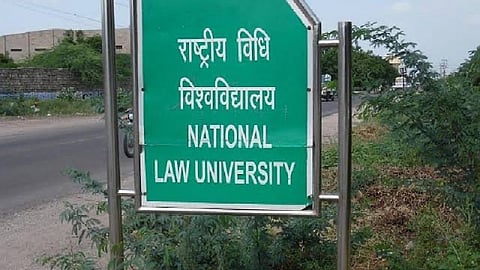


A National Law University does not belong to any region. It belongs to the Constitution and every student studying in it.
The debate over the location of the National Law University of Jammu and Kashmir has regrettably degenerated into a regional contest between Kashmir and Jammu, reducing a prestigious institution of legal education to a matter of territorial pride.
An NLU is not an asset to be claimed by any region. It is a public institution that must be structured in accordance with constitutional principles of equality and academic excellence. This debate must not displace the purpose for which the institution was conceived. Instead, it must address the educational and institutional needs it was meant to serve.
A Prolonged Delay
The idea of establishing a National Law University in Jammu and Kashmir first took shape in 2018 under the then BJP–PDP–led state government. However, due to the political and constitutional developments of 2019, the project remained unrealised.
Nearly six years later, following the Assembly elections in the Union Territory in 2024, the Chief Minister announced an allocation of ₹50 crore for the establishment of NLU J&K and further stated that the University would begin functioning from April 2026 at an interim campus in Budgam.
While this announcement marked a significant step forward, it has unfortunately reignited a territorial contest between the Jammu and Kashmir regions.
It must be recognised that the erstwhile State of Jammu and Kashmir, and particularly its youth, have endured sustained adversity, from terrorism and law-and-order challenges to the emerging menace of drug abuse, for over four decades. To prolong this adversity by reducing an institution of national importance to a regional dispute offers no roadmap to a viable or prosperous future for the youth of the Union Territory.
It is deeply regrettable that despite decades of hardship, we continue to frame public institutions through the lens of regionalism rather than constitutional purpose.
Multi-Campus Models
A legally sound resolution to this debate lies within the framework of the Jammu and Kashmir National Law University Act, 2018 itself. Section 3 of the Act empowers the Government to establish the University by notification in the Official Gazette, specifying its headquarters, and further authorises the approval of additional campuses. Section 8 establishes that the officers of the University, including the Vice-Chancellor, Registrar, and other statutory officers, exercise authority over the University as a whole, not over a specific location.
A plain reading of these provisions not only dispels the artificial controversy surrounding the location but also realigns the discussion on the core academic objectives that are presently being overshadowed by regional sentiment.
India already offers several institutional precedents where national institutions operate successfully through multi-campus models while preserving academic integrity and regional balance. Institutions such as IITs, IIMs, and AIIMS demonstrate that physical decentralisation need not dilute institutional unity.
Lessons from Orissa
In this context, the IIT Bhubaneswar model offers a particularly instructive example. IIT Bhubaneswar functions through a permanent main campus at Argul, which serves as the academic and administrative core, alongside a specialised city campus in Bhubaneswar focused on research, innovation, and outreach, both operating under a single statutory and governance framework without prejudice to either location.
Drawing from this model, NLU J&K can adopt a similar multi-campus structure to resolve the present impasse.
A plausible and pragmatic model could include a location designated as the permanent academic and administrative campus, housing undergraduate teaching, core postgraduate programmes, and central governance. The second location may function as a specialised statutory campus dedicated to advanced legal research, judicial training, law and governance centres, and faculty-led research institutes.
Both campuses can operate under a single governance structure, with common authorities, funding mechanisms, and infrastructure guarantees, ensuring that no location-based hierarchy or rivalry emerges.
The Government should issue a formal notification clearly defining the multi-campus structure and functional roles of each campus to prevent future ambiguity.
The IIT Bhubaneswar model demonstrates that institutional unity and functional decentralisation are not contradictory but complementary.
Adopting such a framework would shift the discourse from the question of “who gets the NLU” to the more constitutionally relevant inquiry of “how should the NLU function best.”
The Government must act decisively to adopt this multi-campus model, for public institutions are not regional trophies. They are constitutional assets meant to serve the collective future of Jammu and Kashmir.
Have you liked the news article?