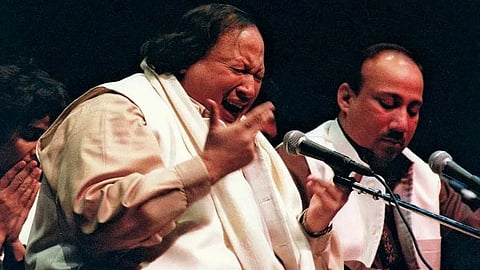


What can be the connection between Nusrat Fateh Ali Khan and the Indian Left? Apparently, nothing. But the recent viral resurrection of one of his Ghazal-Qawwalis surprisingly mirrors both the trajectory and tragedy of Left politics in India.
Among many other couplets, the composition contains a poignant line, ‘Woh bhi apne na hue, dil bhi gaya haathon se; aise aane se to behtar tha na aana unka’ (They never became mine and my heart too slipped from my hands. It would have been better had they not come at all).
Anyone who has heard this Qawwali by Nusrat knows how effortlessly its mellifluous tune softens the rigidity of the raga and blends it with Sufi longing. It is music steeped in yearning, doubt and disenchantment. The same mood captures the predicament of India’s Left today.
Like elsewhere on the global map, the Indian Left too arrived with a promise of justice and equality. It spoke for/of the masses. Or maybe it simply believed it did. But in course of time, it lost both the people it imagined it had and the ideological expanse it once commanded. Is Left’s erosion a non-fit in shifting times? Its dethroning from Nepal to its near erasure from Bihar’s electoral map can be the start of an unsettling truth.
When India won ‘freedom,’ the Left gave a new language of dignity for those who were structurally unfree. It exposed the contradictions of the state, mobilised landless workers, organised trade unions and built influential student movements. It helped cultivate a culture of public debate, reading and collective action. At the same time, it housed a wide spectrum of Marxist traditions within its fold. By the 1990s, India had more than 200 Left parties, each driven by its own fixed teleology.
The combined Left movement in India produced some of the most intellectually vibrant analyses on inequality. At the height of the Naxalite upsurge, it even came to embody a kind of intellectual solemnity.
There was a time when, if a Naxalite suspect had only a second-division score, the police would dismiss him outright saying that someone with such low marks could not possibly be a communist. Yet even in that era of intellectual prestige, a deeper question lingered: were people truly prepared for the change the Left envisioned?
The current generation carries the legacy of these unresolved tensions. Today, the question of undignified labour is not approached through the lens of historical injustice. Instead, people look for immediate relief from the daily pressures and uncertainties of life.
In this light, Nusrat’s words, ‘they never became mine,’ feel uncannily diagnostic. The Ghazal evokes a political project adept at mobilising people, yet unable to forge a lasting sense of belonging.
This estrangement becomes even brusquer against the backdrop of global decline. Across Europe, Latin America and large parts of Africa, the Left politics has retreated from public imagination.
It is important to remember that they don’t have caste. Ironically, what is left of India is staggering levels of inequality. Imagine a tiny fraction of the population controls unimaginable wealth while millions live with less than a dollar a day. Welfare mechanisms have shrunk to the level that the state uses nationalism as its moral shield. Yet what is left of India, was/is never a space for the Left to claim or reclaim. Social fissures were never converted into political momentum. The ‘heart’ of the people came just partially. It was never visible.
Marx had cautioned long ago that when the mode of production shifts, old social forms begin to crumble. Ironically, though he wrote this about capitalism, the warning fits the Left’s own missteps in mobilising its most natural allies – the workers. They never became any ‘less exploited,’ yet most workers saw their predicament not through economic lens but through cultural ones.
As capitalism expanded, the Left’s traditional base steadily eroded. This was the first ‘Jhatka’ the Left failed to anticipate. Cultural right-leaning unions like BMS and economic right Congress-affiliated unions now command more workers between them than all Left trade unions combined.
The second ‘Jhatka’ came from the Left’s long-standing treatment of caste as a ‘secondary contradiction,’ a mere offshoot of class rather than an autonomous affiliation of power. This stance alienated Dalit, Adivasi and OBC communities, whose daily experiences of humiliation were not only economic but deeply social. As a result, the politics of caste drifted into various Ambedkarite currents.
The far Left turned its attention to organising Adivasi communities in forest regions, while Ambedkarite groups gradually aligned themselves along a spectrum, from the economic right of the Congress to the cultural right of the BJP. The far Left kept the ‘Chingari’ (spark) of tribal resistance alive, but the moderate Left often dismissed these struggles as peripheral, even ‘other.’ Today, that ‘other’ is in total disarray after Operation Green Hunt, with many of its leaders killed unceremoniously. This is the third ‘Jhatka’ (jolt) to the Left. Oddly enough, the moderate Left looks away when its own comrades fall.
Perhaps the greatest irony of the Left lies in Gorakh Pandey’s famous Bhojpuri song:
‘Samajwad Babua Dheere-Dheere Aayi’ (Socialism came slowly my friends). The refrain ‘Samajwad unke dheere-dheere aayi’ (Socialism to them came slowly) was sung for decades at Left gatherings and rallies. The song itself warns of a socialism that arrives in fragments, weighed down by hesitation, compromise and false promises.
When Gorakh Pandey wrote, ‘Parson le aayi, barson le aayi, hardam akase takayi’ (It promised tomorrow, then promised years, always staring up at the sky), he actually mocked a political project that keeps deferring justice and the very idea of change and having abstract dreams while everyday suffering intensifies on the ground.
The tragedy is that the Left repeated these lines with passion, even pride, without recognising that the satire was aimed at them. Their own socialism too had begun arriving ‘slowly,’ diluted, delayed and ultimately disconnected from the people it claimed to represent.
Despite its failures, the Left remains the only credible force that still resonates with the most marginalised. But it must step out of the cloistered world of academia and learn to speak in the language people actually live in. It must become a political voice like Nekrasov, who reminds us that ‘what life has once taken, fate cannot snatch from us.’ And it must rediscover the poetic force of Marx, who overturned the opening line of the Social Contract - ‘man is born free, and everywhere he is in chains’- with the closing line of the Communist Manifesto: ‘We have nothing left to lose but our chains.’
This becomes even more important when we know that we live in a country where the number of hungry people exceeds that of half of Europe combined. The ‘Chingari’ (small sparks of resistance) will glow when more than 20,000 unnamed people die in different cities. The greatest nation doesn’t care for them. It only archives them unmarked in different death rituals.
The Left has at its disposal the haunting power of Gogol’s dead souls. But to use it, it must speak to dignity as forcefully as it speaks to inequality. Poverty is material deprivation. Humiliation is a lived experience.
The Right has surged in India precisely because it reads this emotional terrain far more effectively than the Left. Therefore, it can easily summon the ghost of primordial identities and make them connect with the people. The Left must remember that the people do not change. Only their circumstances do. Those who can be bought for ₹10,000 today are the very ones who can, under different conditions, set ablaze the pretensions of capital.
Nusrat’s couplet resonates so profoundly, perhaps, because it captures a truth that Indian politics is reluctant to confront. Sometimes the people you fight for do not become yours, and sometimes your own heart, your own ideological core, slips away when you aren’t looking. But this qawwali is not only a lament.
Nusrat’s rendering is itself a reinvention. It is an experiment that blends ghazal and qawwali into a form both Sufi in spirit and strikingly material in its sensibility. It holds despair, yes, but it also holds longing. And longing is often the first step toward renewal.
For the Indian Left, then, the question is no longer whether the heart ever arrived. The real question is whether that heart can be recovered, and whether the people it once claimed in theory can finally be claimed in practice.
Have you liked the news article?
Support us now:
https://www.gofundme.com/manage/jammu-kashmirs-sole-independent-voice-under-threat